The Riviera Gold Coast: Monaco to Saint-Jean-Cap-Ferrat

by Michel Thibault & Marla Norman
all photos by Marla Norman unless otherwise noted
The French Riviera has been an international destination since the 18th century. But along this 550 mile coastline – traditionally called the Côte d’Azur — is a smaller stretch that is even more glitzy and alluring. We’ve named it the Côte d’Or (Riviera Gold Coast): Monaco, Èze, Saint-Jean-Cap-Ferrat and Beaulieu-sur-Mer.
We start our roadtrip in MONACO.
Two Bentleys are in front of us and a Bugatti Veyron behind when Marla and I pull into the Monaco Place du Casino. There, I park by two Ferraris and a Rolls Royce. I’m grateful we rented a BMW so we don’t look too shabby!!!
Over 40% of Monaco’s residents are multi-millionaires whose average income exceeds $20 million — officially making this city/principality the world’s richest. (Business Insider) The region’s scenery, climate and lifestyle are all part of the attraction — but the fact that Monaco’s residents pay no taxes is clearly the biggest draw. I follow Formula 1 and I’ve noticed that 13 of the 20 race car drivers live here, along with soccer players, politicians and assorted billionaires.
After paying the valet $50 to park the car (No wonder everyone is wealthy in Monaco!) we make our way to the Casino de Monte-Carlo, passing dozens of other visitors who, like us, want to observe the rich and famous. The streets are lined with chic shops: Chanel, Louis Vuitton, Dior, Prada, etc. At the Casino, uniformed attendants check our passports, collect another $50 and let us know that for additional fees, Roulette, Chemin de Fer and other money-grabbing tables are available.

Le Casino de Monte-Carlo is also home to the Monaco Opéra and Ballet.

Grand entrance to the Casino de Monte-Carlo

One of many formal salons at the Casino de Monte-Carlo.
We opt for a few slot machines near the entrance where we lose $100 in 20 minutes. That ritual complete, we wander around the glamorous salons. Built in 1863, the complex is also home to the Monaco Opéra and Ballet. And of course, the Casino has inspired many books and films — most famously Ian Fleming’s James Bond. Both Never Say Never Again and GoldenEye were filmed at the Casino.
But, since we don’t spot a Bond lookalike or any sinister villains, we make a quick exit and head for dinner — a much better use of our money. Plus, tonight we’re celebrating Marla’s birthday and I’ve booked a table at Yannick Alléno’s Pavyllon in the nearby Hôtel Hermitage. With restaurants all over the world and 16 Michelin stars making him the 2nd most starred chef in the world, Yannick Alléno has a pretty impressive résumé.
The restaurant itself is actually fairly small — set up in a semicircle with tables against large glass windows. We choose to sit at the bar where we can observe the chefs at work. And that, my friends is half the pleasure. These men and women are dressed impeccably, each one crowned with a majestic toque. More importantly, they are incredibly serious and focused on their tasks. It is such a pleasure to watch a chef use four tiny pans to mix a sauce that will end up on our plates within two minutes.
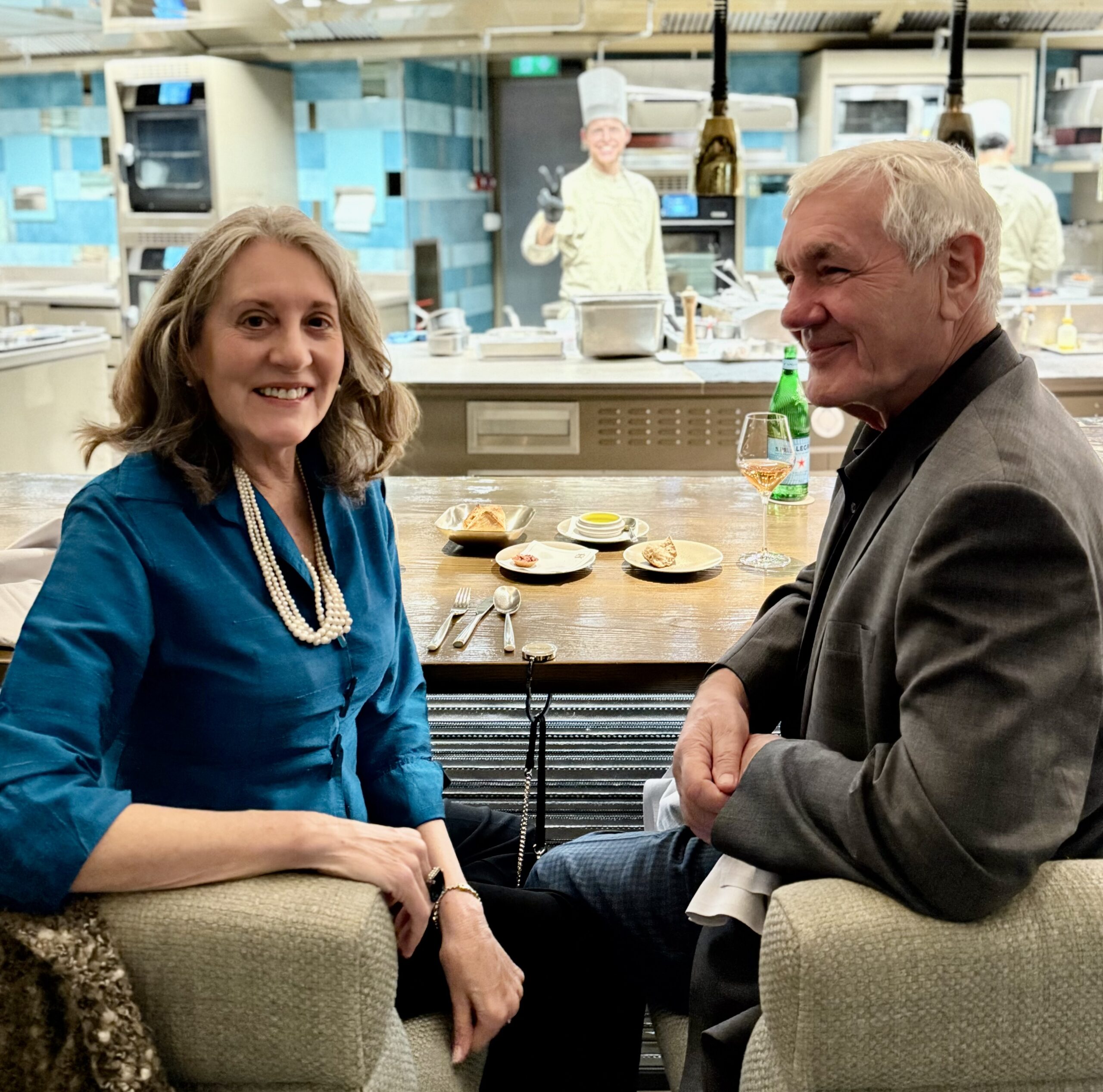
Observing the chefs at Yannick Alléno’s Pavyllon.
Needless to say, the food is insanely good — take for instance the Porcini Mushrooms and Parmigiano Tart or the Amberjack Sashimi with Caviar and Lemon Zest or Lamb Chops and Turnips in Lemon and Cumin Sauce. Dessert is an Iced Stracciatella Mascarpone with Coffee Crème. Unbelievable!!
And of course the wine list is outstanding as well. I spot a a Rousseau Gevrey-Chambertin — a producer very, very difficult to find and very rewarding. It’s a 2017, so not a great vintage but I can tell you, it over-delivers with silky notes that just highlight the beauty of our food.
The service is not only faultless but also friendly, which is often not the case in that kind of restaurant. Prices are fair — expensive, but not inordinately so.

A rare bottle of Rousseau Gevrey-Chambertin is an added treat!

Amberjack sashimi with caviar and lemon zest

Lamb chops and turnips in lemon and cumin sauce.
Our next stop is ÈZE.
In Èze there is a lower and upper village. The lower village sits on the road to Monaco. U2’s Bono has a large home overlooking the sea, which shows the pedigree of the region. Better known is the village sitting on top of the cliff, featuring exotic gardens, medieval ruins and cobblestone streets and, importantly, two world-renowned hotels with equally famous restaurants: Château Èza and Château de la Chèvre d’Or.
I cannot say enough about the panoramic views from these two properties.You can sit on the terraces of either place and see the gorgeous water, the villas nestled between the umbrella pines and feel the sun gloriously wrapping around all of it.
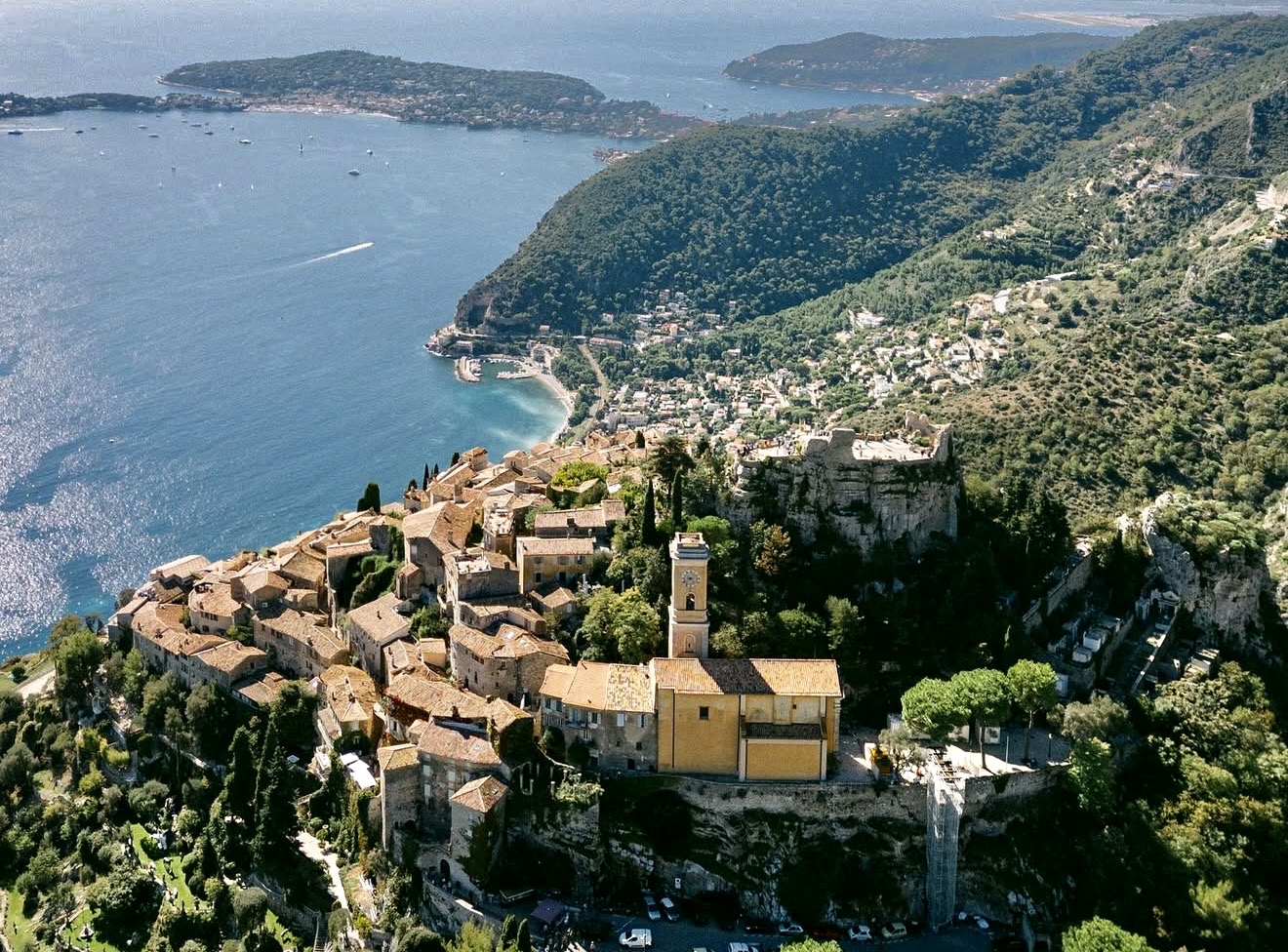
The hilltop village of Èze with Châteaux Èza & Chèvre d’Or.

The main bar at Château de la Chèvre d’Or.
Outside the two exclusive Châteaux is the tiny village of Èze, which is overrun by tourists, busses and constant traffic. The village must be less than a half-mile long with about 12-15 businesses so you can go from one end to the other in 30 min then battle your way back down to Nice or Monaco.
We spend several nights at Chèvre d’Or. Prior to booking there, I had read many reviews and they were mixed. I feel the same way. The hotel rooms are somewhat oldish so a bit disappointing. Our room also hosts a colony of ants before we have them removed!!! But again, the view is unmatched. I think Chèvre d’Or lives off the view and unfortunately has lived off of it for a long time. It really needs improving, especially considering the price.
With regard to the restaurants, we eat at both. Château de la Chèvre d’Or boasts of having two Michelin stars and the chef’s statement for the menu reads: “My cuisine does not seek your praise, it seeks your remembrance.” I don’t know how to feel about that statement!?! In fact, lunch is quite good with an excellent amberjack dish for Marla and sweetbreads (a favorite of mine that many abhor) right on spot. I love sweets, but I’m not so crazy about the fig dessert. However, overall it’s a good experience, but very expensive.
We also have a few small plates in the bar on another occasion and feel the same way — very good but pricey. Breakfast however is hugely disappointing, with a buffet that offers no imagination and a staff who obviously would prefer to be elsewhere.
The restaurant at Château Èza is more creative. A Sardine appetizer and Pumpkin Gnocchi are both splendid and the Codfish entree with Chorizo works very well. The restaurant is smallish but the view is magnificent as well. All in all, I highly recommend taking a drive to Èze to sample the food from either restaurant, but mostly to view this amazing, divine place overlooking the sea.
🍷 MICHEL’S WINE NOTES: We always try to experience locally grown wines, so during this trip we visit Château de Bellet, situated on a hillside overlooking Nice. Interesting is that the winery is not only organic, but the varietals used are quite unusual. The estate’s flagship wine, Folle Noire (Crazy Red), is made from Braquet, with aromas of red berries, lots of freshness, minerality and some spice. The Rosé is also made from Braquet while the white is mainly Rolle also known as Vermentino, a varietal a little more common in that part of France. While in Bellet, we also sample a red from Clos Saint-Vincent. This wine also incorporates both Braquet and Rolle, with herbal undertones and nice minerality. Very pleasant. All in all, however, when we visit the Riviera, we seem to enjoy more the Rosé from the hillsides overlooking Saint-Tropez or the bold reds from Bandol.
On to SAINT-JEAN-CAP-FERRAT
Monaco is the world’s wealthiest community, but a mere 8 miles away is the world’s second wealthiest address, Saint-Jean-Cap-Ferrat. Known as the “Peninsula of Billionaires” the city’s properties regularly sell for over €40,000 per square meter, with luxury estates exceeding €100 million. (Forbes)
What’s the attraction? Unlike Monaco, Cap-Ferrat is not a tax haven. The city is very much a part of “La France” and its residents pay accordingly. Here the charm is the seclusion, the spectacular natural beauty and a reputation established over decades for discreet opulence. The peninsula is dotted with grand, historic villas once owned by figures like Winston Churchill, Elizabeth Taylor, Hubert de Givenchy, Charlie Chaplin, Andrew Lloyd Webber and the Rothschilds.
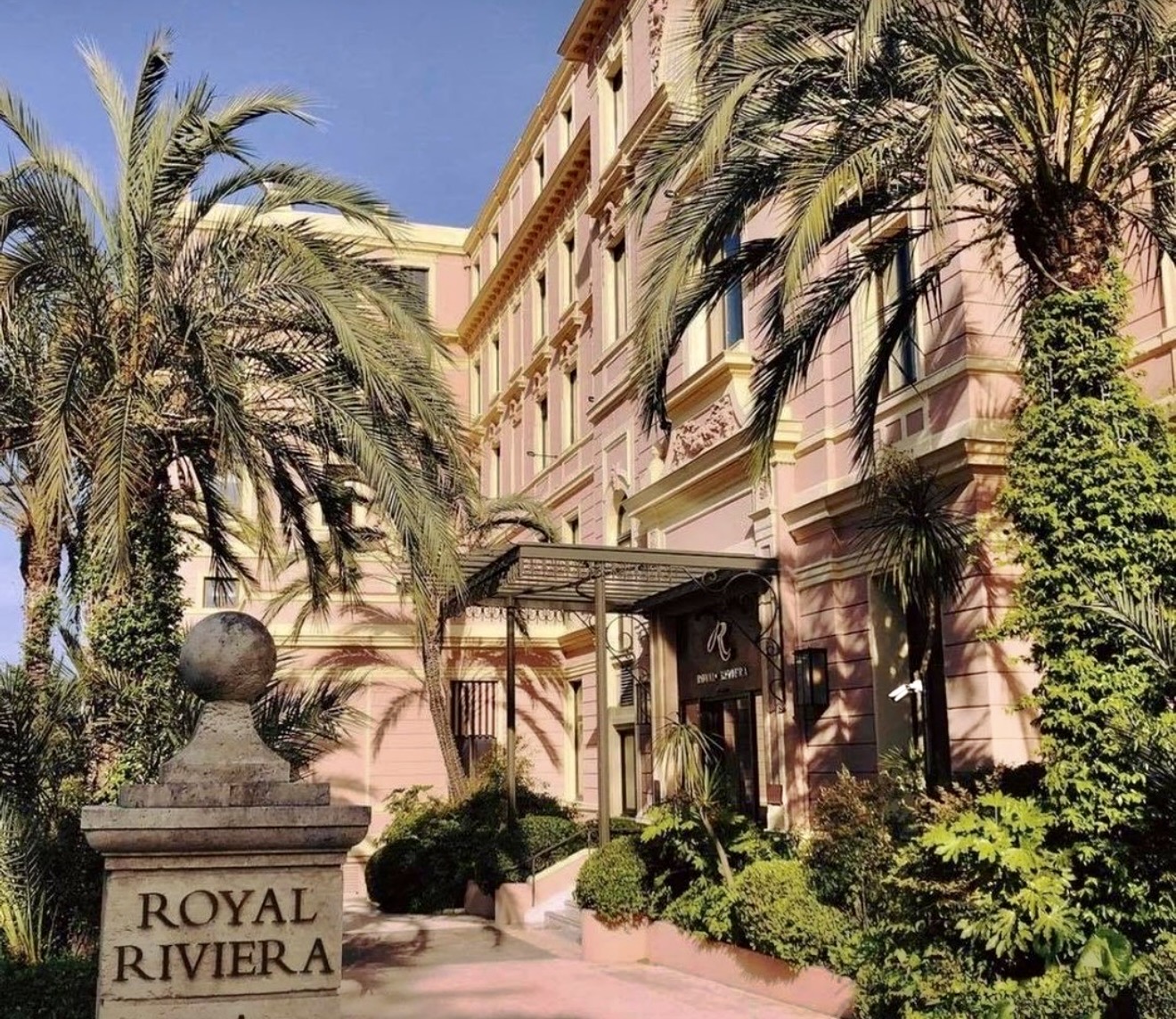
Hôtel Royal Riviera – featuring luxurious rooms and spectacular views. Photo courtesy of the Royal Riviera.
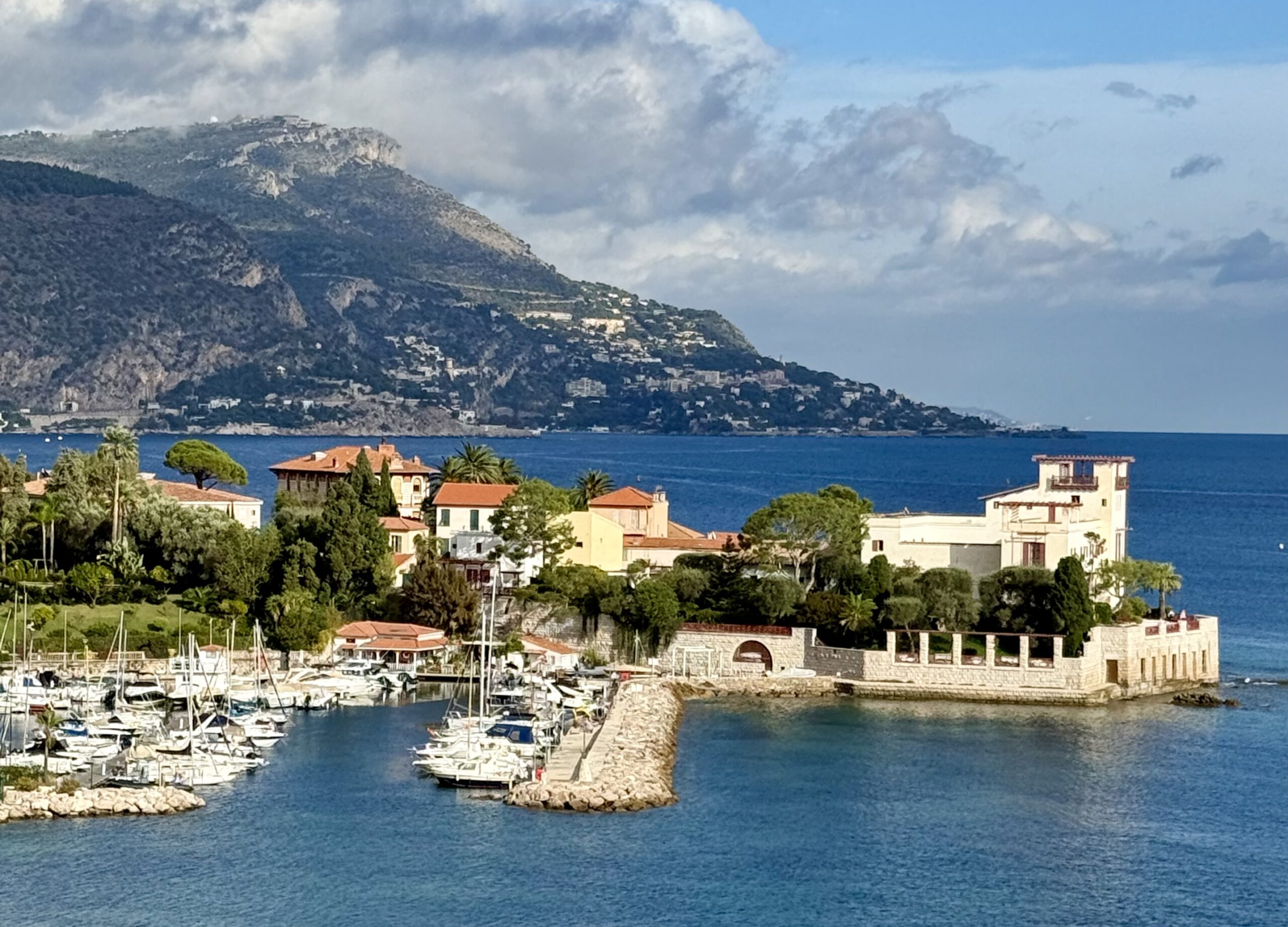
Views of Villa Kérylos from Hôtel Royal Riviera .
We have booked at the Hôtel Royal Riviera and Michel and I are immediately impressed with the attentive staff, spacious, beautifully-appointed rooms and knock-out views — right on the water. (And we don’t have to share the room with a single ant or bug of any kind!) A superb restaurant — La Table du Royal — is on the property. Seafood is the specialty and the menu is a perfect match for the setting.
A short walk along the ocean leads to Beaulieu-sur-Mer, which translates as “beautiful place by the sea.” This sweet little village fully lives up to its name. Like Cap-Ferrat, Beaulieu was once a winter home for aristocrats. Leo Tolstoy, French Empress Eugénie and Gustave Eiffel (architect for the Eiffel Tower) all had estates here. Things are quieter now — in a good way. We find a cute boulangerie and order croissants to start the day.
After breakfast, we visit Villa Kérylos. Built by French archaeologist Theodore Reinach in the early 1900s, the estate is a compilation of Reinach’s scholarly studies and achievements. The villa itself is Greek Revival, while the interior is Roman and Egyptian influenced. Intricate mosaics and furniture fill the house and the gardens are unbelievably fragrant with, of course, extraordinary views.
Later that evening, we walk the Cap-Ferrat’s Coastline Promenade, which twists and turns along the peninsula. Local residents are also out for a stroll. We are struck by how friendly and talkative people were. But in such a lovely place, why not?
Eventually, we reach the center of the village and find a seat on a big open terrace facing the marina. Sailboats, yachts, fishing boats — every kind of water-worthy vessel is arriving. Its great entertainment accompanied by a Pissaladière (A type of flatbread topped with caramelized onions, anchovies, and olives) and a good Rosé. Not a bad first day!
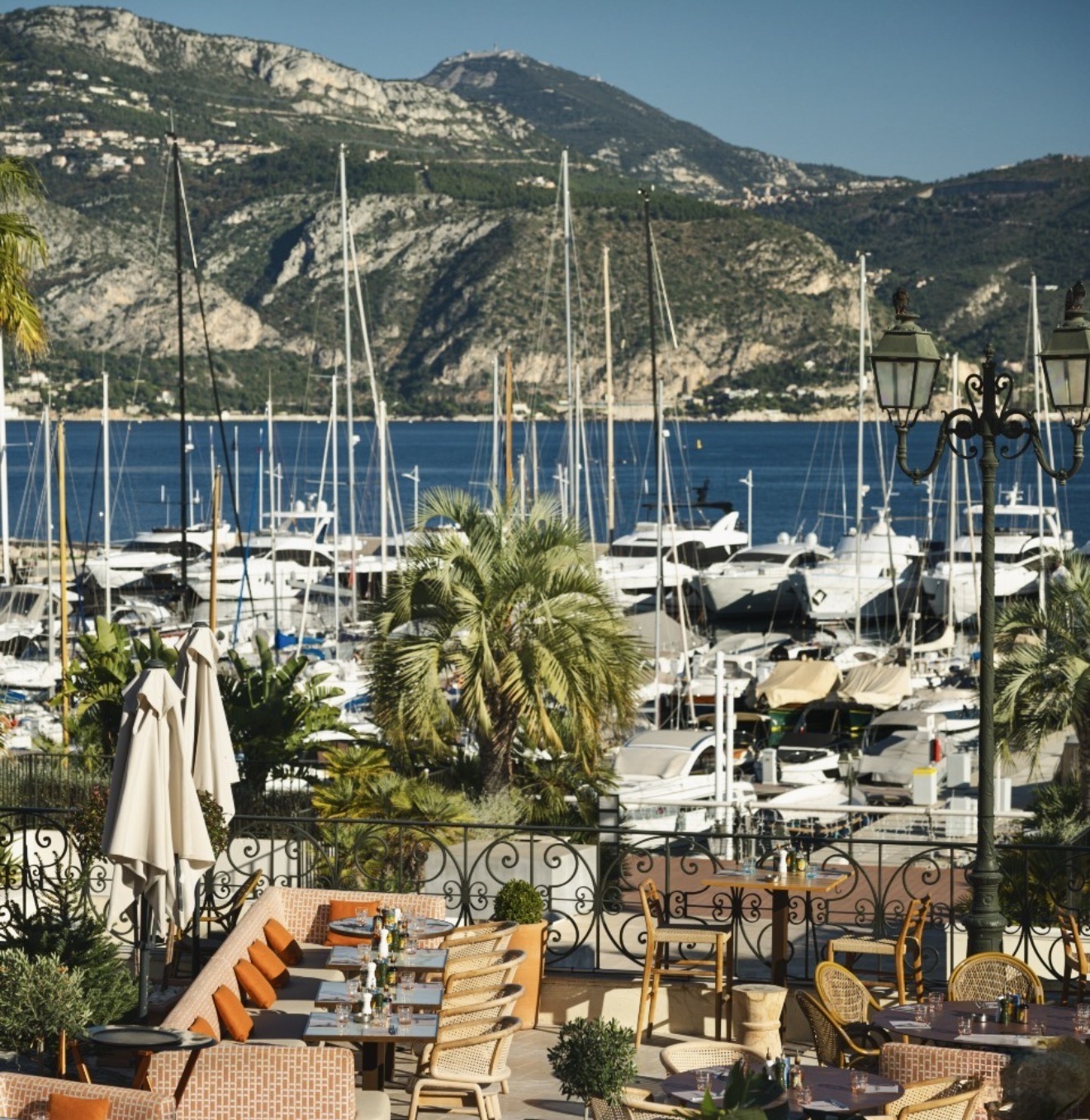
Open-air dining at Saint-Jean-Cap-Ferrat marina.

Villa Ephrussi de Rothschild, built in 1912
The next day, we follow the Promenade to the famous Villa Ephrussi de Rothschild. With it’s unrivaled position atop the Saint-Jean-Cap-Ferrat promontory, the villa dominates the peninsula. The fact that it’s painted a vivid pink enhances visibility as well. The grounds are exquisitely landscaped with no fewer than seven gardens topped off by a Temple to Diana.
The villa’s owner, Baroness Béatrice de Rothschild, was inspired by her cousin’s home — Villa Kérylos in nearby Beaulieu-sur-Mer. Béatrice was the daughter of banking magnate Alphonse James de Rothschild (Wine lovers will know him as the original owner of Château Lafite Rothschild). Her husband, Maurice Ephrussi, was also a prominent French banker. All to say, budget was not an issue!
The Baroness took inspiration from the sea around her and wanted the house to resemble a ship. But coming up with a final plan was another matter. “Architects followed one another at a frantic pace… indeed, eleven architects surrendered while the walls of the villa were barely off the ground.” (Beaux Arts Magazine, 1998)
Eventually, the construction begun in 1907 was completed in 1912. The Baroness then began to furnish her new home with rare Sèvres and Meissen porcelain, masterpieces by 18th-century painters such as Fragonard and Boucher, furniture by top cabinetmakers Joseph Baumhauer and René Dubois — including Marie Antoinette’s gaming table. The Baroness also commissioned the Rothschild Fabergé Egg on display in the Villa. As our guide explains, “the collection assembled by the Baroness is encyclopedic.”

Baroness Béatrice de Rothschild filled her Villa Ephrussi with rare collectibles including Marie Antoinette’s gaming table.

One of seven formal gardens at Villa Ephrussi.
What would it have been like to visit Villa Ephrussi back when Béatrice was entertaining? The poet Andre de Fouquières describes his experience: “I remember in particular, one summer night, when we had the privilege to see her gardens, which drew from her mansion across to the sea, and bathed in moonlight, Anna Pavlova dancing to the Chopin nocturnes.” (Traces écrites, 1951)
On our last night in Saint-Jean-Cap-Ferrat, we make dinner reservations at Le Cap, a restaurant within the Grand Hôtel du Cap-Ferrat. Here, Chef Yoric Tièche, originally from Aix-en-Provence, sticks to his culinary roots. We enjoy Oyster Raviolis, Red Mullet in Sweet Harissa with a Saffron Rice accompanied by Zuccini with Caviar — what a pairing! Dessert is a Mandarin and Lemon Tart.
The wine list at Le Cap is stellar — with 1,200 selections from France’s top vineyards plus Italian and Spanish wines. Michel chooses a bottle of Krug Special Cuvée, since the hotel has a relationship with the Krug Champagne House.
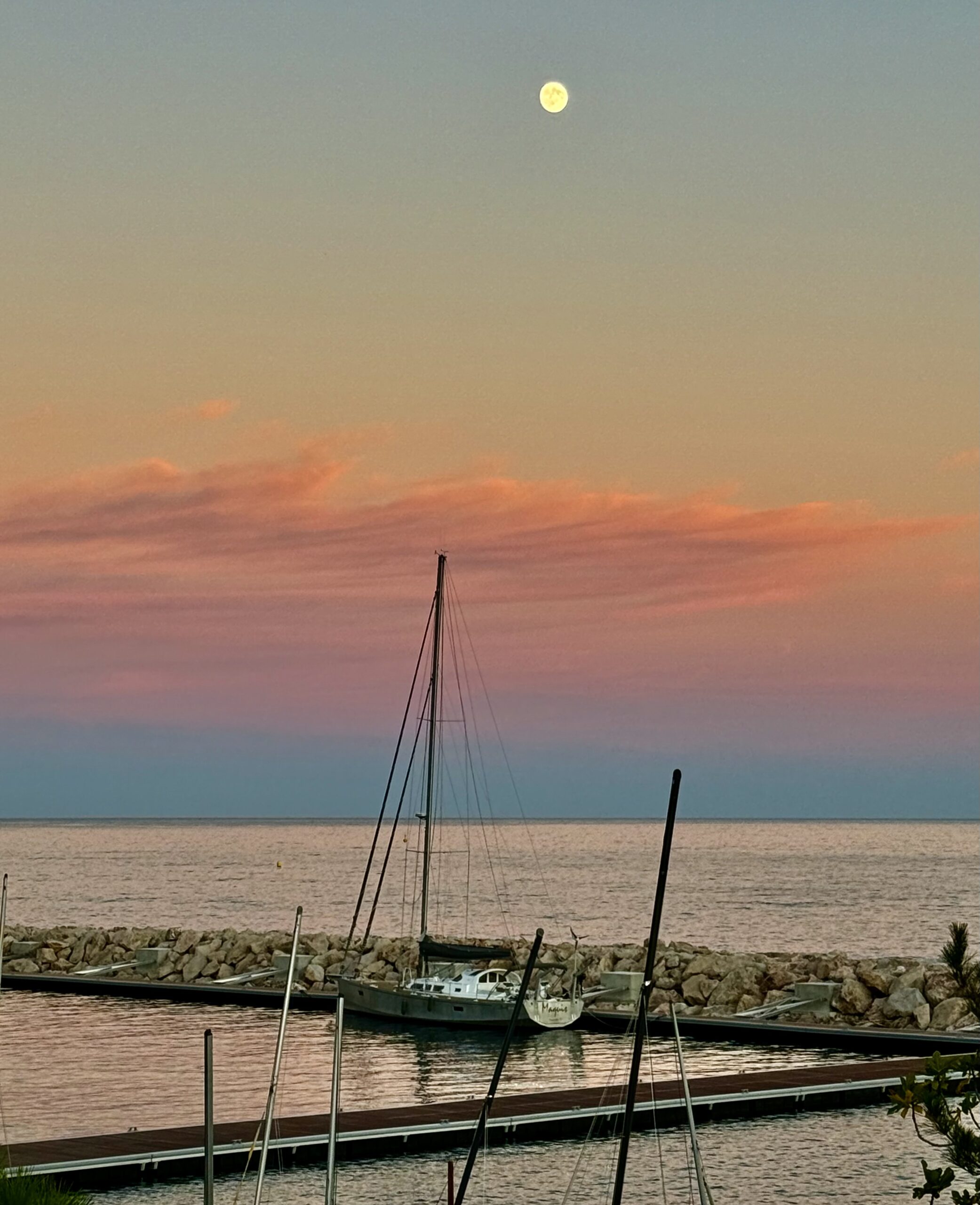
The restaurant features a terrace surrounded by tall Aleppo pines and another stunning seascape. We wonder if the locals ever take these exceptional views for granted. We certainly haven’t!! And tonight, after a magenta sunset we even have a full moon lighting up the Mediterranean. Jaw-dropping! Easy to run out of superlatives in Saint-Jean-Cap-Ferrat.
⭐️ A FINAL BIT OF TRAVEL ADVICE: As always, if possible, travel off-season in either early spring or late fall, when the crowds are fewer and the rates are much lower. Also, be sure to visit Èze – see the gardens, dine at one of the restaurants, marvel at the views — but stay in Saint-Jean-Cap-Ferrat. The accommodations are remarkably better and there is more to see and do within walking distance.