Sevilla: Fiestas, Flamenco, Fabulous Food & Vermut
by Marla Norman & Michel Thibault
Photos by Marla Norman
The drive from Málaga to Sevilla is about 536 kilometers (330 miles) with spectacular rolling hills covered with acre after acre of olive groves — from huge ancient, gnarled trees to tiny, recently planted infants. Impressively, Spain produces almost half of the world’s supply of olive oil and this drive confirms it!!
But I’m digressing already… we’re headed to Sevilla. Just outside the city, the olives are replaced with oranges. Trees loaded with fruit fill the parks and line the streets. The fragrance is heavenly!
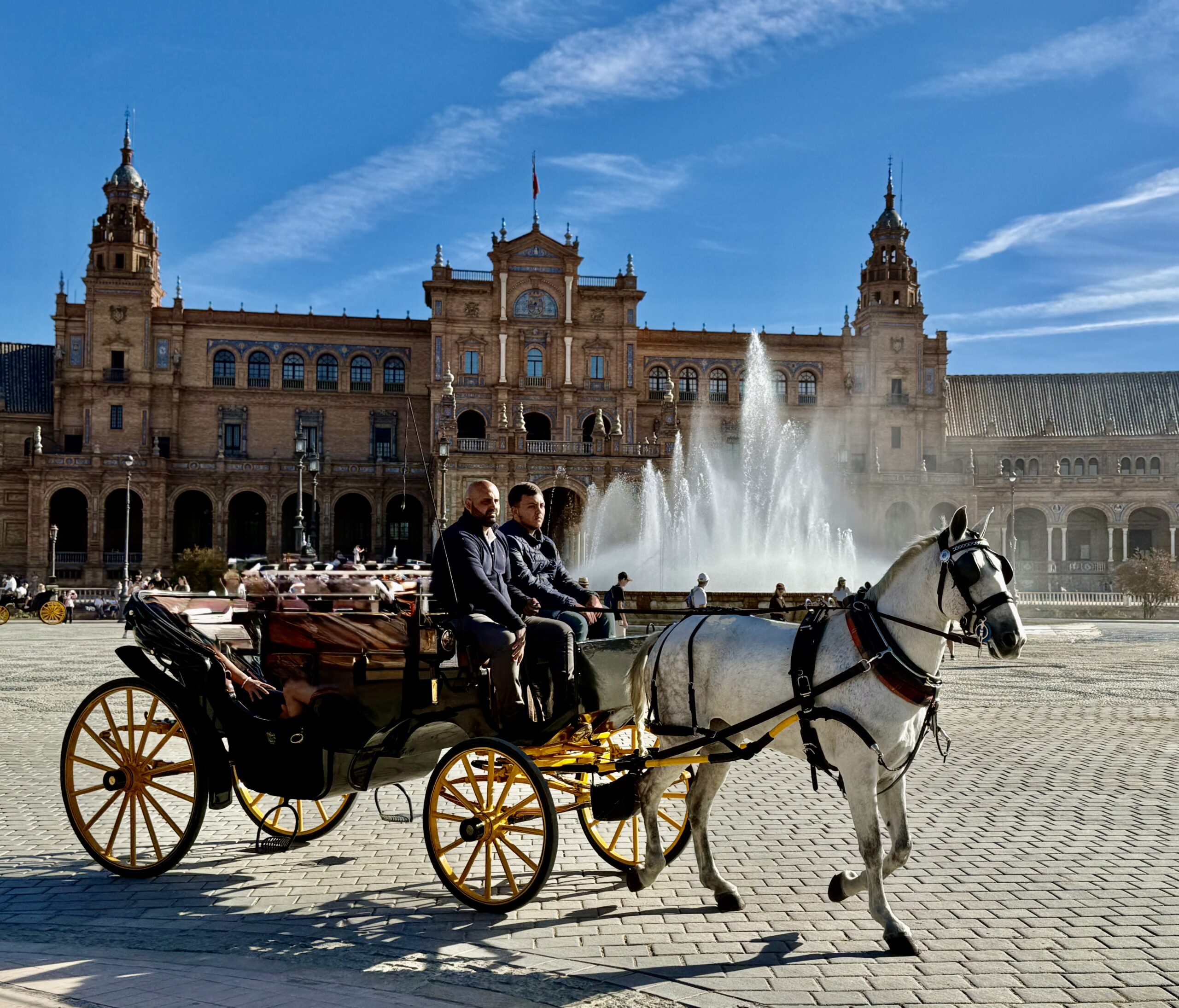
Crossing the Guadalquivir River, we spot La Giralda — the bell tower that grandly caps the city’s famous cathedral. As we approach the old city center, the streets narrow considerably and there are more horse-driven carriages than cars.
Our hotel, in the heart of the old town, is the 100-year old Alfonso XIII — commissioned by the Spanish king in 1929. Elaborate azulejos (Spanish tile work) decorate the walls. Huge crystal chandeliers and patterned marble floors are historical treasures. The Spanish royal family continues to frequent the hotel from time to time. And the staff is so attentive, we feel like aristocrats as well.
After the long drive, we’re famished so find a table in an enormous open courtyard restaurant. Here, Chef Felipe Arango oversees the kitchen with his unique take on Andalusian cuisine. We dive into croquetas de jamón (Iberian ham croquettes) and anchovies. An artichoke stew and lamb are savory main courses.

Hotel Alfonso XIII – 100-years old. Still regal and meticulously maintained.
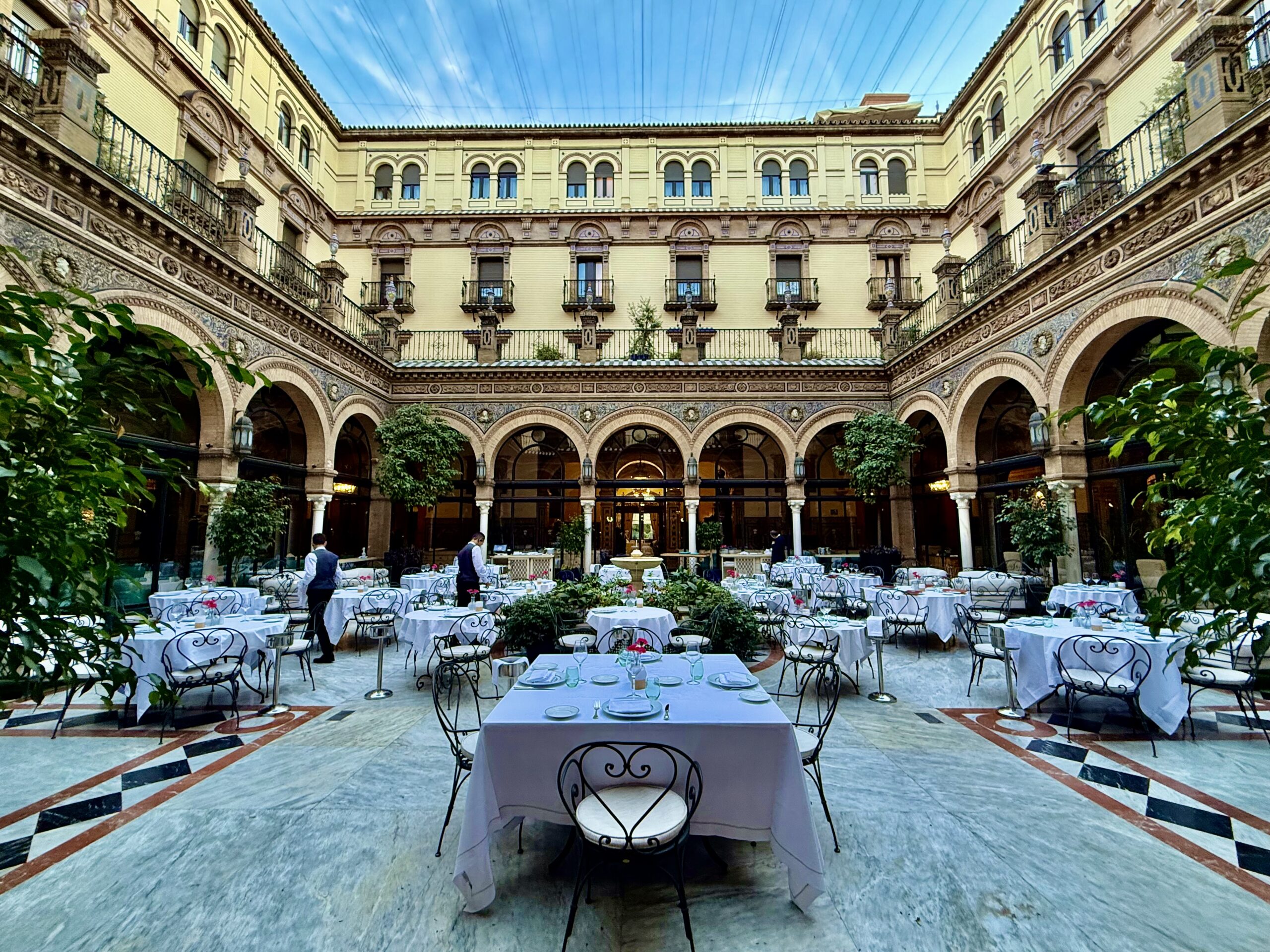
Courtyard restaurant at Alfonso XIII, featuring Andalusian cuisine.

In Sevilla, every night is a fiesta!
Later that evening, we explore the neighborhood and are immediately impressed with how lively the streets and cafés are. There are the obvious tourists like us, but local residents with young families are out in force. Every major intersection seems to have a flamenco dancer with brilliantly-colored skirts practicing “golpe” full-sole stamping or “zapateado” more intricate footwork. Some are accompanied by guitarists and “cantors” passionately chanting their gypsy refrains. It’s a nightly fiesta!
We wander street after street, completely losing track of time, mesmerized by all the activity and music. Eventually a platter of delicious looking tapas attracts our attention and we collapse in the first available chairs. A waiter suggests we try an “Agua de Sevilla” — whiskey, sparkling wine, cream, and tropical fruit juices — everything but water in other words. It’s thirst-quenching for sure and an appropriate end to our first day in Sevilla.
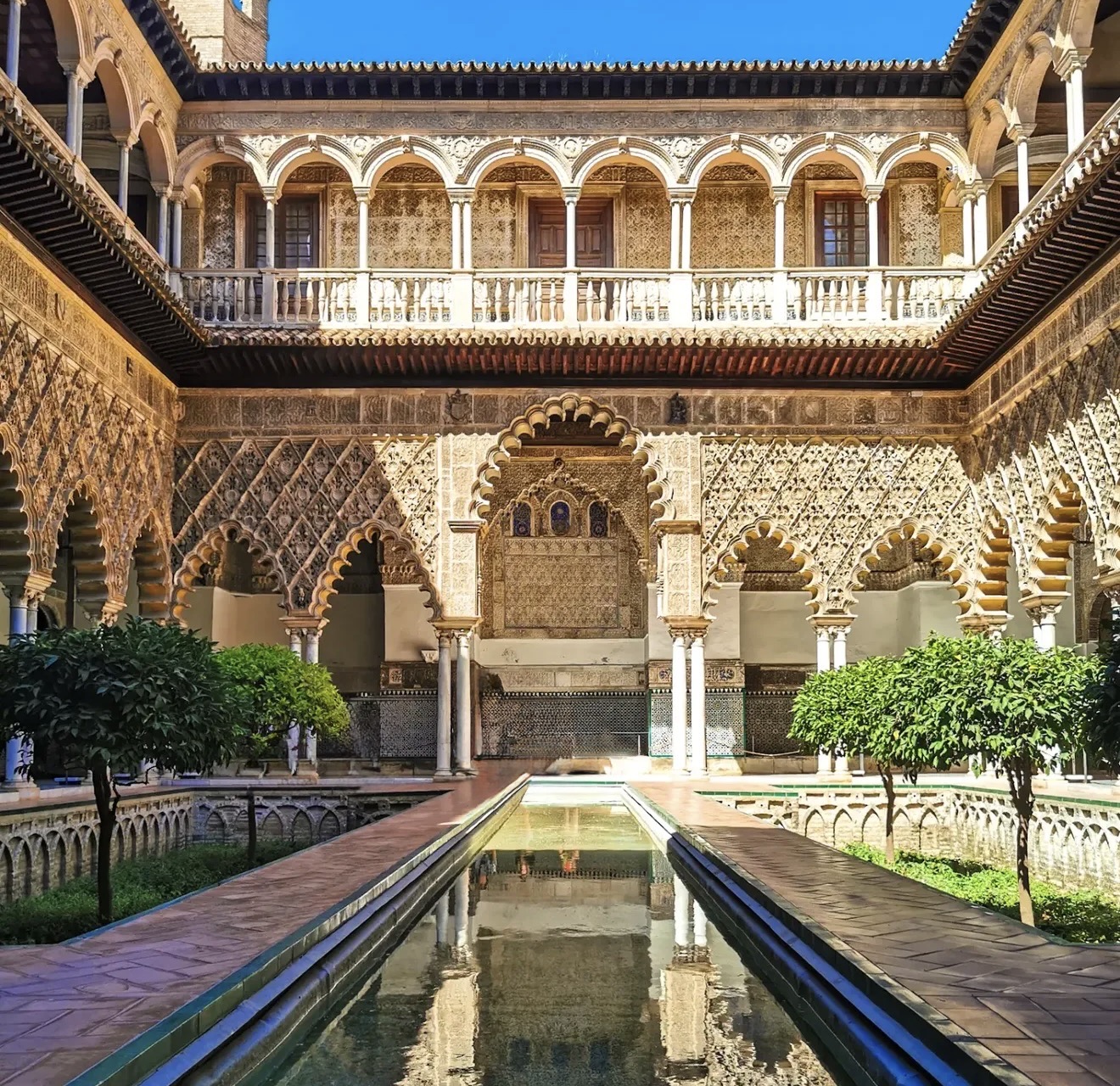
El Patio de las Doncellas in the Royal Alcázar.
REAL ALCÁZAR – WHERE THE NEW WORLD BEGAN
It’s early morning and a sunrise is just beginning to color the sky. Amazingly, the streets that were so lively and vibrant last night are completely deserted. We’ve booked an 8:00 a.m. tour at the Real Alcázar — one of Sevilla’s most beloved historical sites. Normally, the palace is crowded with visitors, but through WALKS TOURS, we’re able to visit an hour before the site officially opens.
At the entrance of the Alcázar, our guide reminds us that Spain was ruled by Moors for nearly 800 years, from 711 to 1492. Spanish Christian monarchs began to retake parts of the Iberian peninsula in what is known as “La Reconquista.” During that period, Sevilla was reconquered in 1248 and much of the original Alcázar was destroyed.
Around 1360, Pedro I commissioned a new palace in the Mudéjar style – a blend of Moorish, Romanesque and Gothic architecture. Interestingly, artisans skilled in tile work were brought in from Granada, which was still under Moorish rule at the time. As a result, the Alcázar very much resembles the Nasrid Palaces of the Alhambra in Granada.
During the 15th and 16th centuries, Sevilla’s Alcázar served as the Spanish capital and royal seat of power. It was here in the glittering Salón de los Embajadores (Hall of Ambassadors) that Queen Isabella met with Christopher Columbus to discuss funding his expeditions.
The Salón is adorned with intricate tiles and a magnificent golden dome. We try to invoke the past and imagine Isabella, a brutally tough negotiator who regularly donned armor and led her troops into battle, conversing with Columbus, the young Italian navigator. Was he intimidated? He was obviously convincing. What would the world have been like had that conversation not occurred way back in 1492?
After admiring the interiors of the Alcázar, we visit the extraordinary gardens — some 17 acres, with exotic trees and flowers, as well as peacocks.

Salón de los Embajadores (Hall of Ambassadors) with a gold-domed ceiling.

Exquisite Moorish tile work created in the same syle as the Alhambra in Granada.

Gardens at the Real Alcázar cover over 17 acres.
LA CATEDRAL & LA GIRALDA
Sevilla’s Moorish past is especially evident in the city’s colossal cathedral — officially known as Catedral de Santa María de la Sede y de la Asunción de Sevilla (Cathedral of Saint Mary of the See and of the Assumption of Seville) It’s a site that can only be described in superlatives: the largest Gothic building in the world, the largest and tallest cathedral in Spain and the third-largest church in the world after St. Peter’s in Rome and St. Paul’s in London.
After the recapture of Sevilla, the city mosque originally built by Yusuf II in 1171 was razed. However, the spectacularly beautiful mosque minaret was retained and converted into a bell tower. The 314-foot tower features a revolving statue — a kind of weathervane or “Giralda” in Spanish.
The massive cathedral has five naves. The central nave is 138-feet tall and includes an enormous choir loft. The main chapel features a golden altarpiece that is the largest in Christendom at 82-feet high and 66-feet wide with over 40 panels. Designed by Flemish master Pierre Dancart, the monumental project took over 80 years to complete and involved multiple generations of sculptors.
The Main Sacristy is decorated with a bas-relief depiction of Biblical scenes from Genesis to the Apocalypse. A prestigious collection of Spanish Baroque art includes paintings by Bartolomé Esteban Murillo and Pedro Roldán. Here too is the quite-amazing “Custodia” – a 13-foot tall Renaissance monstrance crafted in silver.
We also encounter Columbus once again… maybe. An impressive tomb and memorial to the explorer is near the main entrance. Columbus died in Valladolid, Spain, but at his request, was buried in Santo Domingo. Later, his remains were exhumed and buried in Havana, then finally returned to the Sevilla cathedral — although some recent DNA studies indicate that someone else’s bones might be in the tomb. ¿Quién sabe?
Our final stop is the lovely Patio de los Naranjos (Courtyard of Orange Trees) part of the original Grand Mosque. The fountain here is even older, a surviving remnant of the pre-Islamic, Visigothic era later used for cleansing ablutions by Moors.
NOTE: Be sure to purchase tickets for both the Cathedral and the Alcázar well in advance of your arrival. These are both incredibly popular destinations and lines to visit can last hours if you’re able get in at all. Also be aware that high season is Fall, when almost 2 million tourists descend on the city. Summers are less popular because temperatures routinely reach 115°F.

Sevilla’s cathedral is the largest Gothic building in the world, the largest and tallest cathedral in Spain and the third-largest church in the world after St. Peter’s in Rome and St. Paul’s in London.
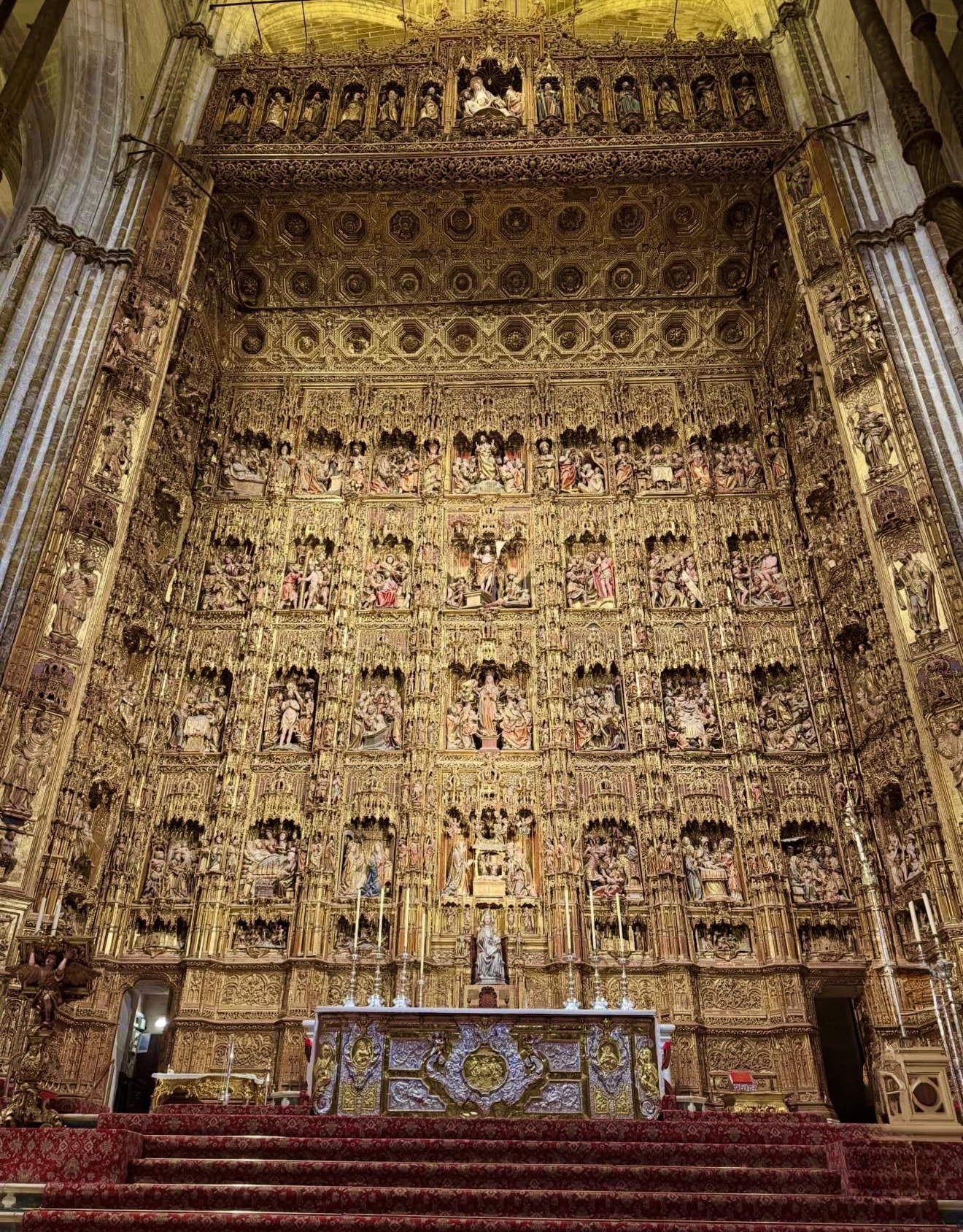
The Cathedral’s main chapel features a golden altarpiece that is the largest in Christendom.

The majestic tomb of Christopher Columbus, with pallbearers representing the four ancient kingdoms of Spain.

Patio de los Naranjos with a view of La Giralda.
CARMEN’S CIGARILLOS & PLAZA DE ESPAÑA
Adjacent to our hotel is the Universidad de Sevilla (Seville University), founded by Dominican priests in the 13th century. Ironically, the building housing the former Fabrica-Real de Tabacos (Royal Tobacco Company) is now part of the campus. Spaniards discovered the pleasures of tobacco on Columbus’ first trip to the Americas and maintained a strict monopoly for 350 years. The first tobacco processing plant — the Royal Tobacco Company — was built in Sevilla and was considered the largest industrial space in Europe. In 2007, tobacco production was relocated to another facility and the building donated to the University.
Opera lovers will recognize the location as the setting for Bizet’s “Carmen” — based on a true story. The opera’s famous score was inspired by Spanish folk music and Gypsy culture. The University offers free tours Monday-Thursday at 11:00 a.m. Local guides conduct tours on weekends.
Also nearby and not to be missed, is the Plaza de España. The collection of buildings and fountains served as Spain’s centerpiece pavilion at the 1929 World’s Fair. We get a quick lesson in Spanish history and geography as we walk around tile-covered representations of Spain’s 48 provinces — arranged in alphabetical order, from Álava to Zaragoza. Four bridges span the Plaza, representing the four ancient kingdoms of Spain: Castile, León, Aragon, and Navarre. Small boats are available to row through the canals that surround the Plaza.

Entrance to the University of Sevilla and former Royal Tobacco Company.
FLAMENCO, TAPAS & VERMUT
One of our top experiences in Sevilla is an evening of tapas and flamenco that Marla and I booked with DEVOUR TOURS. Our guide, Mercedes Muñoz Valé, leads us down a narrow street in the historic Santa Cruz neighborhood. Our first stop is Maestro Marcelino — a combination grocery store and bar called an abacería. Maestro Marcelino specializes in traditional meats such as Jamón Ibérico, carved right next to you, shaved paper thin and served with a few unbelievably tasty olives.
Mercedes, who is a true Sevillana orders for us. Plates of Manchego cheese and roasted meat on toast (Carne Mechada con Queso) are enjoyable and so is the pork loin in sauce (Lomo a la Cazadora) but best are the pork shank in mustard (Codillo en salsa de mostaza ) and the pork cheeks (Carillada).
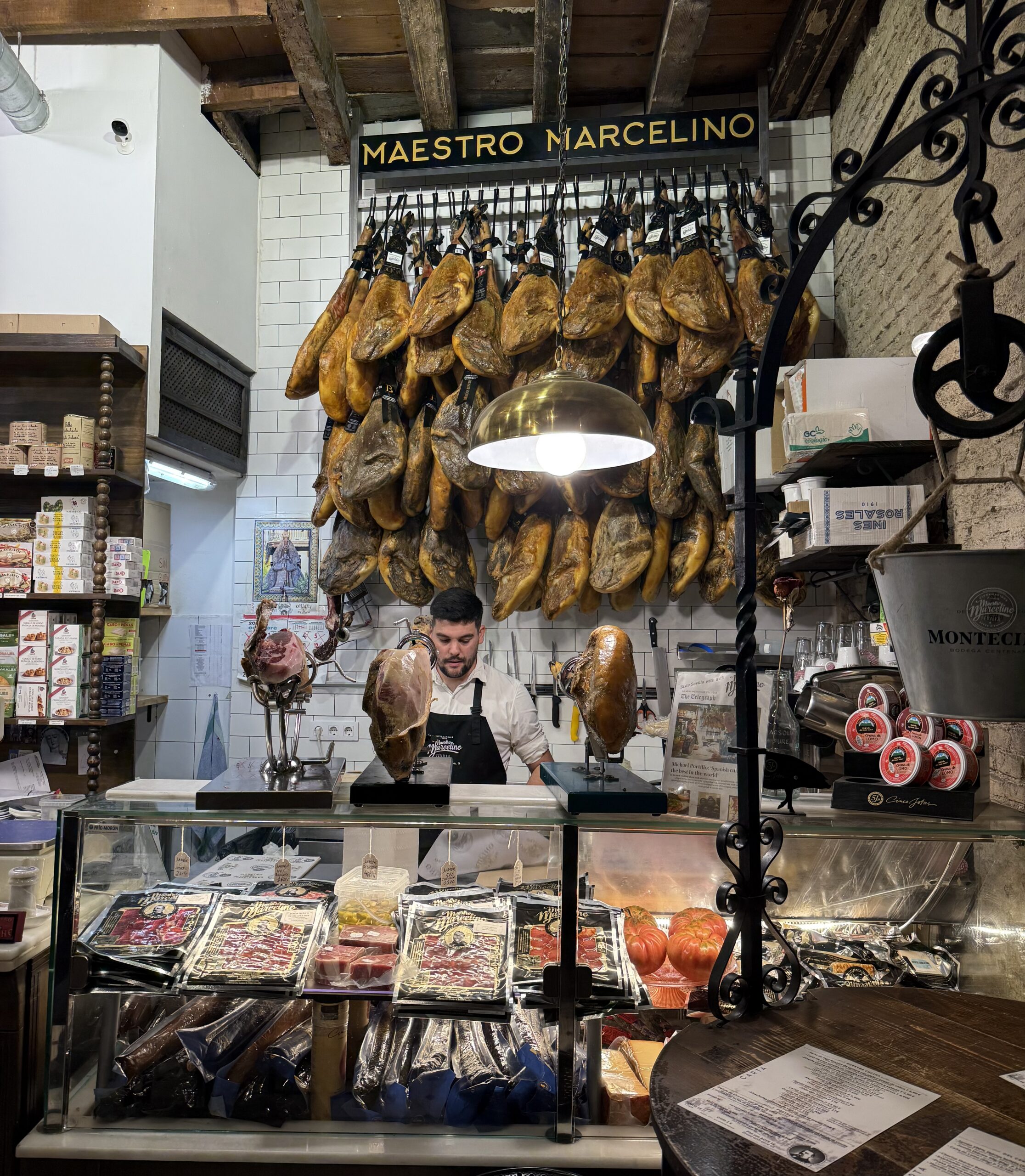
Maestro Marcelino, a traditional abacería, known for its high quality Spanish meats.
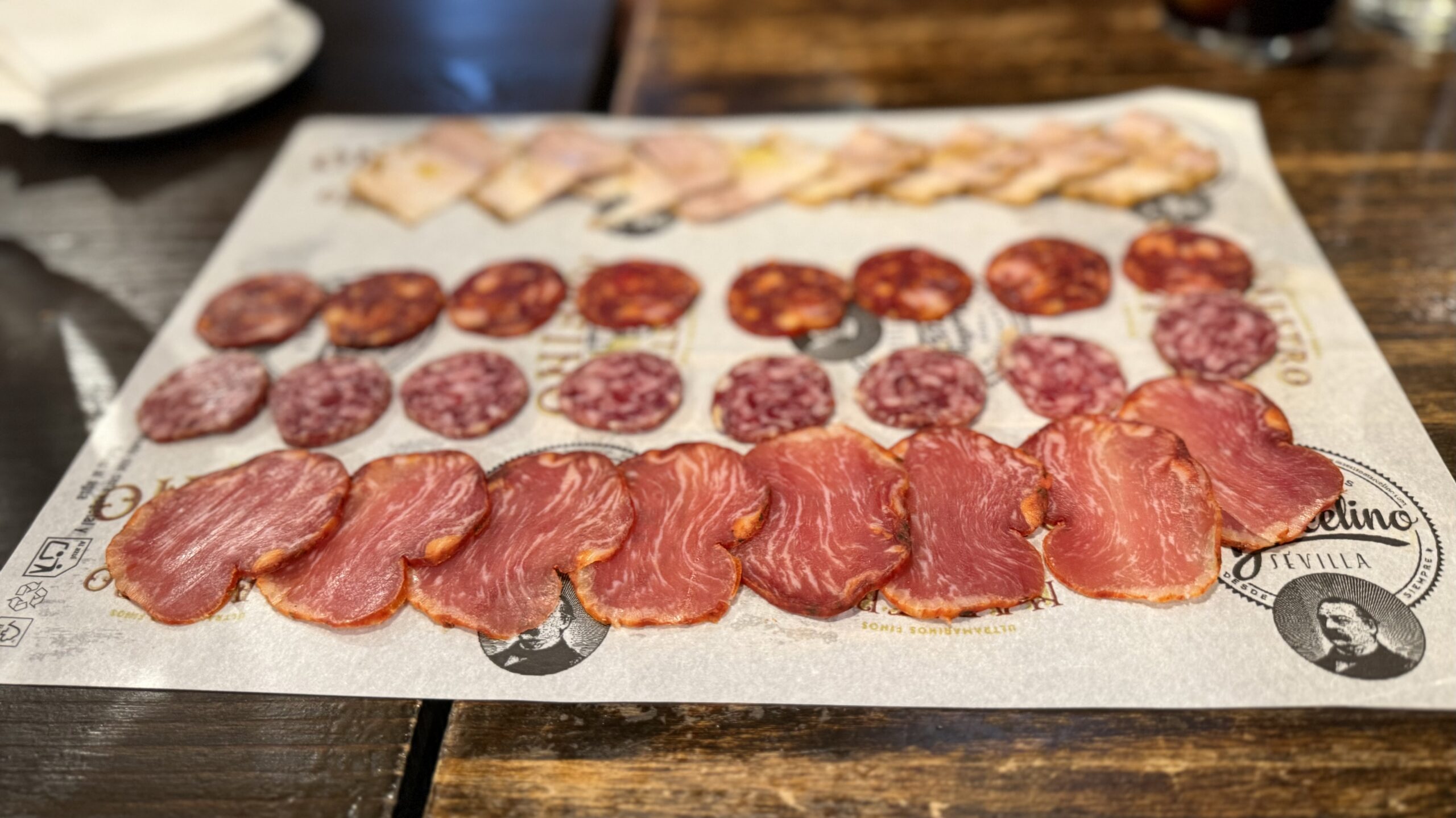
Tapas from Maestro Marcelino, including Jamón Ibérico.
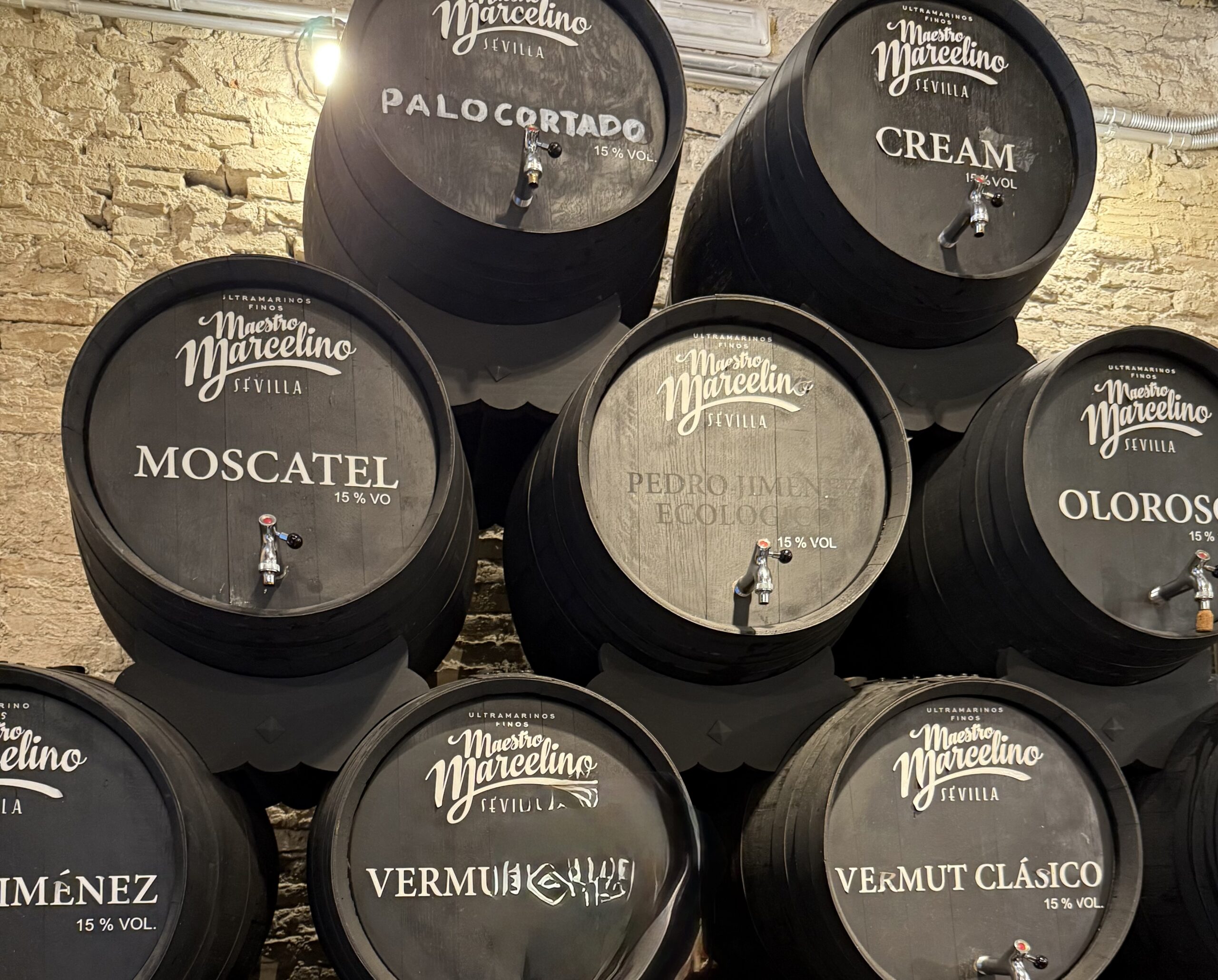
Spanish specialties, including Pedro-Ximenez and Vermut.
I particularly enjoy the wines at Maestro Marcelino. One wall of the tiny store is lined with barrels and we have the option of picking our poison, whether Pedro Ximenez, the famed sherry, or the new sought-after drink in Spain, Vermouth or “Vermut” as it is spelled here — a fortified wine, usually 16-18% alcohol with added grape brandy. A wine aromatized with botanicals, herbs that are usually found in the forests.
Vermouth was originally popular in Italy, where they serve it as a martini and is also popular in France which boasts of the finest dry vermouth, a brand called Dolin Vermouth de Chambéry. In the US, it is often mixed in cocktails, the most famous being both a martini where one adds a drop of dry vermouth to flavor gin or vodka and sweet vermouth with whiskey to make the famous Manhattan cocktail. The finest sweet vermouth (red in color, rich in flavor) is either Carpano or Cocchi Storico, depending on the level of sweetness desired.
But back to Marcelino… here the Vermut is ripe, rich and spectacular. I want to get a larger goblet’s worth! It marries our montaditos (tiny sandwiches with chorizo, Jamón Ibérico, olives etc). The atmosphere is relaxed with laughter, food and wine and no pretense. The perfect bite before serious partying!
From Marcelino, we walk a few more blocks to an elegant, 15th-century building, an old convent that has been converted to a venue for flamenco, appropriately named Casa del Flamenco. The performance is an incredible sensory experience! Not only do the dancers perform with extraordinary foot and legwork, but every movement expresses all their emotions: joy, anger, depression. Their faces are in tune with their bodies and one can experience and share the anguish they seem to feel. All the while the music wraps itself around your soul, languishes, sometimes hollers, but never leaves you uninvolved. When the show is over, musicians and dancers are exhausted …and so are we!
After the flamenco, we head to Vinería San Telmo, a place known for its extensive collection of Spanish wines curated by owner Juan Manuel Tarquini. The signature dish, Torta de Castuera is a soft-ripened, creamy sheep’s milk cheese that pairs well with almost anything. Also tasty is the Pluma Ibérico, a cut from the famous Iberian Black Pigs, referred to as the “wagyu of pork.” …. What a night !

Dining at La Isla, specializing in fresh seafood, Andalusian cuisine and a superb wine list.
On our last night in Sevilla, we dine at La Isla — an instant favorite. I spot a bottle of 2017 Finca Dofi Priorat on the menu and it’s spectacular. I sometimes feel that Spanish reds can be a little dusty, where the fruit does not shine through and I have a tendency to dismiss many but that is so wrong. This wine, made by the magical Álvaro Palacios checks all the boxes. For me, it meets the food halfway and improves and multiplies the flavors while running effortlessly down my throat. Never too powerful nor too thin.
Later, walking back to our hotel, we realize how much we enjoy the outdoor, street activity in Sevilla. When evening falls, the avenues start to fill with families, people on bikes, trams going by and cafés constantly filled with patrons. There is a feeling of humanity in Sevilla that gives us a sense of appreciation for others.
Back at home we miss Sevilla and its evening song!