Paris Spirits & Favorite Haunts
by Marla Norman & Michel Thibault
Photos by Marla Norman unless otherwise noted
It’s almost Halloween, a holiday that is gaining popularity in Europe and France, although nothing on a scale of the US extravaganza, with pumpkin-bedecked homes, elaborate costumes and piles of trick-or-treat candies. However, if you’re looking for old haunts, ghosts and assorted spirits, Paris is a great place to observe the “All Hallows Eve” and not just on October 31st!
Michel and I start with some of the city’s most famous goblins — the Chimera & Gargoyles at Notre-Dame. Legendary French architect, Eugène Viollet-le-Duc, who headed up the restoration of Notre-Dame in 1844, designed the scary sculptures as an aesthetic, “to reinforce the Gothic identity of the Church.” In medieval times, gargoyles were meant to frighten away malevolent forces that might try to enter the church. Their more practical function is, of course, to drain rainwater collecting on the steep roofs.
Several of Viollet-le-Duc’s fantastic creatures didn’t survive the catastrophic fire in 2019. Artisans and stone sculptors worked for years to meticulously recreate and repair the damaged figures. This fall, the Cathedral rooftop officially reopened and the creatures are back in place, keeping guard as they’ve done for centuries.
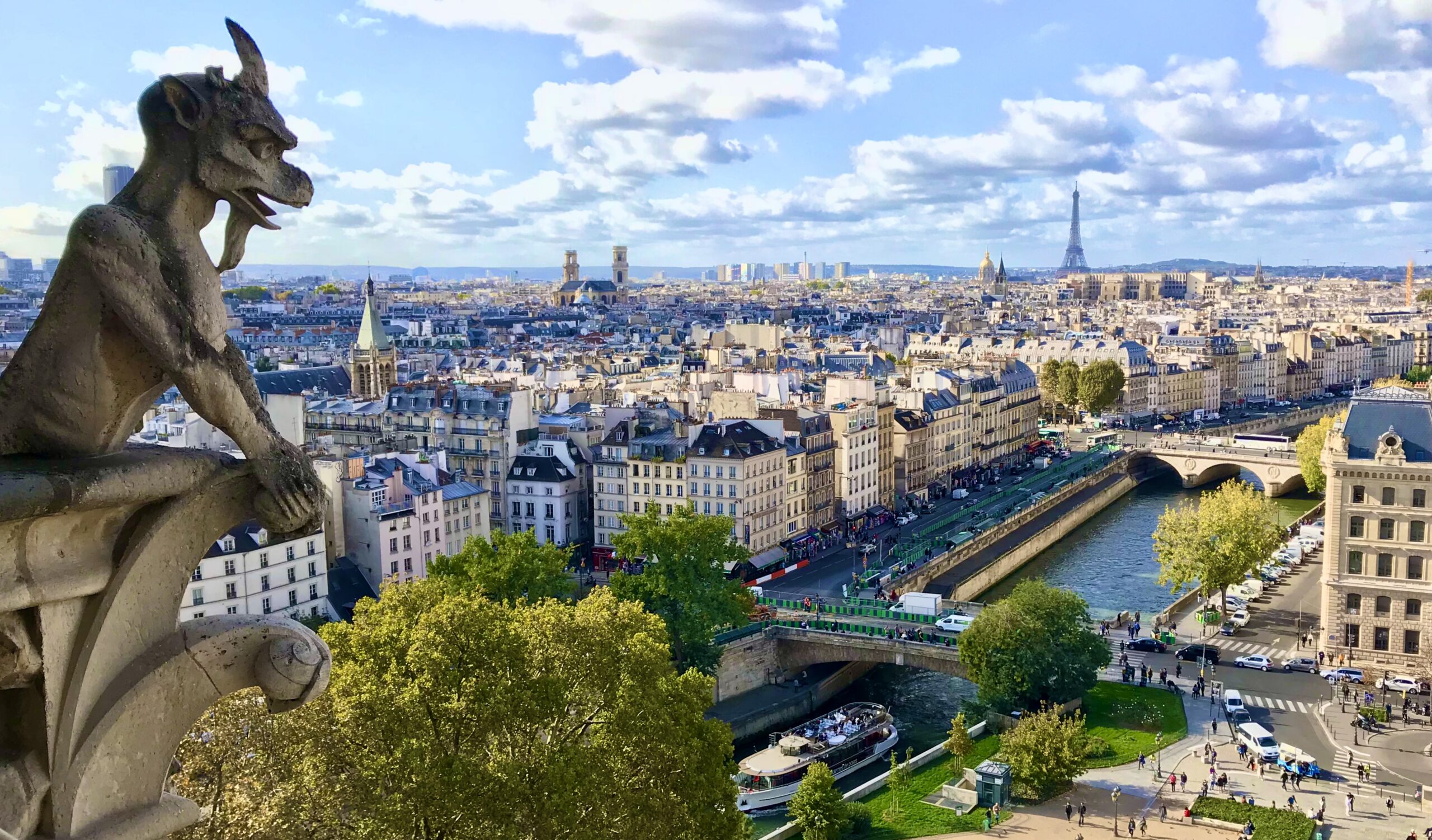
Unfortunately, there’s no elevator to the roof, so we brace ourselves for the 424 steps to the top. (We first made this pilgrimage almost ten years ago — needless to say, it hasn’t gotten any easier! One consolation — the entrance price is still almost the same, only 16€.) The stairs continue to narrow as we climb. Finally at the end of our ascent, we have a panoramic view of Paris, from the Eiffel Tower to Montmartre — truly extraordinary. And a chance to revisit Le Stryge, Wyvern and the other critters — over 100 in all. Visitors are allowed only 15 minutes at the top, but we’re grateful to see these guardians of the Cathedral once again.
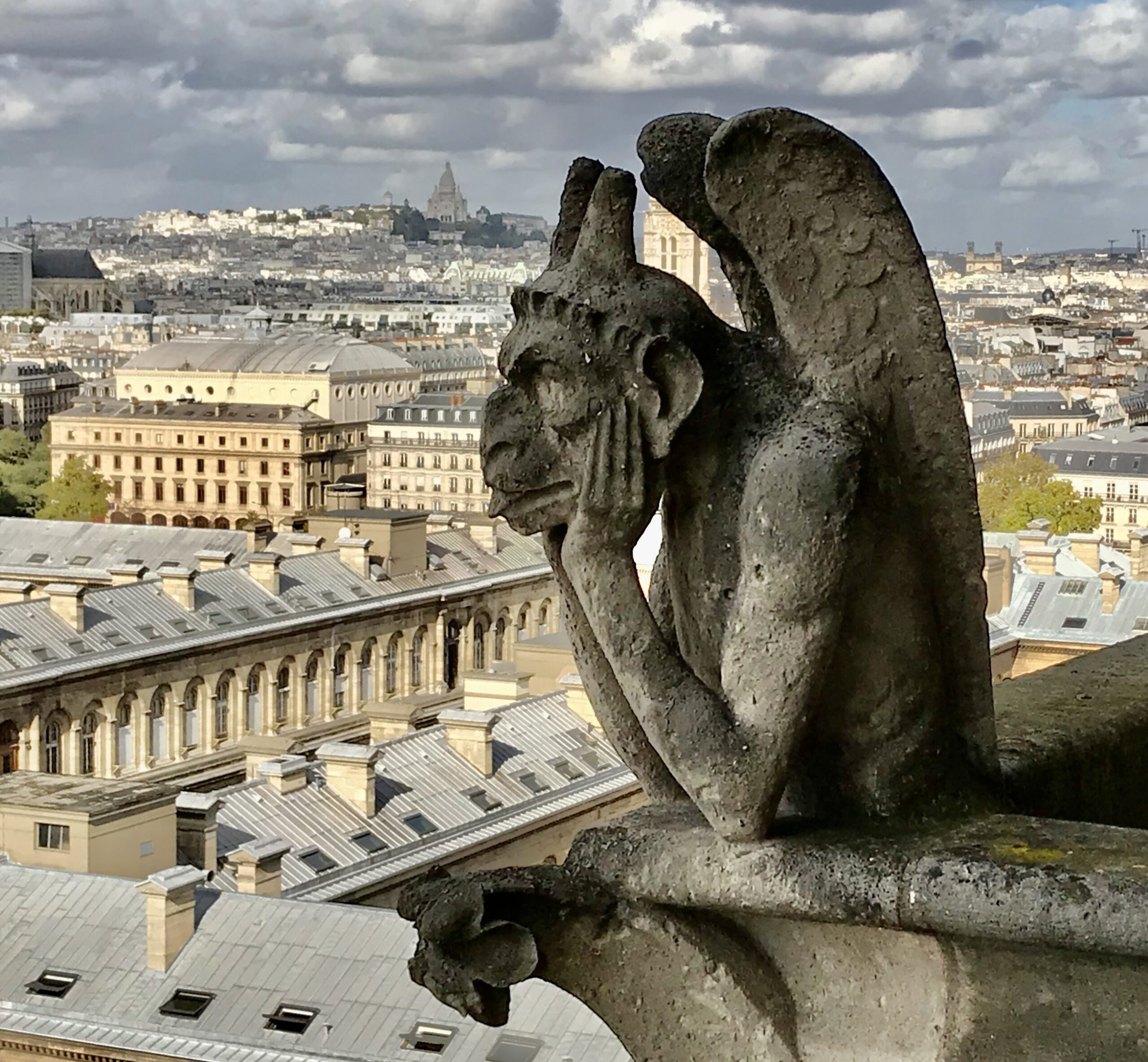
“Le Stryge” – Eugène Viollet-le-Duc’s irreverent tribute to Rodin’s sculpture.
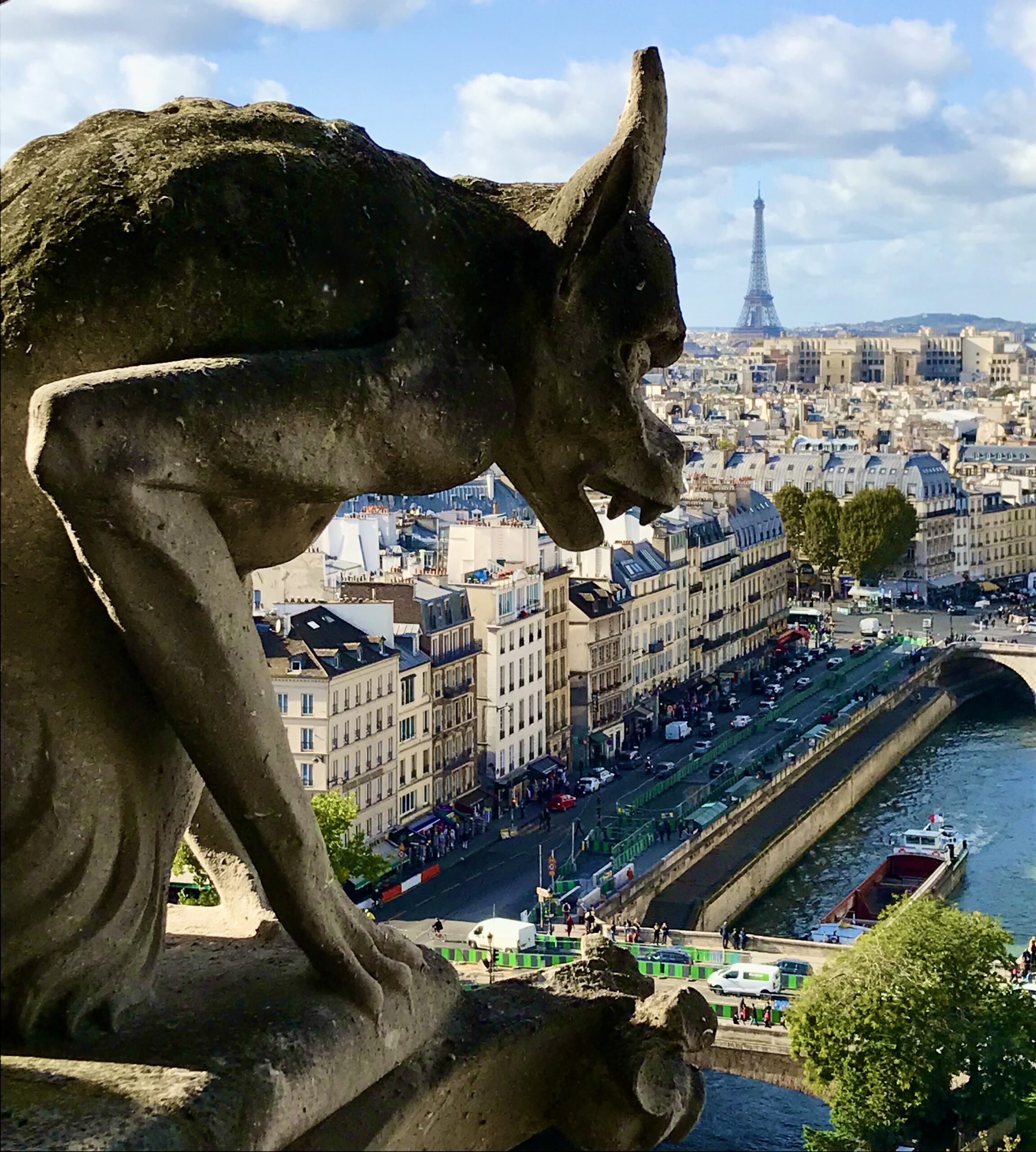
Wyvern on guard at Notre-Dame Cathedral’s rooftop.
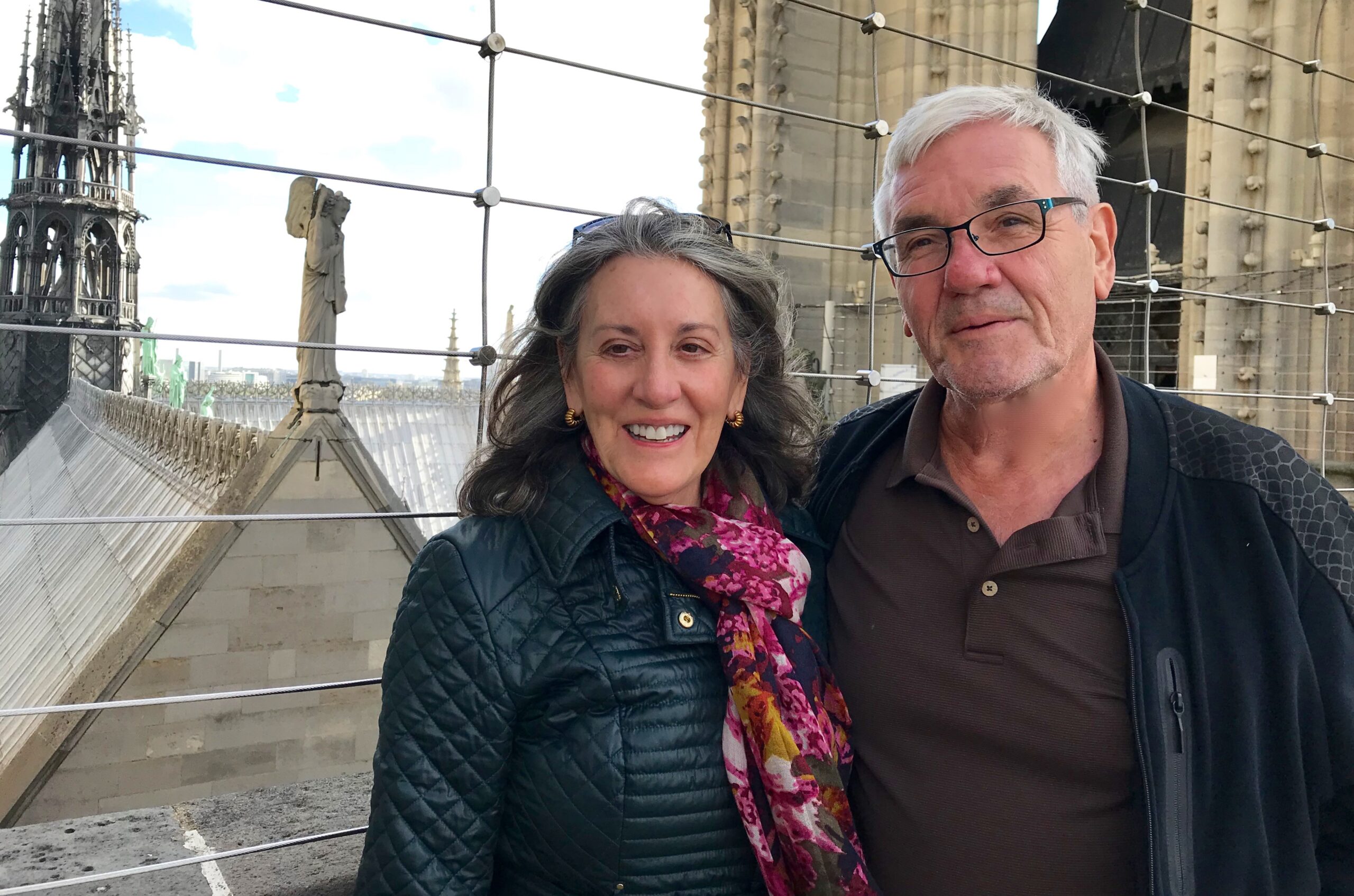
We made it – 424 steps to the top!
LUNCH WITH LES LÉGENDES
The 424 steps up to the rooftop of Notre-Dame and back down (!!!) have us ready for a respite. Le Grand Véfour is a spot we’ve come to love over the years, not only for its historic past, but for its thoroughly modern cuisine. Opened in 1784, the restaurant has hosted France’s most iconic personalities. Napoleon dined there frequently, once to propose to Josephine. La crème de la crème of French literary society was here regularly: Honoré de Balzac, Victor Hugo, Alexandre Dumas, George Sand, Colette and Jean-Paul Sartre to name a few. Tables are marked with brass plaques commemorating these legendary patrons.
What about the food? At one time, Le Grand Véfour held three Michelin stars. Now Chef Bruno Doucet oversees a menu that is more bistro-style, but still elegant and distinctive. Main plates include Veal Tartare, Pâté en Croûte, Blue Lobster. The restaurant’s famous Profiteroles are available for dessert.
Today, we’re seated at Maria Callas’ favorite corner. Just next to us is Julia Child’s old spot. When the weather is warmer, the terrace overlooking the Jardin du Palais-Royal (Royal Palace Gardens) is another great seat. We can imagine Louis XIV strolling past, pondering his castle at Versailles or Napoleon planning his next conquest. Le Grand Véfour is that Parisian blend of ancient history and the here-and-now.
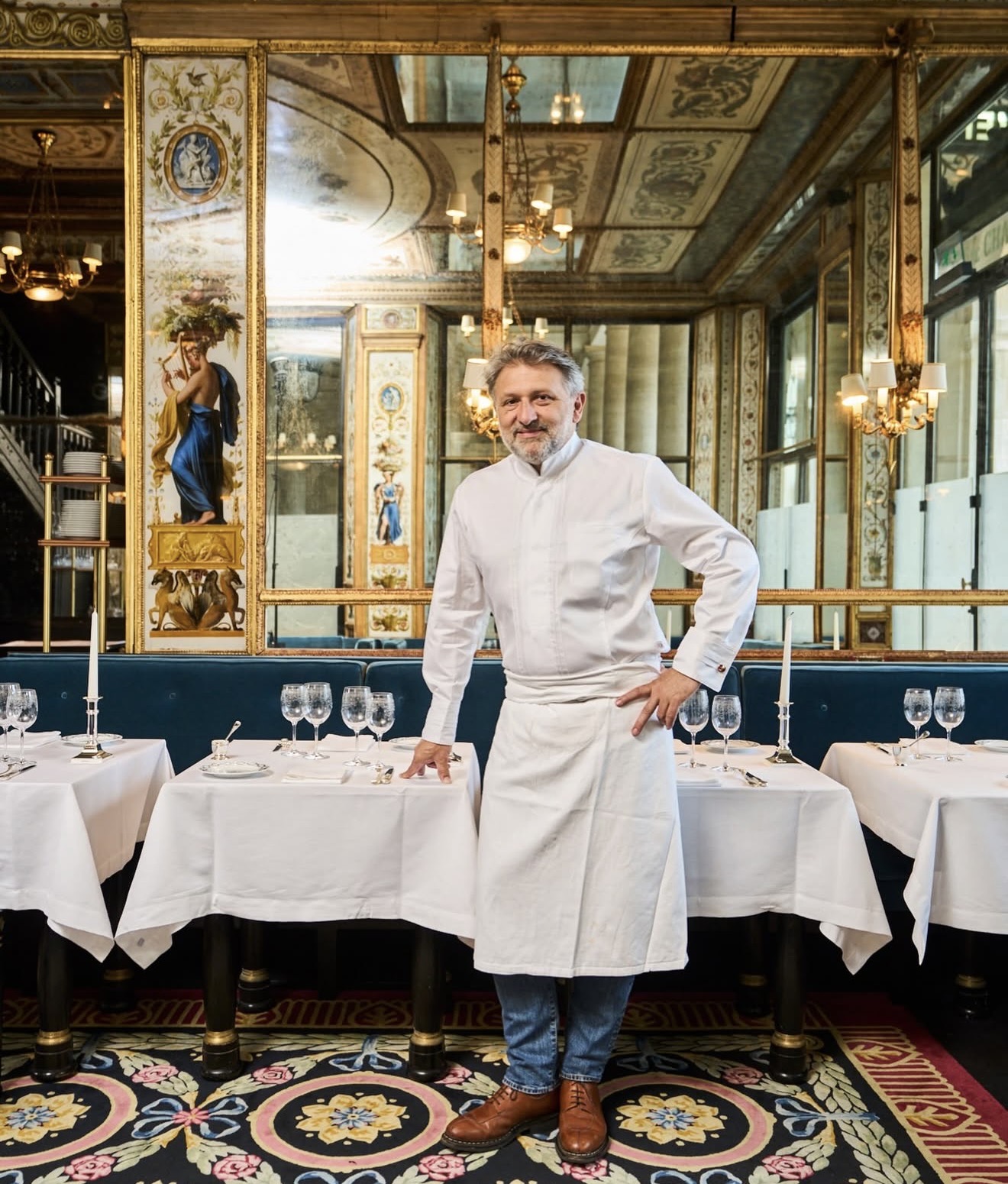
Chef Bruno Doucet oversees the menu at Le Grand Véfour. Photo courtesy of Le Grand Véfour.
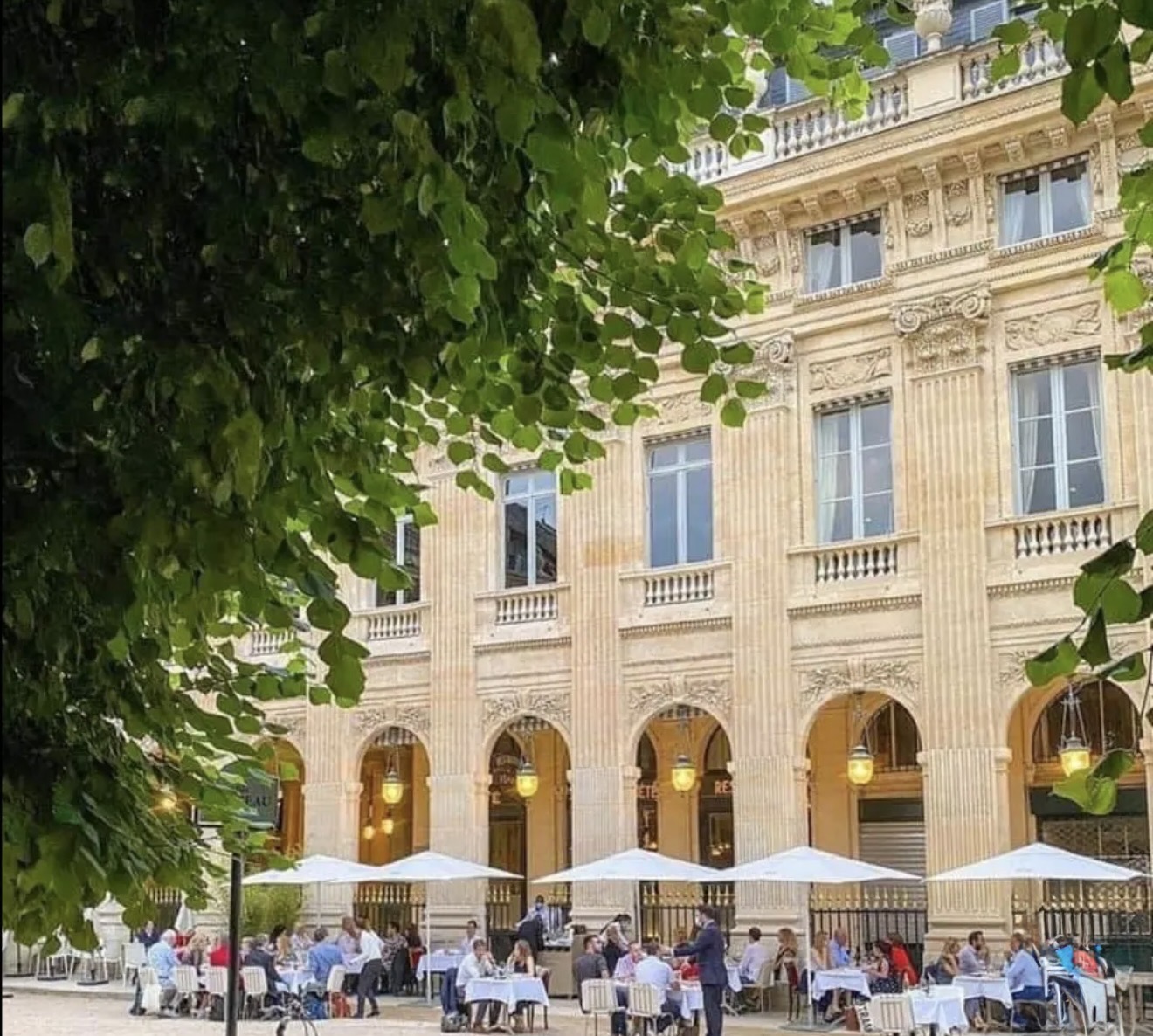
Terrace dining in the Jardin du Palais-Royal at Le Grand Véfour.
IS PARIS BURNING?
What if Paris had been destroyed? Bombed into a pile of rubble? The unthinkable nearly happened during World War II.
In August 1944, as the Allied armies began to liberate France and Nazi forces withdrew, Hitler panicked. If he were to lose the war, he would at least destroy as much as possible to exact revenge. Paris was an obvious target. To accomplish this Hitler sent a trusted General, Dietrich von Choltitz. His mission was stark: Hold Paris for as long as possible, Hitler ordered, “but when the enemy arrives, their city must be a field of ruins.”
Initially Choltitz complied with Hitler’s demand and German engineers mined iconic Paris landmarks: Notre-Dame, the Louvre Museum, Eiffel Tower and the city’s 37 bridges — all set to explode when the Allies arrived. Yet, in the end, Choltitz defied Hitler’s orders, even as a final cable arrived from der Führer, famously demanding, “Is Paris burning?”
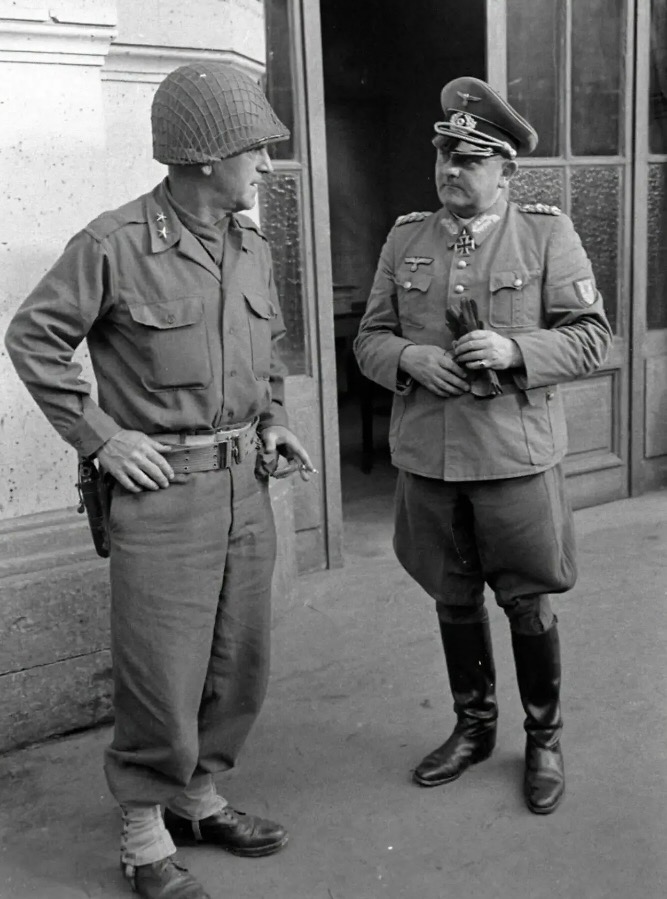
US General Leonard T Gerow with General Dietrich von Choltitz during the German surrender at Le Meurice Hotel, Paris.
Why the change of heart? Many historians claim that Choltitz simply knew the end was near and wanted to secure better treatment for himself and his troops. Choltitz, however claimed that it wasn’t to save himself. It was in fact, his admiration for French culture that prevented him from destroying Paris and its historic architecture.
What is verifiable, is that General Choltitz made his headquarters at Le Meurice, considered one of Paris’ finest hotels since its opening in 1835. His offices faced the Tuileries Gardens, the Louvre and Eiffel Tower. Numerous sources document Choltitz’ appreciation of these magnificent views, along with the hotel’s restaurant and exceptional wine cellar. So, who knows? Perhaps Le Meurice can claim a part in Paris’ ultimate salvation.
(NOTE: For an in-depth analysis of the Paris liberation see Is Paris Burning, published in 1965 or the film released in 1966.)
Today, Le Meurice is lovelier than ever since an extensive renovation in 2007 under French über-designer Philippe Starck. Alain Ducasse manages the main restaurant which boasts a two-star Michelin. A second restaurant, Le Dalí, is an homage to the surrealist artist who spent a month every year for over 30 years in the Royal Suite of Le Meurice. Here too, Picasso married his first wife, ballet dancer Olga Khokhlova in 1918. The list of patrons is an international Who’s-Who, from the Duke and Duchess of Windsor and the Sultan of Brunei to Jay-Z and Beyoncé.
Our room faces the Tuileries and Louvre — the same view once enjoyed by the Nazi General. Now, however the parks are filled with young couples, children, moms pushing prams. It’s as if nothing happened on that fateful day in August….
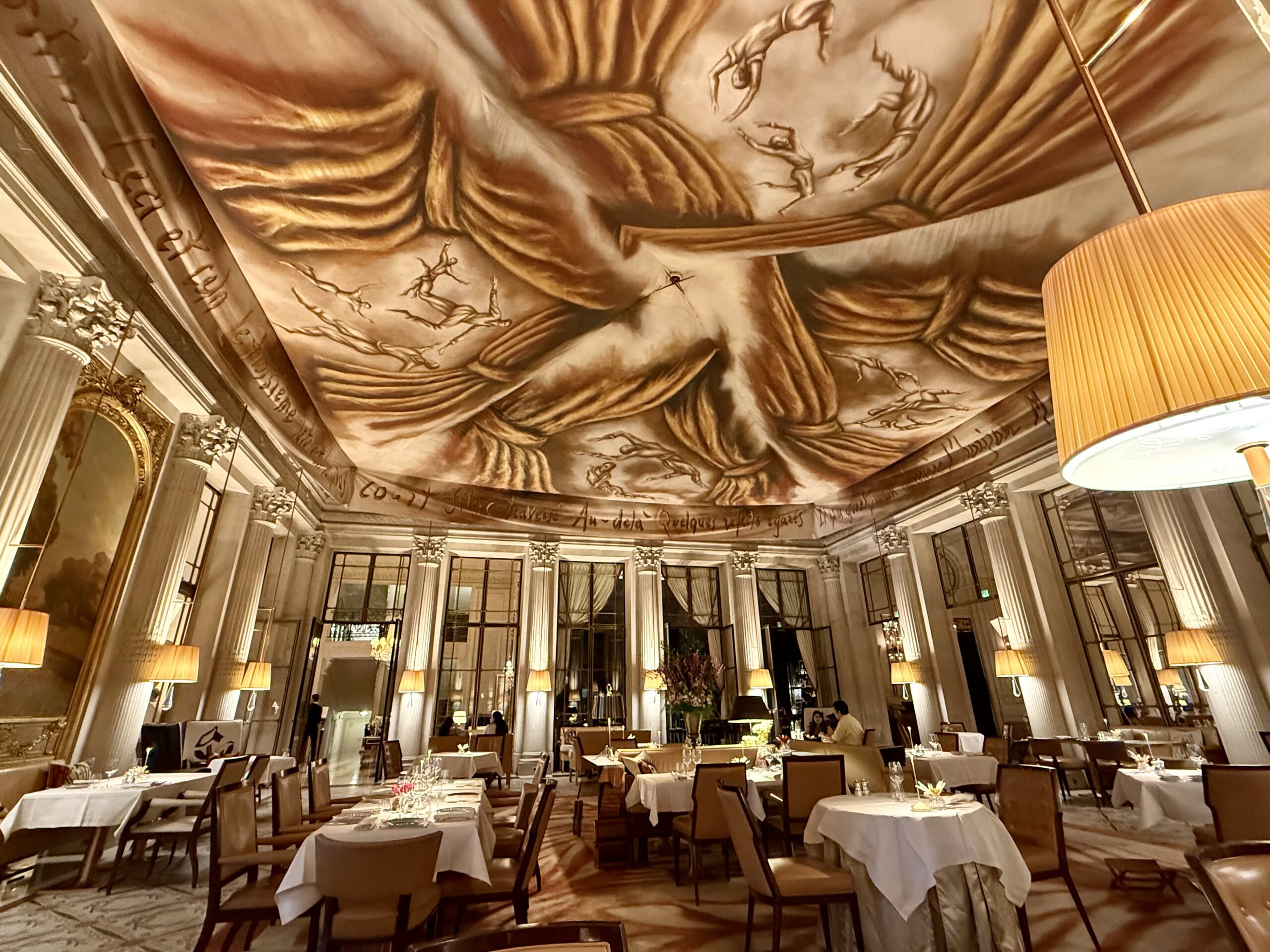
Restaurant Le Dalí is an homage to the artist who frequently stayed at Le Meurice.
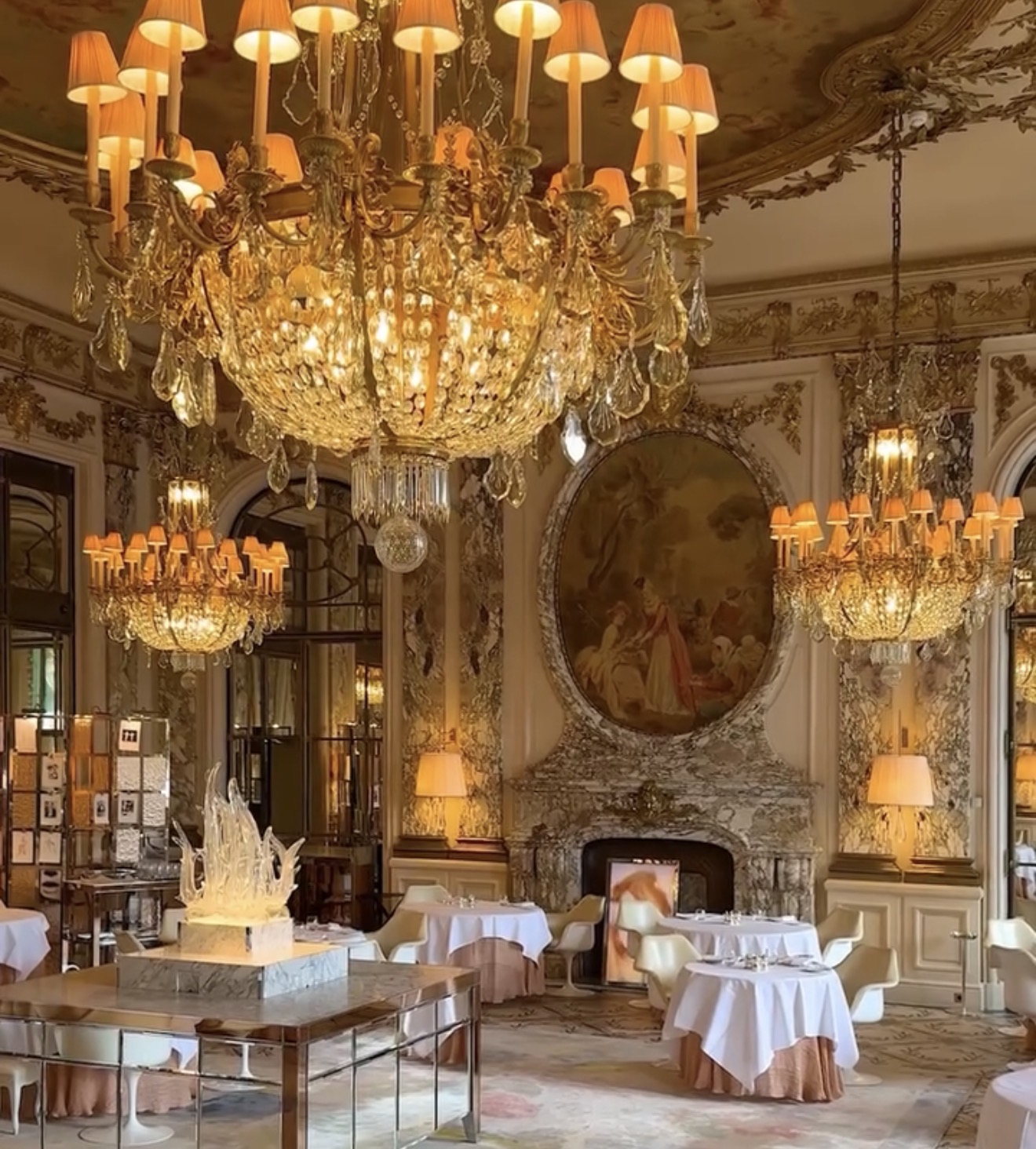
More opulent dining at Le Meurice, established in 1835.
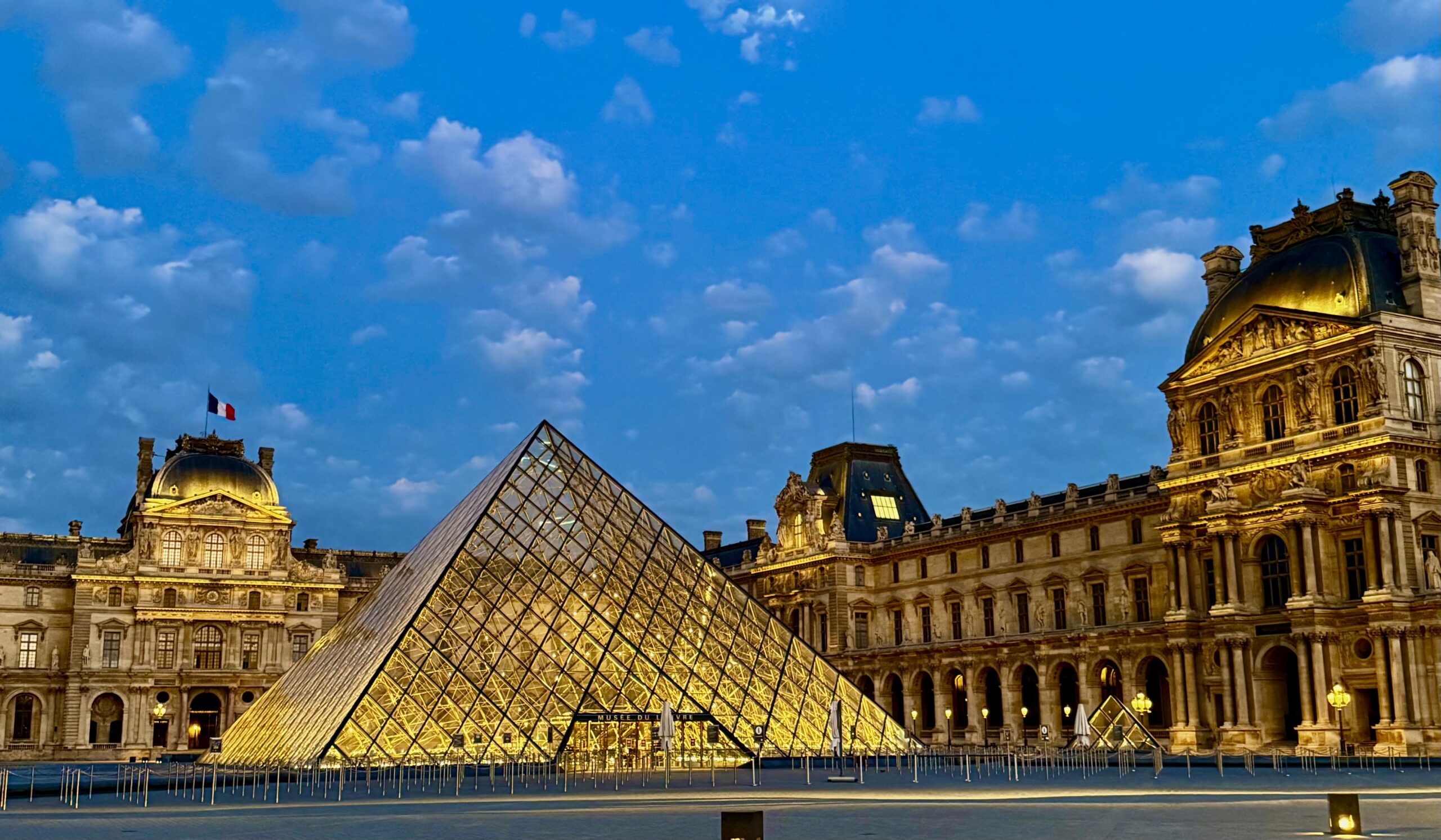
Louvre Museum on a moonlite night.
THE WORLD’S MOST FAMOUS PHANTOM
The Paris Opera House, Palais Garnier, is the haunt of the world’s best known ghost. French novelist Gaston Leroux penned The Phantom of the Opera in 1909. Interestingly, Leroux’s story is based on several real events:
1) A fire on the roof of the opera house melted a wire for an enormous chandelier that crashed after an opening act. (A scene spectacularly recreated in the musical.)
2) Rumors of a ghost haunting the opera circulated for years prior to the Leroux novel.
3) An enormous cistern — aka the phantom’s underground lake — actually exists beneath the opera house and is still used for training Paris firefighters to swim in the dark.
The Phantom first gained popularity in 1925, when Universal released a film version of the book starring Lon Chaney. In 1986, Andrew Lloyd Weber debuted his version of the Phantom, which ultimately became the longest-running Broadway show and ranks as one of the highest-grossing musical productions in history.
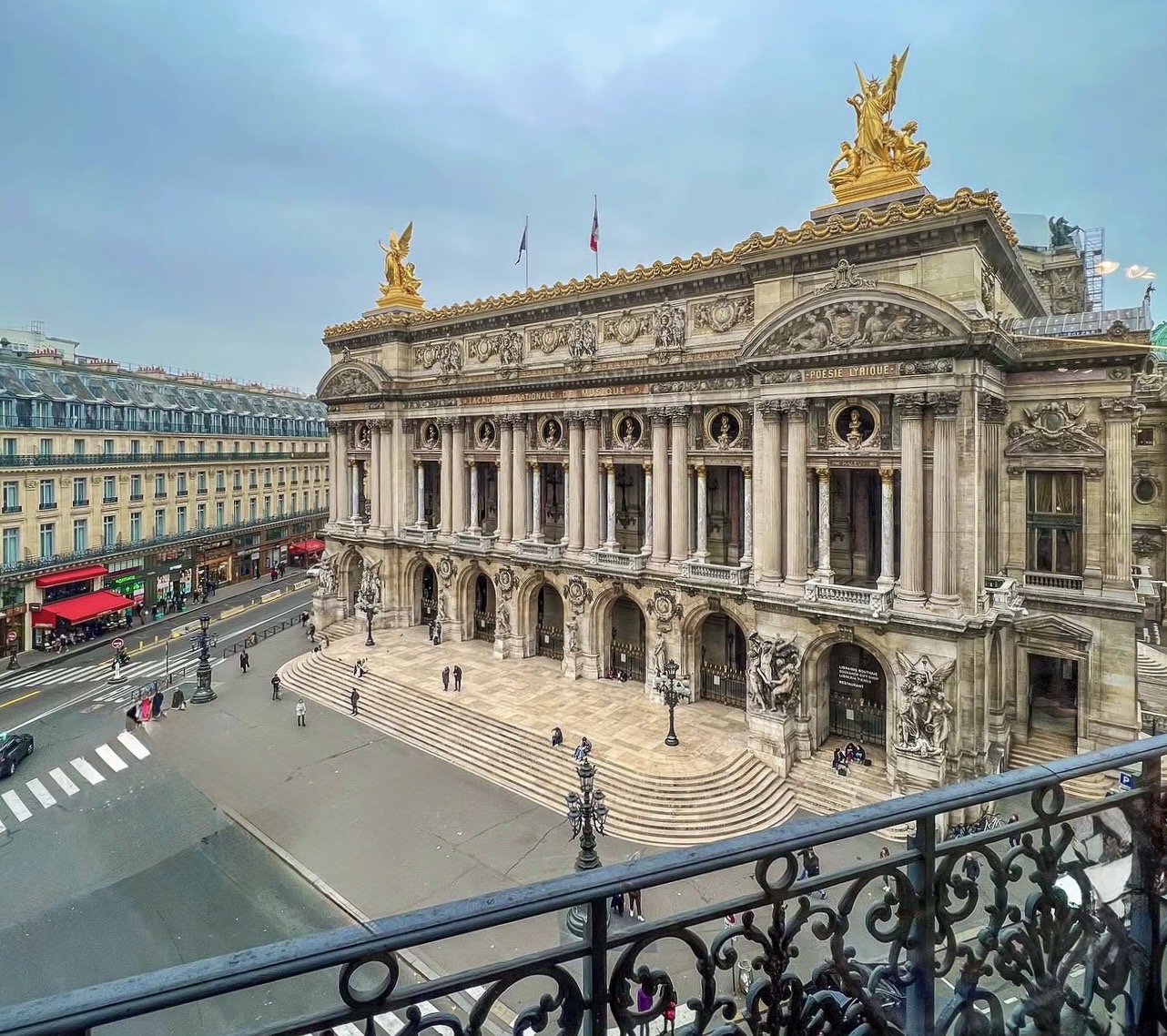
Jean-Louis Charles Garnier was the architect for the Opéra National de Paris in 1861.
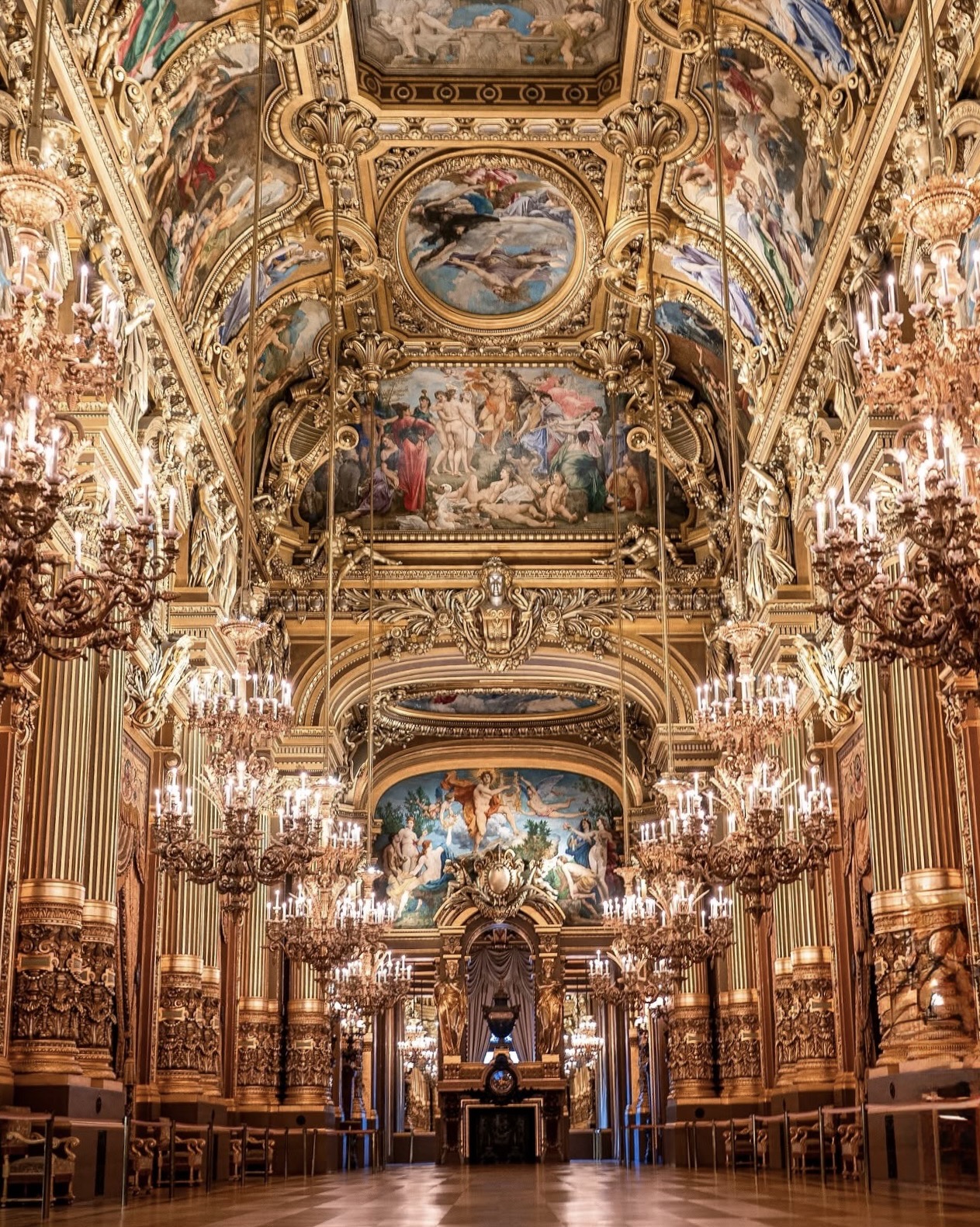
Versalilles-like Hall of Mirrors at the Palais Garnier Opéra National de Paris.
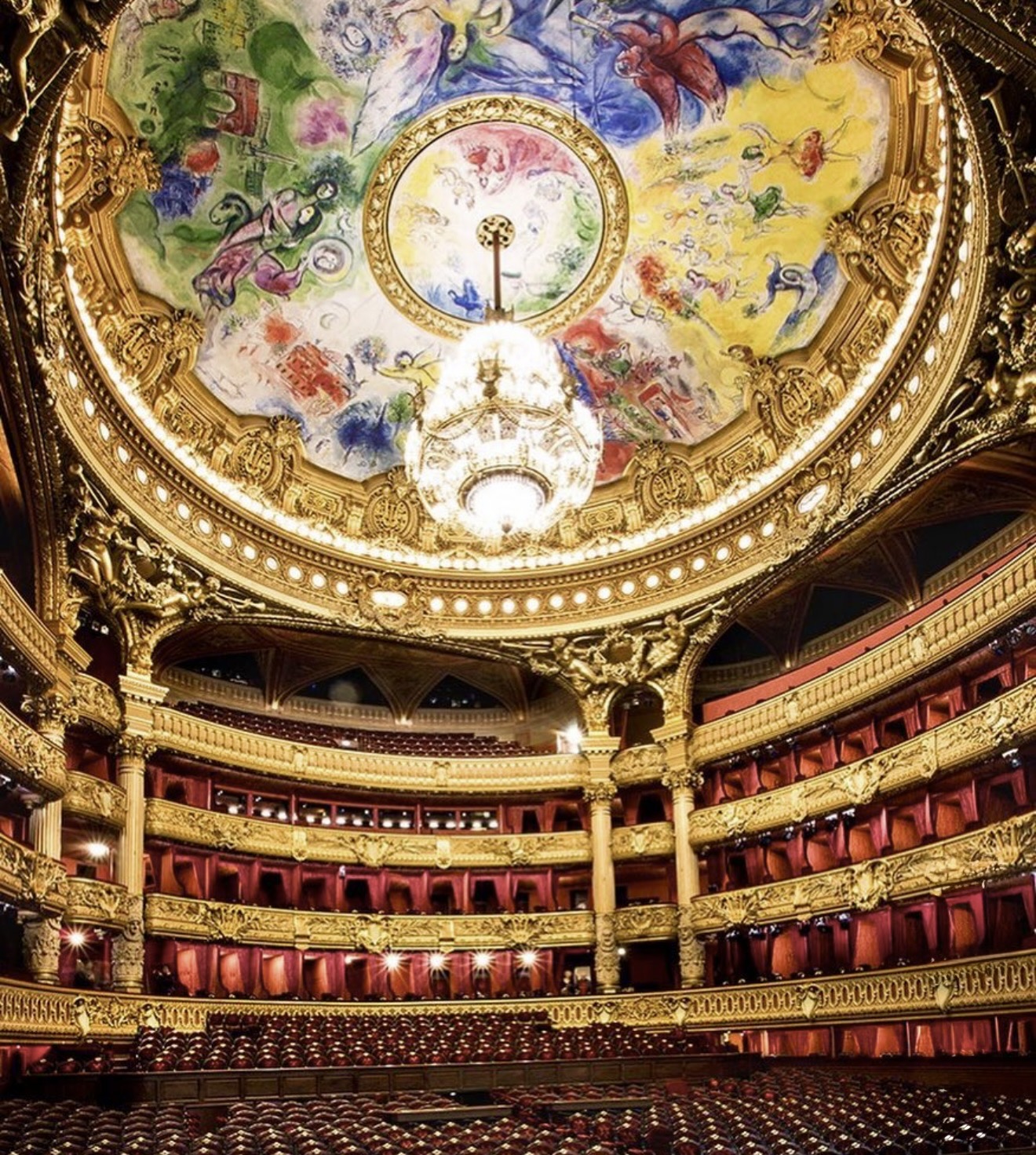
Marc Chagall’s 2,400 square-foot canvas hangs above the Opera auditorium.
We keep an eye out for the elusive ghost when we visit the Palais Garnier. (Note: Tours are available daily, but must be booked online at Opéra National de Paris.) Our guide tells us that the opera was built in 1861 with Jean-Louis Charles Garnier as the architect — hence the name. Napoleon III, ruler at the time, wanted a structure that rivaled Versailles. Garnier obliged with golden-framed mirrors, endless chandeliers, gilded columns and frescoed ceilings. Extravagant and ornate, every detail is designed to impress.
The Palais Garnier stage is the largest in Europe and can accommodate some 450 artists. Seating capacity within the opera auditorium is 1,979. Suspended from the auditorium ceiling is Marc Chagall’s 2,400 square-foot canvas, installed in 1964. The massive painting pays homage to 14 composers and is a strikingly modern contrast to the baroque architecture. We loved learning that Chagall refused payment for his work, but gifted it to the city of Paris.
We also have a chance to see behind the stage, where scenery for the lavish productions is stored and row after row of costumes are kept. At the end of our tour, we walk back down the massive stairs. Suddenly, the lights dim! A dark figure in a long cape appears behind one of the columns.
“Did you see that?” Michel whispers.
I nod and turn to look again. The figure has vanished. We both laugh. After all, the opera is the perfect environment for creative imaginings. Continuing down the stairs we pause again at the bottom.
“Wait! Do you hear footsteps?” 👻
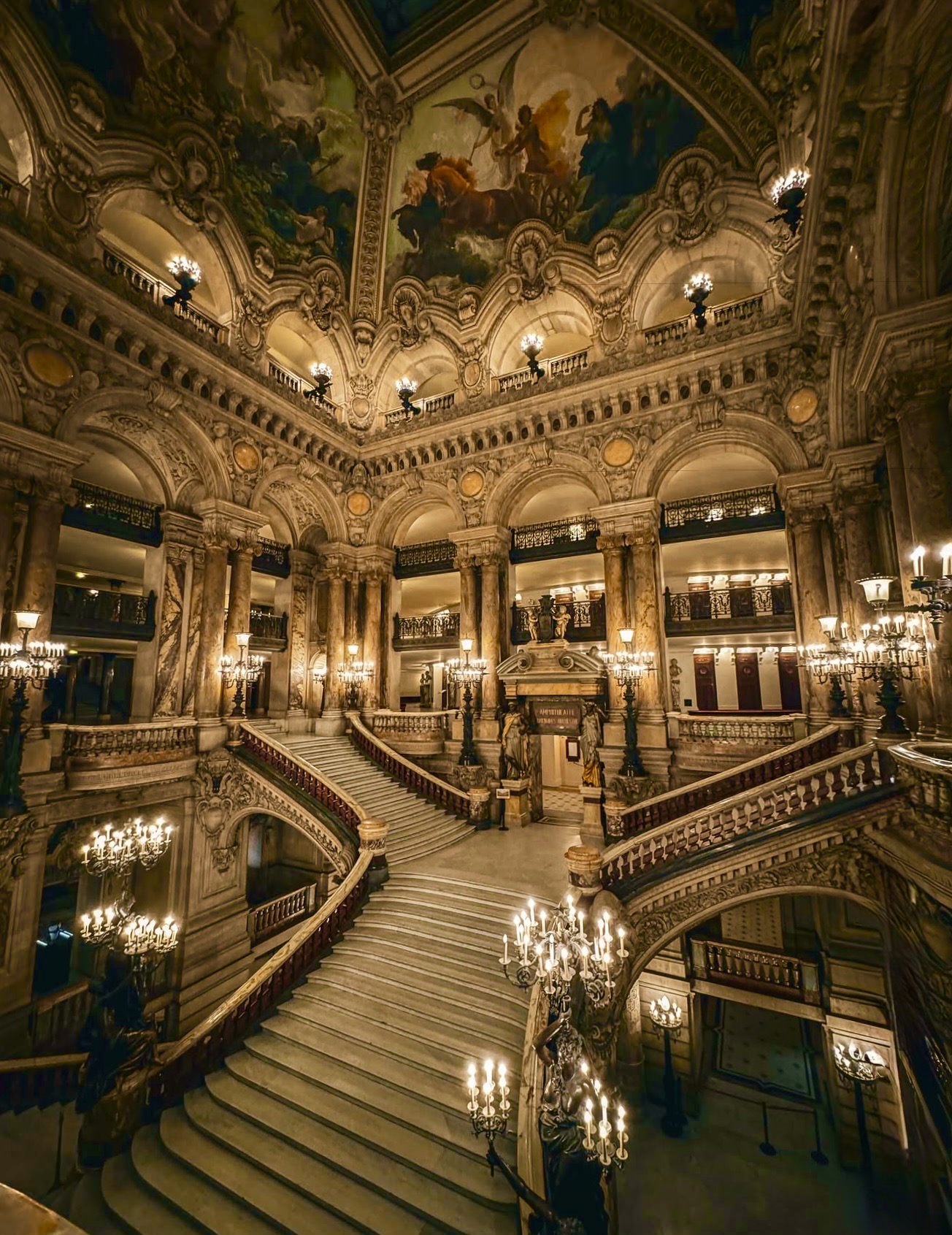
Monumental staircase leading to the auditorium at the Palais Garnier Opera.
CIMETIÈRE PÈRE LACHAISE
Of course, the ultimate place to connect with Paris spirits is the city’s first and largest municipal cemetery, Père-Lachaise. Jim Morrison, Edith Piaf, Maria Callas, Sarah Bernhardt, Isadora Duncan, Proust, Chopin, Oscar Wilde, Colette, Delacroix and Molière are all here. The cemetery is also one of Paris’ most popular tourist sites — any time of the year. (We booked with Get Your Guide )
There are approximately 80,000 plots within the 110-acres, although, since the cemetery was established in 1804, no one knows exactly how many people have been buried there. Estimates vary radically from 300,000 to 1 million. Our guide explains that “Currently there are no plots available. Père-Lachaise does allow families to sprinkle the ashes of their loved ones within the cemetery grounds.” (OK! Something to keep in mind…. )
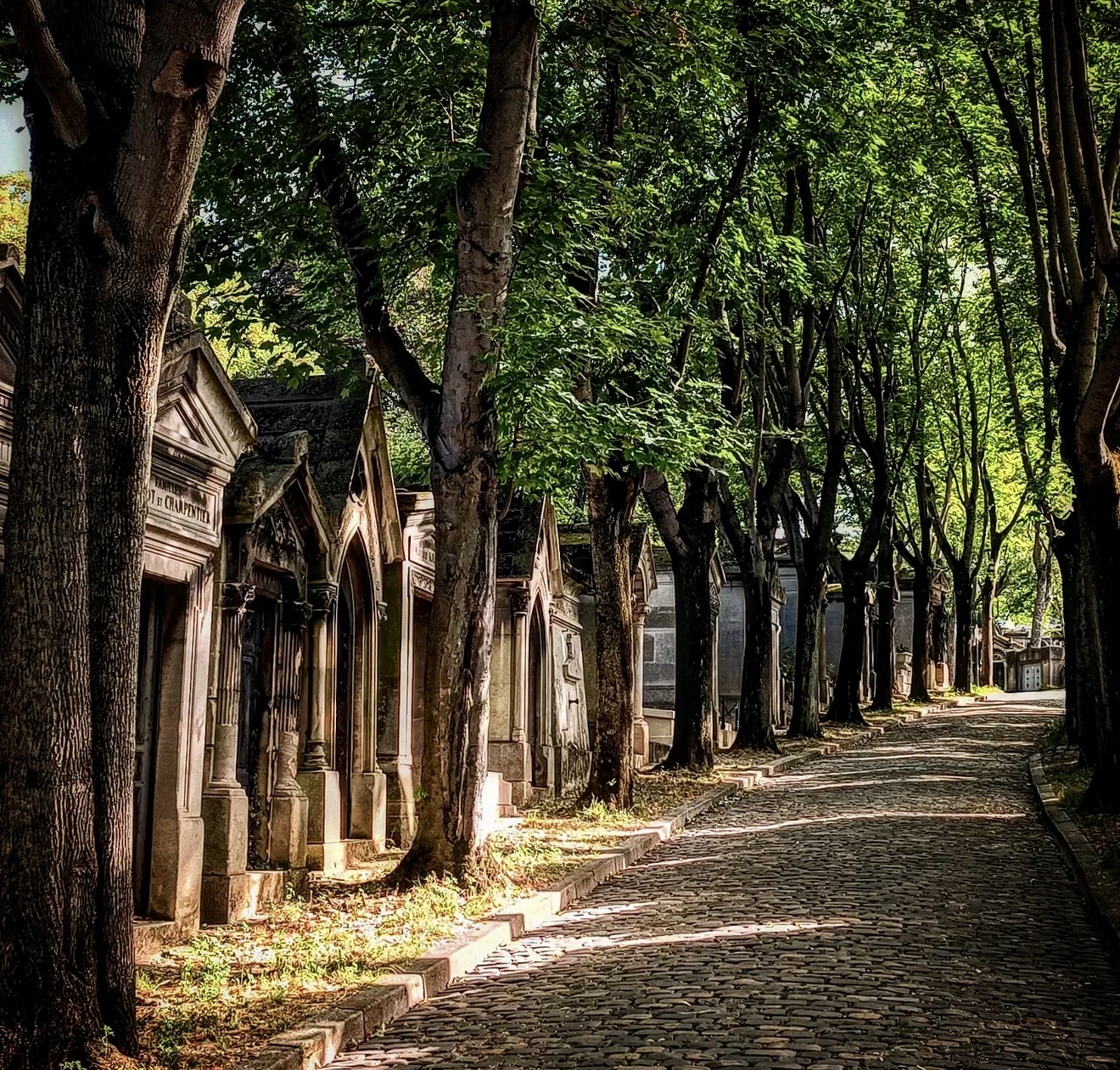
Père-Lachaise is the largest cemetery in Paris with many notable personalities.
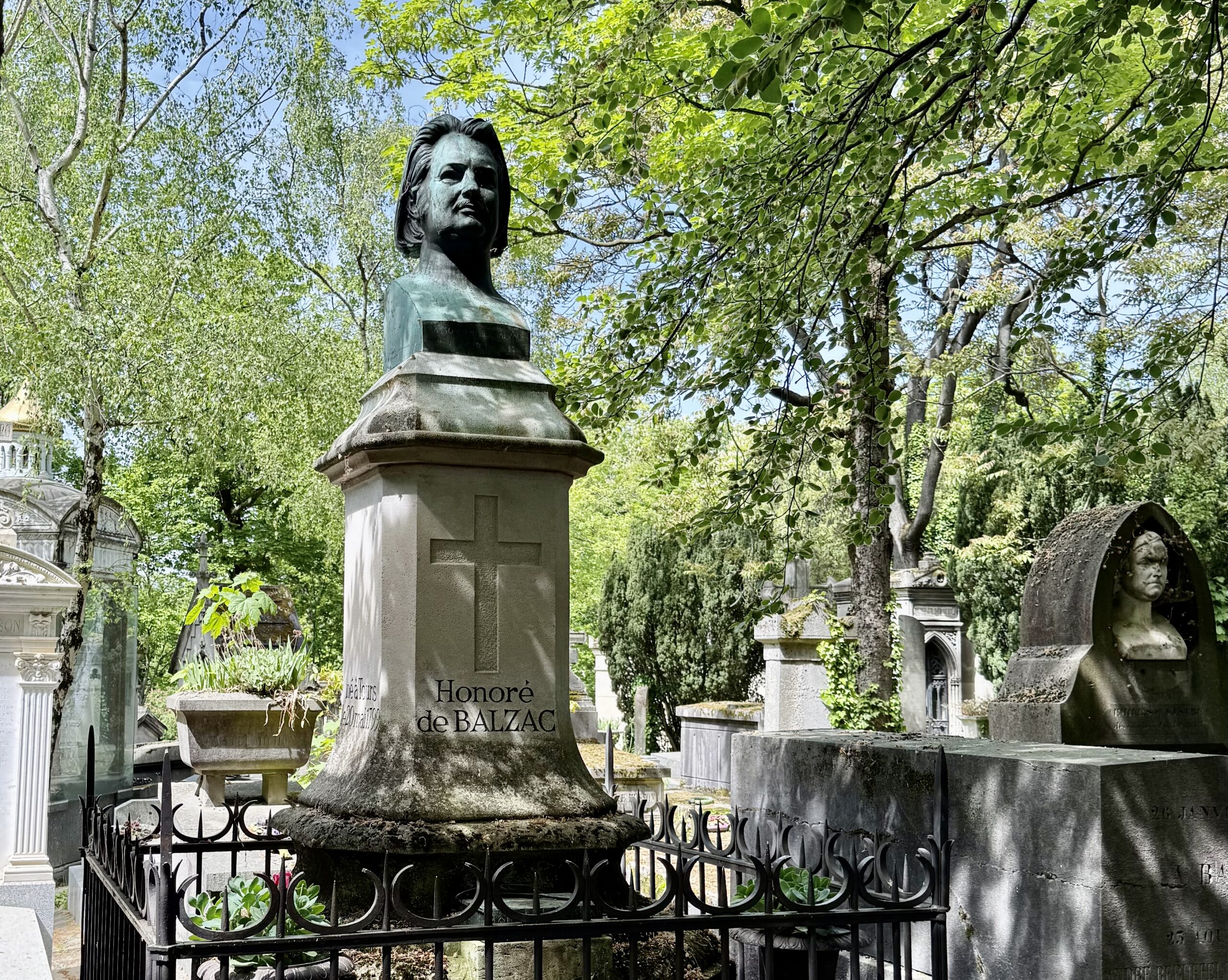
Tomb of Honoré de Balzac – novelist and playwright.
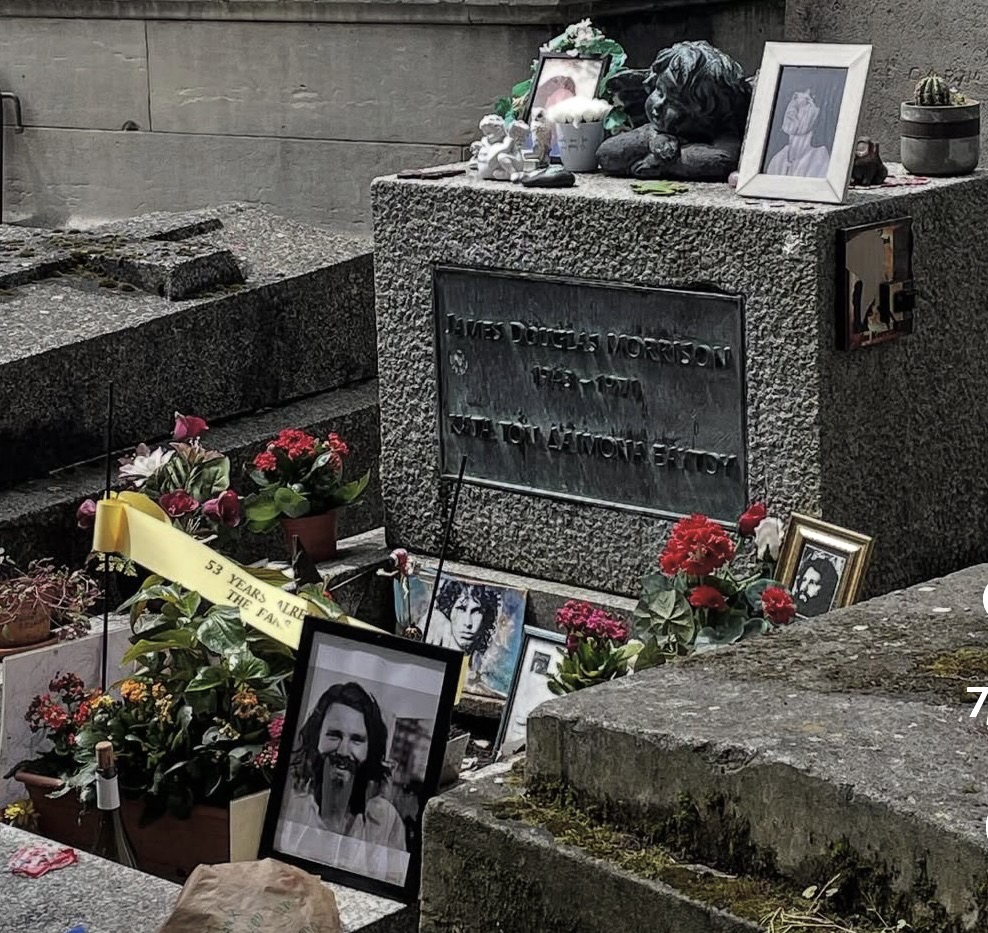
Jim Morrison’s small grave is the most popular site at Père-Lachaise.
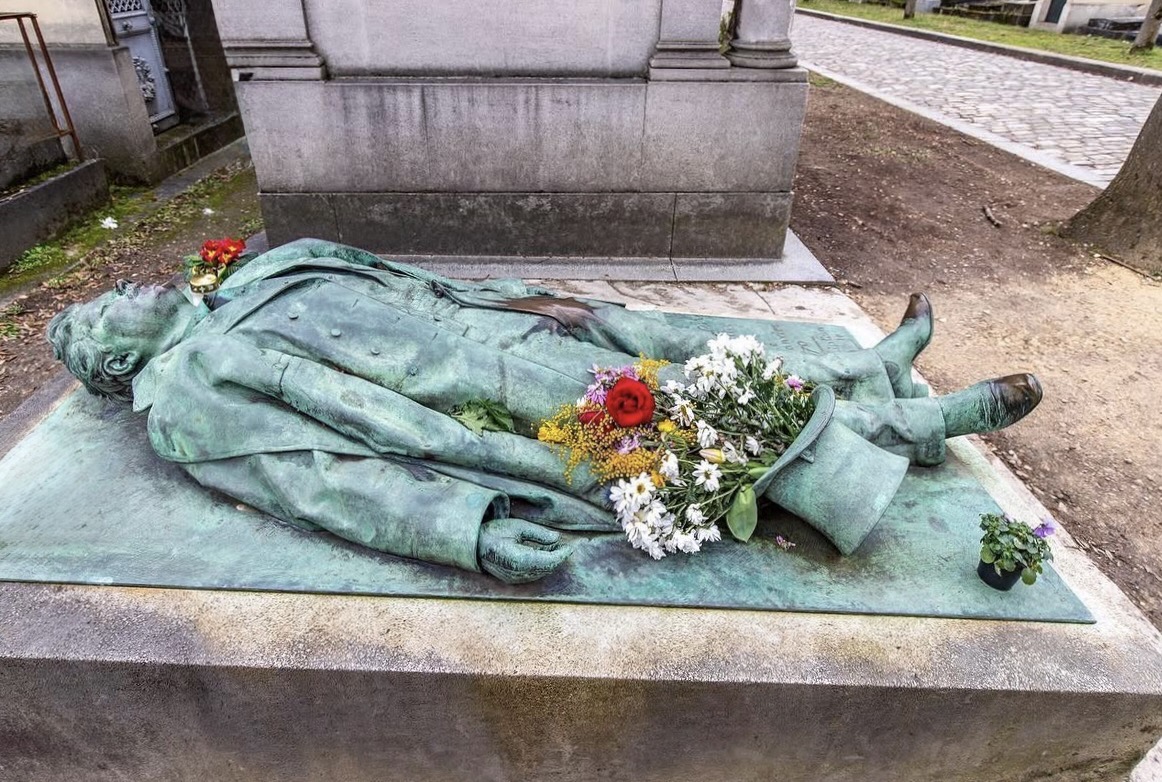
Life-size bronze of journalist Victor Noir
The most-visited tomb is that of American singer-songwriter Jim Morrison, who died in Paris at age 27. More than half a century after his death, his grave site is regularly filled with flowers and mementos. French singer Edith Piaf is considered the second-most popular tomb. Oscar Wilde’s plot has a glass barrier to protect it from fans who leave lipstick kisses on his Egyptian-themed tomb.
Another popular site is the grave of Victor Noir, a journalist killed in 1879, during a duel with Napoleon’s nephew, Prince Pierre Bonaparte. Sculptor Jules Dalou created a life-size bronze of Noir to appear as though he has just fallen in the street after being fatally shot.
Significantly, however, in addition to his dangerous political views, Monsieur Noir was also known for his success with women. The slight bulge in his trousers became an obsession with his admirers and eventually spawned a strange ritual. In the words of our guide, “Many dévotes kiss the statue on the lips, leave a flower in his hat, and rub the genital area hoping to have enhanced fertility, a great sex life, or to find a husband. Because thousands touch the statue every year, parts of the bronze have become very shiny.” ………Oh là là là là ! Enough to make the palest ghost blush. 😱
All bizarre practices aside, we’re impressed with just how lovely Père Lachaise is. Enormous trees line the paths. Beautiful shrubs and flowers grow everywhere. There are numerous exquisite sculptures and heartfelt tributes. We sit for a few minutes to take it all in before leaving the spirits to rest.
IN PURSUIT OF THE GREEN FAIRY 🧚
At this juncture, Michel is more interested in a different kind of spirit — the quaffable kind. Here he is to explain:
If I had to associate a beverage with Paris, it would be Absinthe, the ancestor of today’s national drink in France, Pastis. Historically, Absinthe became popular with counterculture artists, writers, bohemians and famous characters such as Ernest Hemingway, James Joyce, Lewis Caroll, Baudelaire and Toulouse Lautrec. In the early 1900s, it was so popular that in one particularly indulgent year, over 40-million bottles were consumed in France alone! Even the French military in North Africa drank Absinthe… as a medicinal protection against malaria.
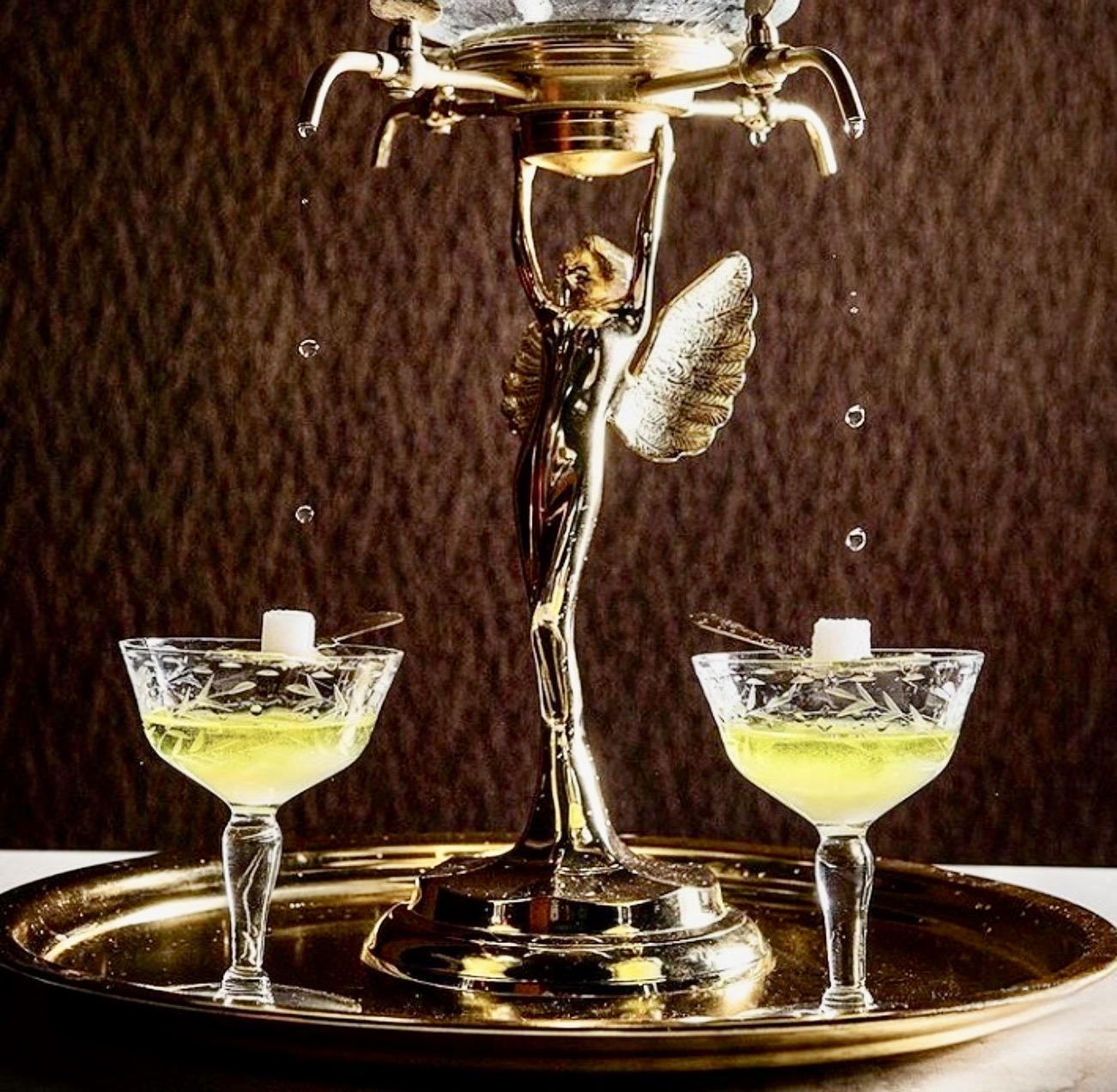
Proper Absinthe service with fountain, slotted spoon and sugar cube.
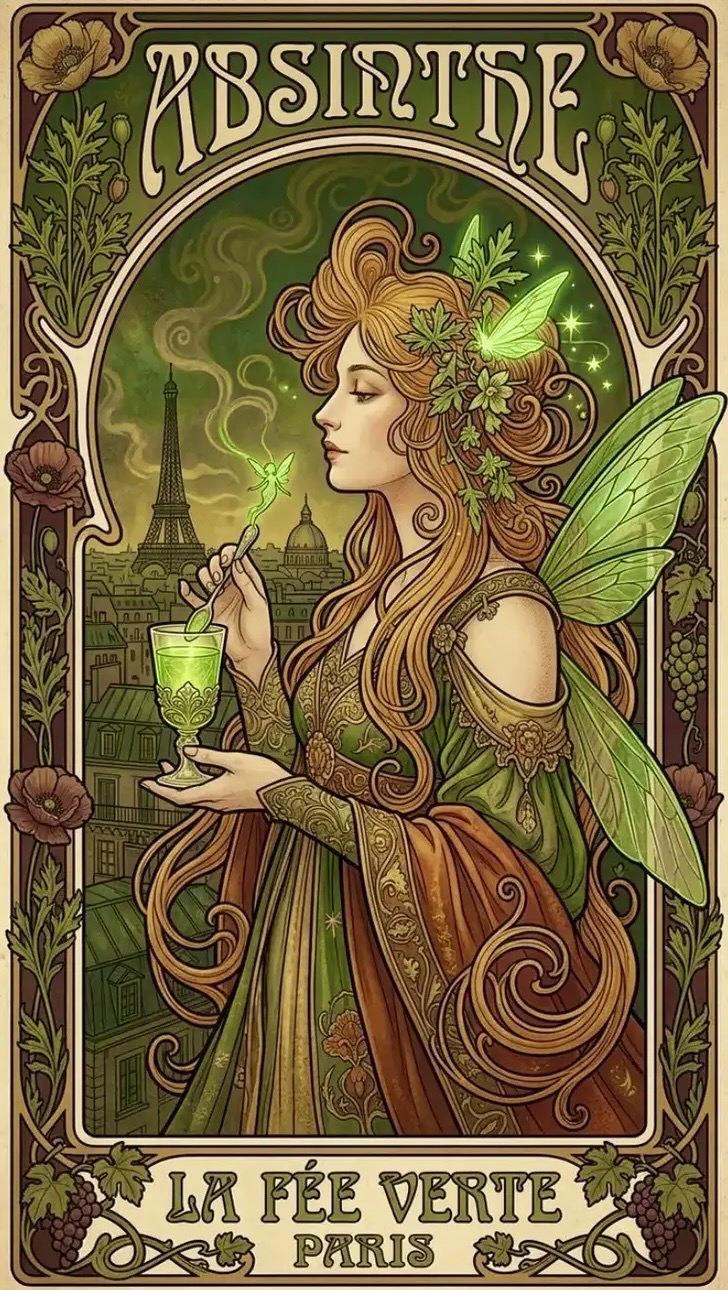
Absinthe is a spirit made from the distillation of herbs such as anise, fennel and wormwood, first produced in the late 1700s. Origins vary, but a Frenchman named Pierre Ordinaire is believed to have been the creator. Absinthe is sometimes colorless but often green because of the chlorophyll present during the secondary fermentation. As a result, it earned the nickname “Green Fairy” and as it gained popularity, evening cocktails in Paris and other cities became known as “The Green Hour.”
Needless to say teetotalers were appalled by the spirit and began enacting laws to limit its use. By 1915, most countries in Europe had banned it. The reason given was that Absinthe users experienced psychotic events, sometimes leading to crime. Modern science has since debunked these theories. What is more likely to have happened, is that the alcohol level was so high that drinkers could not help but be disoriented by its effect. Originally, alcohol levels in Absinthe were in the range of 90-150 proof or 45-75%. If you’ve ever tasted 90-150 proof spirits, whiskies for example, the difference from a standard 80 proof to those is significant!
In the past 35-40 years, Absinthe has made a comeback and is legal in many countries. The French brand Lucid became the first Absinthe brand to be imported in the US in 2007 and today there is an American brand, St George Spirit, producing a quality Absinthe. I say quality because the good brands distill their macerated botanicals with distilled water. It is time consuming, but the end product is a complex Absinthe with textured herbal notes while the cheaper brands simply cold-mix flavoring products with alcohol. Be careful as there is no law requiring a brand to list how they make their Absinthe.
In the US, New Orleans had a long history with Absinthe. The Old Absinthe House is one of many places that still serve Sazerac, an Absinthe-based cocktail. Apparently Mark Twain, Franklin D Roosevelt and Frank Sinatra were fans!
In Paris, Bar Hemingway, within the Ritz Hotel, regularly serves absinthe in its Grand Derby cocktail, which also includes Grand Marnier, Bourbon, Aperol and Vermouth. Patrons can also order the drink invented by Hemingway — Death in the Afternoon.
Hemingway’s exact instructions from the 1935 book of the same name are brief: “Pour 1 jigger of absinthe into a Champagne glass, add iced Champagne until it attains the proper opalescent milkiness.” He also famously added: “Drink 3–5 slowly.”
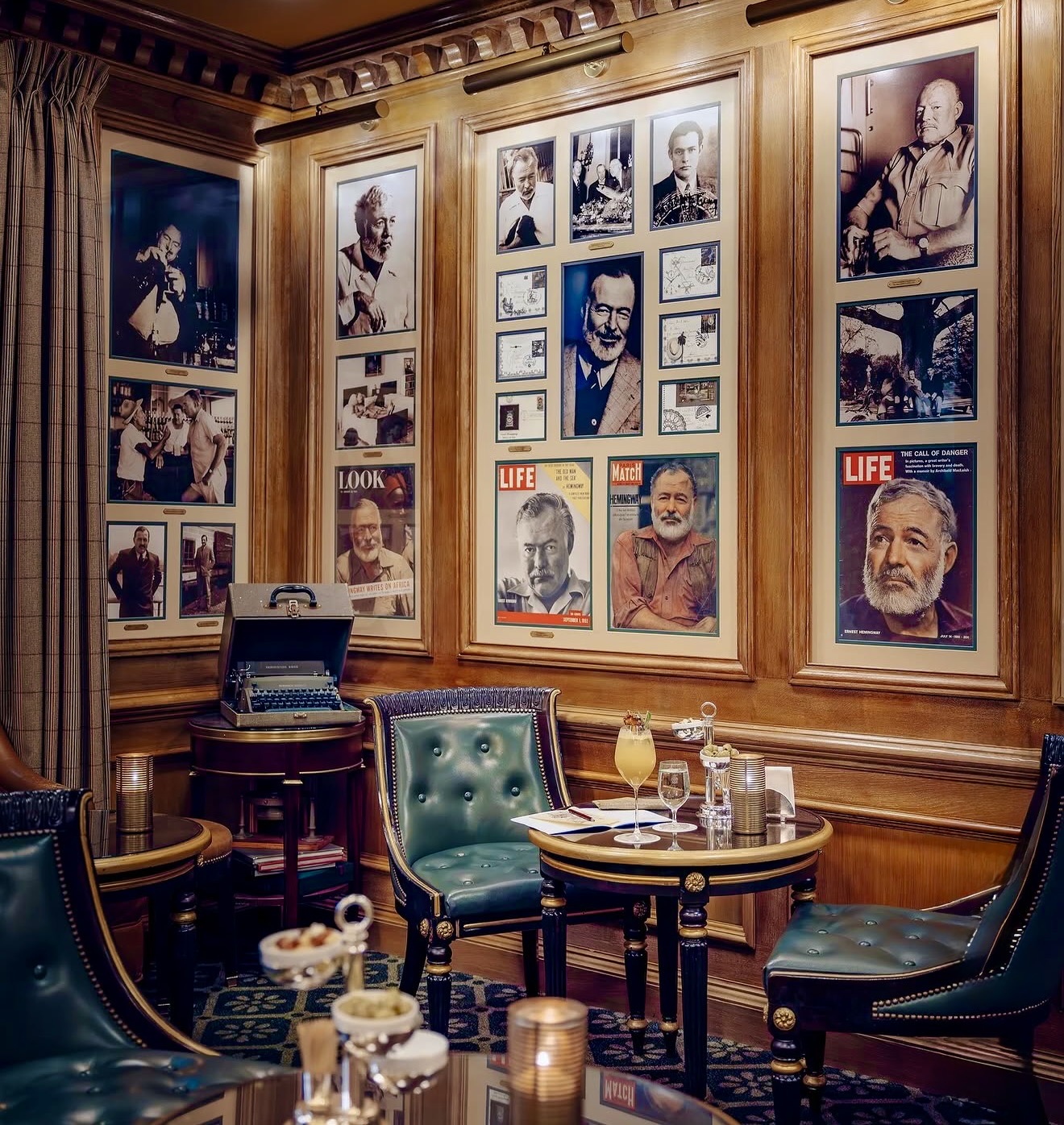
Bar Hemingway at the Ritz Hotel in Paris – filled with photographs and memorabilia.
LAST CALL AT BAR HEMINGWAY
According to local legend, Ernest Hemingway “liberated” the bar at the Ritz Hotel when Allied troops freed Paris from the Nazis during World War II.” A journalist at the time, embedded with US forces, Hemingway immediately adopted the place, then known as Le Petit Bar. The author continued to frequent the Ritz when he lived in Paris from 1921-1928. Later the spot was renamed Bar Hemingway in his honor, although it remains very “petit” with only 25 seats.
In addition to his Absinthe-based Death in the Afternoon, Hemingway favored the Montgomery Martini, a very dry version of the cocktail with a 15-to-1 ratio of gin to vermouth. It’s quite strong,” the bartender warned us. “I wouldn’t recommend for Madame.”
“What would you recommend?” we ask.
“What about our Sidecar,” he suggests.
We glance back at the menu. The Ritz Sidecar includes a Prephylloxera Grande Champagne Cognac from 1834 coupled with Cointreau and fresh lemon juice. Price: 3,000€. I almost fall off my stool. Michel says something in French I can’t translate.
“No, no, Monsieur,” the bartender protests. “I meant the Lady’s Sidecar for Madame. Less alcohol and a lower price.” He winks and points to the menu where the cocktail is listed at a mere 39€.
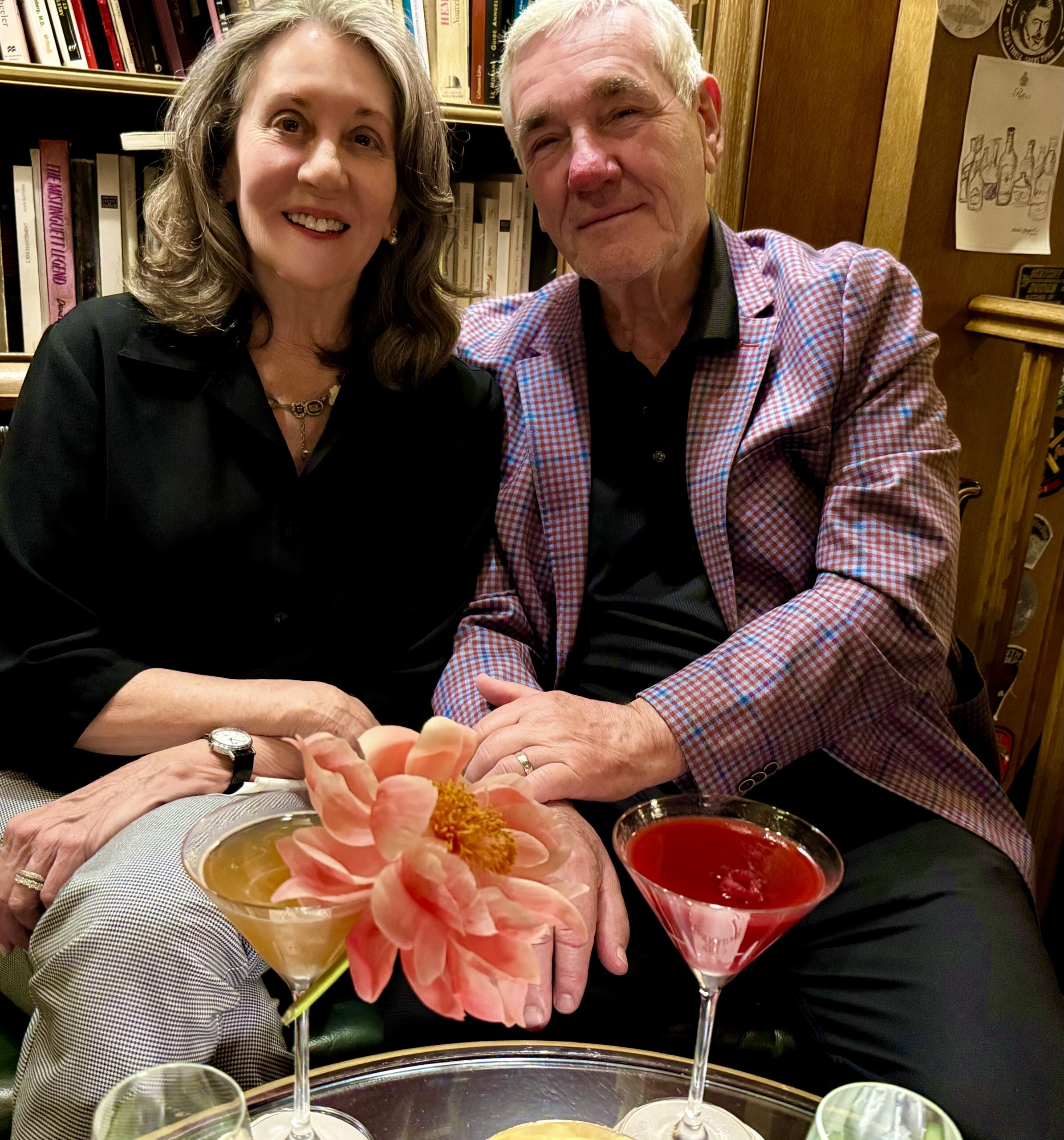
A few minutes later, we’re served the Lady’s Sidecar with a rose. (At Bar Hemingway, all cocktails for women are served with a flower — a tradition honoring the fact that in 1920, the Ritz was the first to welcome women in bars without a male escort.)
Michel’s Red Ruby is a vodka-based Dry Martini with fresh raspberry purée, a hint of Chambord and a dash of cherry liqueur. Both drinks are strikingly beautiful and the taste is equally impressive — some of the best cocktails we’re ever had —seriously!
Sipping our drinks, we reminisce about past trips to Paris over the years. Hemingway’s tiny bar seems to match our mood. We toast the Paris spirits and this bewitching city.
“There is never any ending to Paris and the memory of each person who has lived in it.” (Ernest Hemingway, A Moveable Feast)