Drink it in! 🍷Porto & the Douro Valley
by Marla Norman & Michel Thibault
photos by Marla Norman unless otherwise noted
Porto is in a total frenzy! The city’s beloved FC Porto Futebol is winning their match against rival Santa Clara and clenching the national title! The cafés are packed. Music is booming across the plazas and happy celebrants are dancing in the streets.
Michel and I have just arrived in Porto and had no clue the entire city would be a giant block party. But we’re ready to dive into the festivities. Matriarca – a wine bar & restaurant in the heart of the old town seems like the perfect place to start.
However, Beatriz, our Uber driver isn’t so convinced…. “Most of the streets in the old town are blocked off. Too many people!” She tells us, rolling her eyes for emphasis. “I can try. But you’ll probably have to walk a ways.”
We assure her walking is not a problem. Beatriz thinks the situation over, then sighing deeply ushers us into her car. She drives cautiously through the congested streets until we hit a roadblock. Police behind a barricade order us to turn around. Beatriz gets out of the car to converse with the cops. Amazingly, a few minutes later, they nod and move the barriers.
“What did you say?” we ask, astounded by her ability to work miracles.
Beatriz grins smugly: “I tell them you’re VIPs from FIFA,” she laughs and zooms ahead to deposit us at the door of our restaurant.
Inside Matriarca, we study the wine list — the restaurant is owned by the Symington family, who claim a number of Porto estates, most famously Grahams. Needless to say, the offerings are stellar. We start the meal with a 2021 Vértice Millésime Douro sparkling to toast Porto Futebol and, of course, the indomitable Beatriz.
Later, a table full of tapas — Potato Rösti, beef croquettes, sweet potato gnocchi and Portuguese charcuterie — are accompanied by a 2023 Curtimenta Vinho Verde and a 2022 Quinto Do Vesuvio. Naturally, the evening ends with a Graham’s 20-year Tawny.
Not a bad start to the trip!
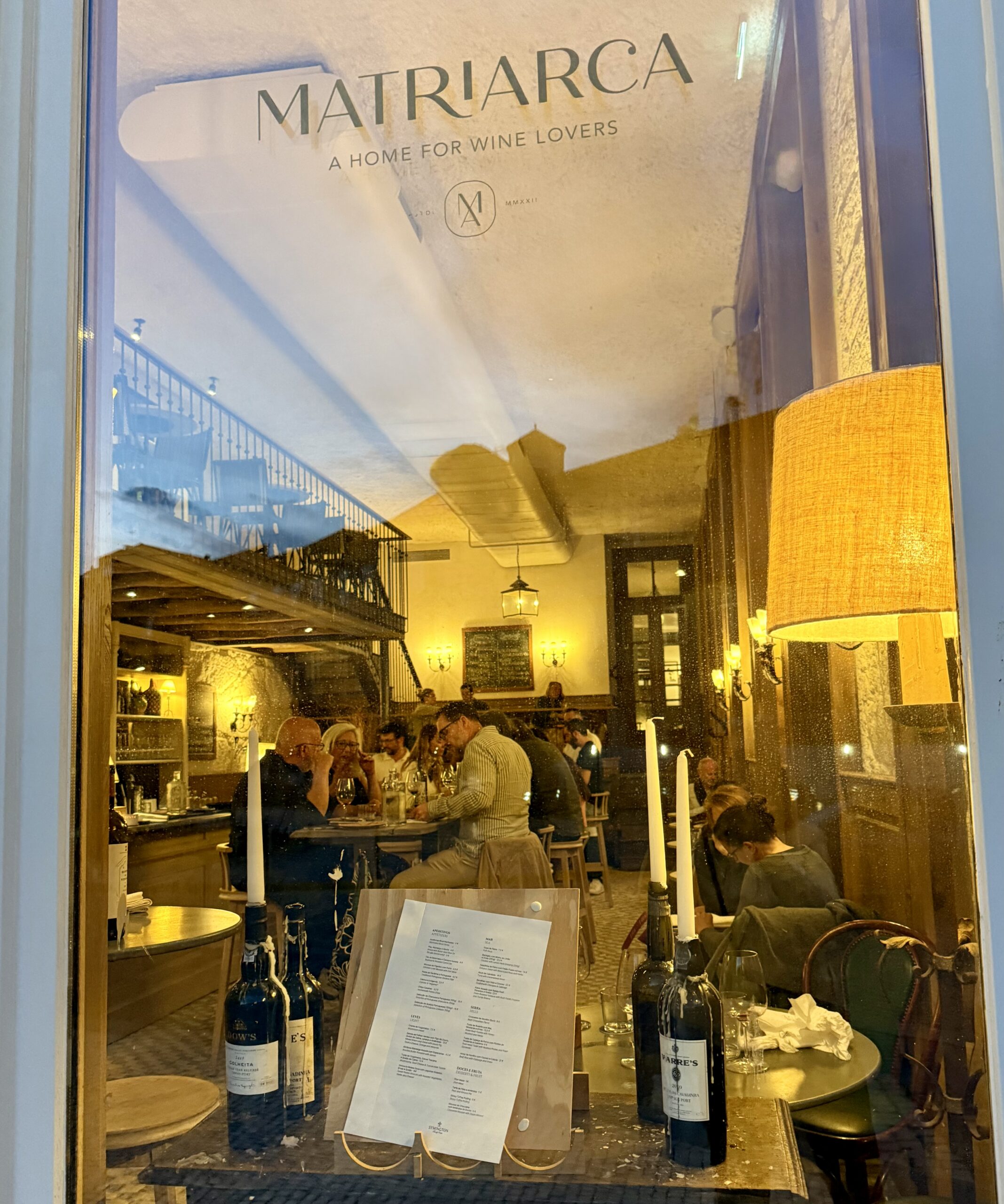
Matriarca – a wine bar & restaurant in the heart of Porto’s old town.

Off to a great start in Porto!
AZULEJOS & PORTUGUESE BLUES
On Sunday morning, at 8:00 a.m. the following day, Porto is as quiet and tranquil as it was rowdy and loud the night before. We take advantage of the calm to tour the city. Our guide, Diogo Alves picks us up in a tuk-tuk — the most popular and efficient method to get around narrow cobblestone streets and crowds of tourists. (NOTE: Contact Diogo directly: diogoalves131@gmail.com)
Our first stop is the Mosterio da Serra do Pilar. A UNESCO World Heritage Site dating back to 1538, the monastery sits high above the city of Porto and the Douro River. The views are unbelievable. We can actually see the river opening into the Atlantic. Remarkable!
From our vantage point, it also feels as if we’re suspended over the Douro and an enormous bridge spanning the river. “That’s the Ponte de Dom Luís I,” Diogo explains. “Can you guess who the architect was?” he asks Michel. “Since you’re French, you should know.”
Michel studies the iron bridge and guesses: “Gustave Eiffel.”
“That’s it! Diogo confirms. “The same guy who built the Eiffel Tower. Pedestrians use the upper level. Cars and buses use the lower level. Beautiful and functional, no?”
We take in the panoramic views for a bit longer and then jump back into the tuk-tuk. Up next is Estação Ferroviária de São Bento (Saint Benedict Train Station), significant for the 20,000 azulejo tiles covering the interior of the building.

Ponte de Dom Luís I, built by French architect Gustave Eiffel.

São Bento Train Station, with 20,000 azulejo tiles.
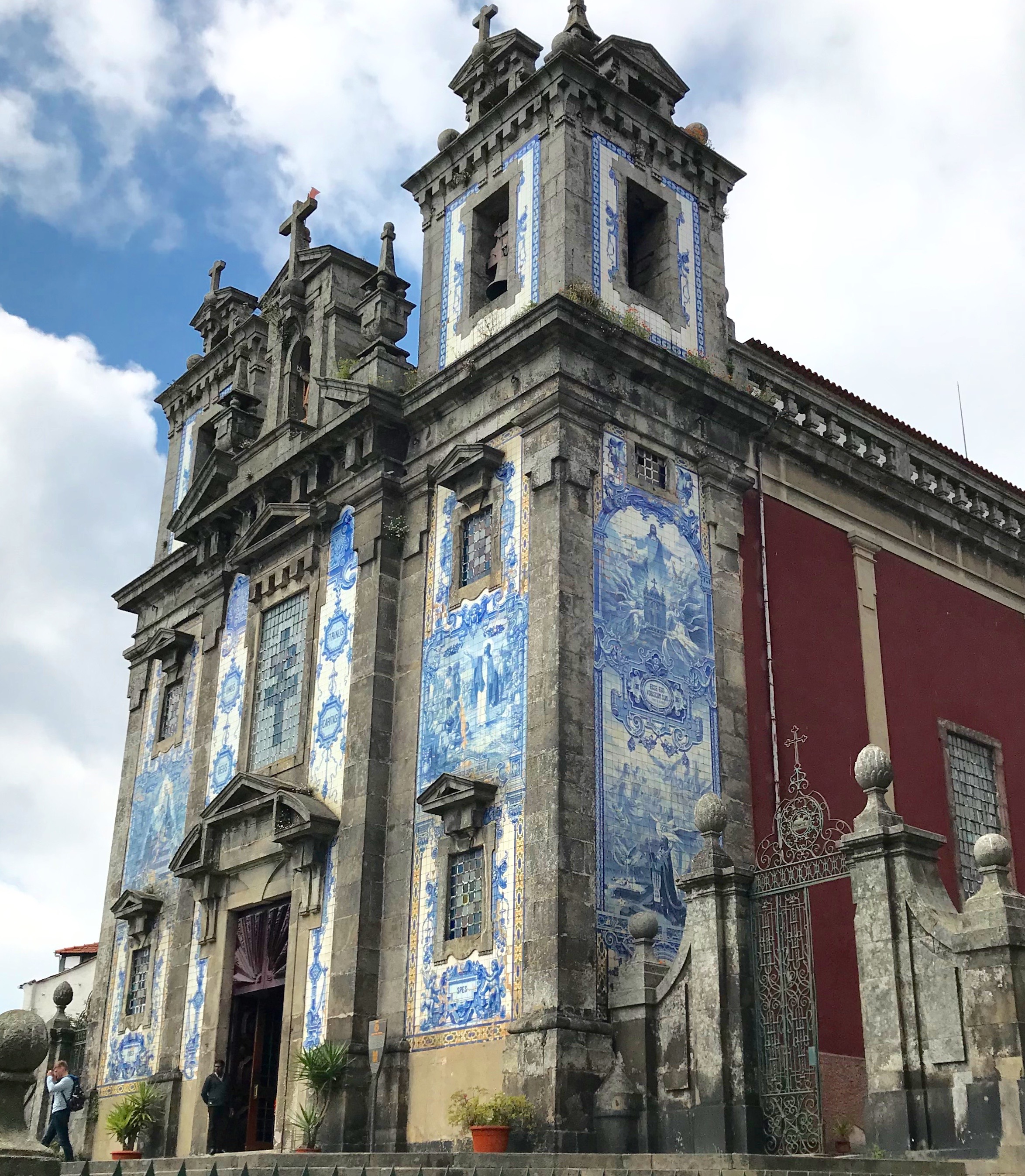
Igreja de Santo Ildefonso displays some 11,000 tiles depicting the Gospels.
Diogo provides a quick history of the “Azulejos” characteristic of Portuguese art and architecture: “When the Moors ruled Portugal, roughly 500 years, from 711 to 1147, they introduced the first decorative ceramic tiles with geometric designs. During the 16th century a technique known as Faiança became popular. This method allowed artisans to paint designs directly on the tiles. From there, murals became increasingly popular and Portuguese artists really adopted this art form — you’ll see the azulejos everywhere.”
Once inside São Bento, we’re captivated by the beauty and scale of the murals. Thousands of tiles painted by Jorge Colaço, one of Portugal’s most beloved artists, depict historical events, religious traditions, the Douro Valley vineyards and shipments of Port wine — always essential to Portuguese commerce. Especially spectacular is a mural of King João I and his English Queen Philippa of Lancaster as they enter Porto to celebrate their wedding. It’s easy to understand why the train station is also a UNESCO World Heritage destination.
Nearby, Igreja de Santo Ildefonso (Church of Saint Ildefonso) is another extraordinary example of Azulejo tile work and, again, Jorge Colaço’s artistry. The church exterior is covered with some 11,000 blue and white tiles depicting scenes from the Gospels and the life of Saint Ildefonso. The Baroque church dates back to 1739. Colaço completed the façade in 1932.
Mass is held daily at Santo Ildefonso and well attended by locals, as well as tourists looking to see the gilded altarpiece by 18th-century Italian artist Nicolau Nasoni.
We’re ready for a break after all the touring. Café Guarany is a choice spot to relax while still taking in Portuguese history. One of the oldest restaurants in Porto, Guarany has been open since 1930, when it was a meeting place for local writers, musicians and intellectuals. The restaurant has gorgeous tiled floors, marble-top tables and Afro-Brazilian murals. Efficient waiters in starchy white jackets make service seem effortless.
We order plates of Pata Negra Ham, Polvo Ceviche and Picanha à Guarany (Grilled beef served with white rice, fries, pineapple, black beans and cabbage). Guarany has long been famous for its excellent coffee and hot chocolate — hence the references to Brazil. In the evening, the restaurant hosts Fado Nights (original Portuguese music), debates and poetry readings. Unfortunately we can’t linger because we have a Port tasting at Vila Nova de Gaia.
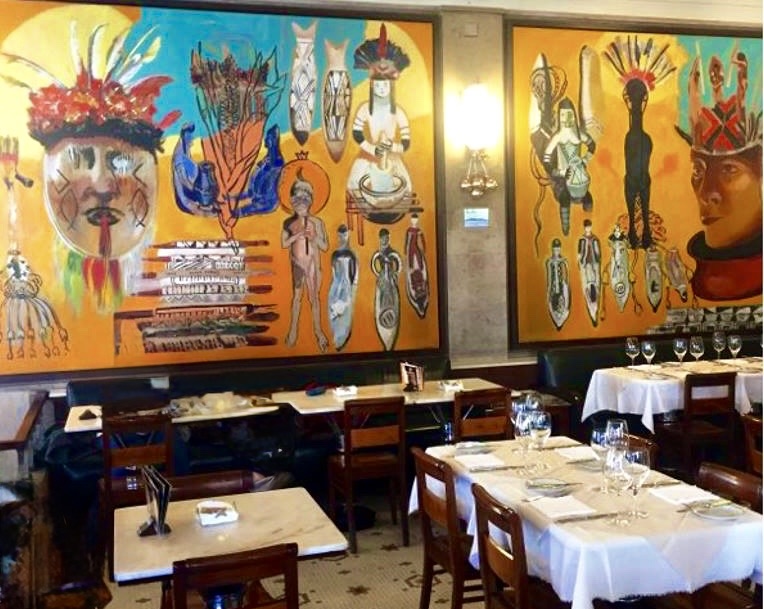
Afro-Brazilian murals at Guarany Café, one of Porto’s oldest restaurants. Photo courtesy of Guarany Café.
PORT: MAGICAL ELIXIR
Porto is, of course, most famous for the wine named after the region. The city’s main source of revenue is the vinification, storage and commercial shipping of port. The vineyards themselves are northeast of the city in the Douro Valley, the oldest wine appellation in the world. And obviously no visit to Porto would be complete without a stop at Vila Nova de Gaia, where most of the port producers have offices and tasting rooms. Graham’s, Sandeman’s, Taylor’s, Niepoort and Ramos — to name just a few — are all there.
But before we proceed…… Dear Readers, I (Michel Thibault) have a humbling confession to make. Believe it or not, until our trip to Portugal, my knowledge of port was somewhat limited. Yes, I knew that port is a fortified wine with neutral alcohol added to stop the fermentation, therefore bringing alcohol levels to approximately 20% while preserving sugar. I also knew that all grape varietals used to make port are indigenous to Portugal — Touriga Nacional, Tinto Cao, Tinto Roriz, Touriga Sousa and Touriga Franca.
What I did not know is that there are 4 kinds of port:
White Port – made from white grapes raised in steel tanks and usually served as an apéritif. A sweeter white port called Lagrima (Tears) is also available.
Rosé Port – Some estates like Sandeman’s produce a Rosé made from red grapes but essentially this too is served as an apéritif.
Ruby & Vintage Port – typically made from a blend of Touriga Nacional, Touriga Franca, and Tinta Roriz that is barreled for two years in Balserios – gargantuan neutral wood vats holding thousands of liters. From there, the wine is transferred to a bottle where it will become either Ruby or Vintage Port. This distinction is decided by a panel of professional judges.
Tawny Port – is also aged in tBalserios for two years, then transferred to smaller wooden casks. Here, the wine slowly oxidizes and, because of contact with the wood, changes to a deep orange copper as the texture thickens and aromas are enriched with vanilla, caramel and nutty tones. Tawnies are sweeter with up to 150 grams of sugar versus 80 to 100 for standard Rubies.
Both Tawnies and Rubies can last almost forever. However, once a Ruby or Vintage Port is opened, it will last only 24-48 hours. Tawnies on the other hand, can last for weeks, even months after being opened. With all that in mind, we can proceed to our first tasting at Sandeman’s, where amid the vast, labyrinthine cellars seven million bottles are stored! There are even a few bottles from the 1880s (Not for sale, unfortunately…just in case you were interested.)

The mysterious Don Sandeman, logo for all Sandeman ports.

Port is ageless…as these bottles in the Sandeman cellars prove.
Our next visit is at Graham’s, where we purchase the “Super Premium Experience.” During this private tour, we visit parts of the cellar where extremely old ports are stored. There, wines from great vintages such as 1935, 1963, 1977 and 1994 are on display, along with a port named Ne Oublie, from 1882 when the Symingtons barreled their first harvest from the Douro — a wine of incredible maturity and complexity! We were fortunate to taste it years ago when we actually had a few to sell. (And evidently there are still a few available. If interested, send me a note.)
At this tasting, we are offered three selections of Vintage Port including 1994, 2000 and 2016. The 1994 was simply stunning with a soft cherry feel wrapped up in black licorice. We also sample three Tawnies: a single harvest 1997, with aromas of crushed almonds and two aged Tawnies, one sporting 30-years and the other 40-years. As a special treat, we are also sampled on a 1994 Quinta do Vesuvio. Beautiful amber color, fruity aromas of dried raisins, toasted toffee and chocolate. This wine has it all. What a day at Graham’s followed by lunch at their superb Vinum Restaurant.
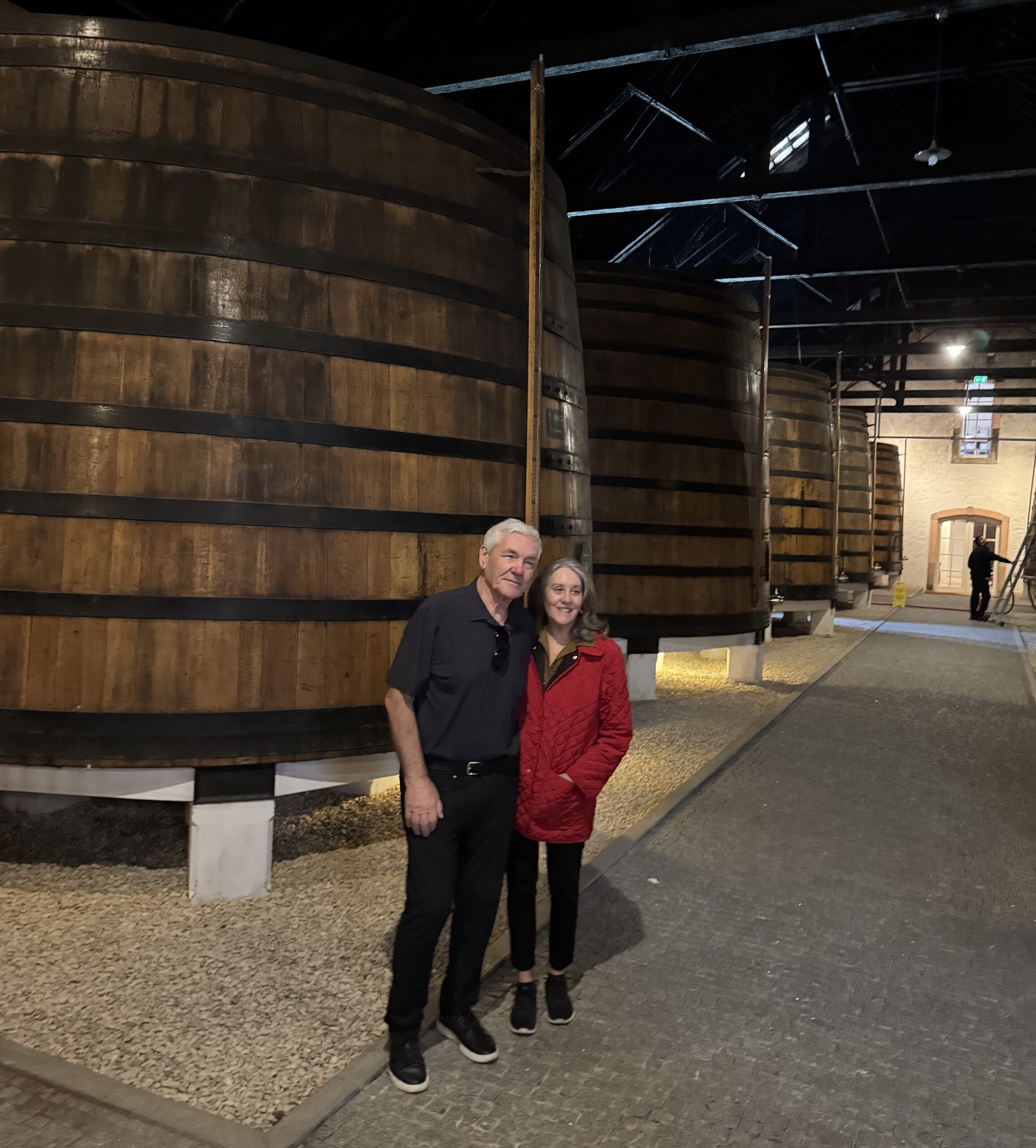
The enormous barrels at Graham’s are also very old, often over 75 to 100 years.
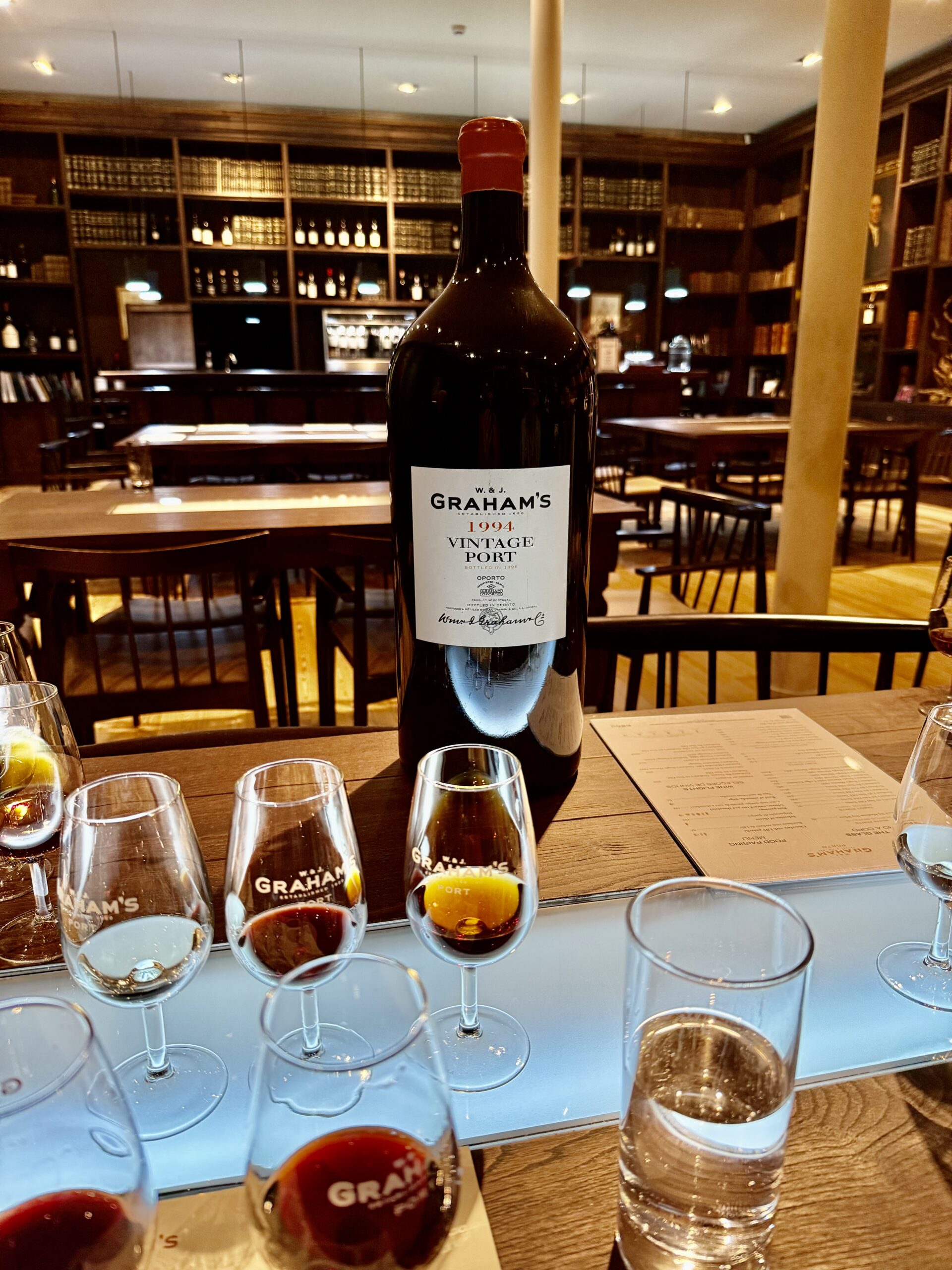
Vintage ports at Graham’s elegant tasting room.

Vinum Restaurant at Graham’s in Vila Nova de Gaia.
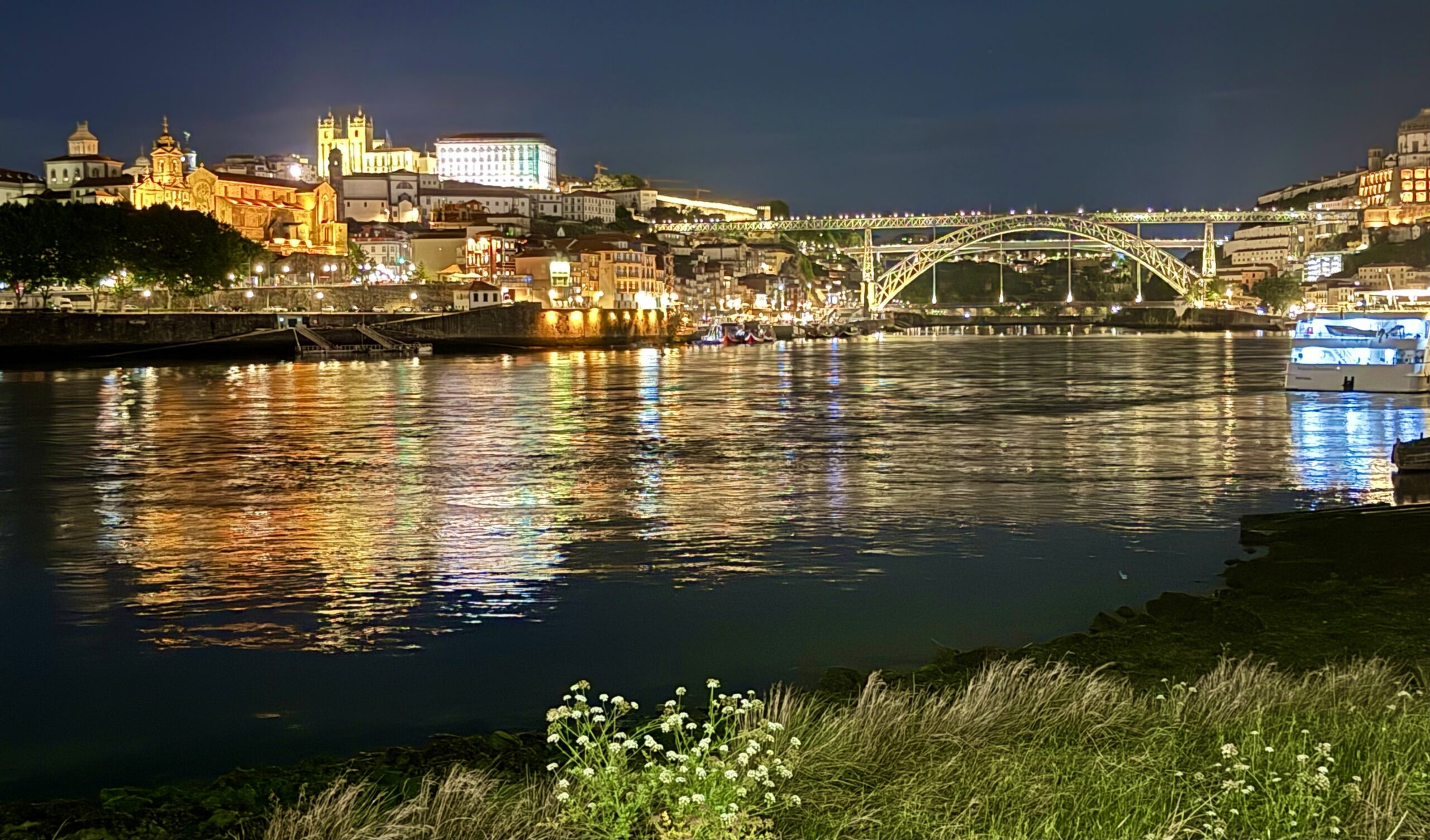
Evening views of Porto from Vila Nova de Gaia.
PALÁCIO DE MATEUS
Driving from Porto to the Douro Valley, we take a slight detour to visit Palácio de Mateus — the same Mateus that produces the slightly sparkling Rosé wine. Clearly sales have been solid over the past almost 300 years, because the family home is remarkable. Built in 1744 by António José Botelho Mourão, 3rd Morgado de Mateus, the palace is a masterpiece of Baroque architecture, ornate cornices, dramatic façades, and multiple decorative rooftop pinnacles.
We explore the formal gardens, consisting of 20-hectares (50-acres) surrounding the estate, before visiting the palace itself. An hour-long tour includes salons, the library with over 6,000 volumes and a religious museum displaying articles from the palace chapel: religious paintings, liturgical vestments embroidered in gold, multiple gold chalices and intricately detailed nativity scenes as well as “Calvário” scenes from the Passion of Christ.
A boutique offers a variety of red and white wines produced with grapes from the Douro, proving the estate offers much more than the commercially successful Mateus Rosé.

A Baroque masterpiece, Palácio de Mateus, built in 1744, sits on 20-hectares (50-acres).

First launched in 1942, Mateus Rosé remains popular throughout the world.

The Douro Valley is the oldest wine growing region in the world and a UNESCO World Heritage Site.
DOURO – WHERE THE STORY REALLY BEGINS
It’s impossible to overstate the remarkable visual impact of the Douro Valley, with its steep, vertical, twisting valleys and row after row of meticulously maintained terraces — many at least 2,000-years old. Not only is the Douro the oldest appellation in the world, it is also the world’s largest area of mountain vineyard, with approximately 45,000 hectares (111,000 acres). Something you have to see to believe!
I literally cannot stop taking pictures as each new curve in the road seems to offer a more spectacular view and vineyard terraces tower higher and higher over us with every turn. Michel, typically eager to cruise at high speed, is driving below the limit, mesmerized by the scenery as well.
We reach Pinhão, the main village in the Douro and find our hotel — Vintage House, an 18th century property that once served as a port warehouse. Rooms are comfortable and spacious, with balconies overlooking the Douro River and endless vineyard views. After settling in, we have dinner out on a leafy terrace watching the sunset while boats ply up and down the Douro.
Quinta do Noval
We thought we’d seen some of the most head-spinning scenery in the Douro Valley…then we drove to Quinta do Noval. At around 1600-feet, the vineyard’s highest blocks are well above many of the other properties in the region.
Emanuel Correia, the estate Hospitality Manager, greets us at the front door and points out the various plots in the vineyard, explaining that Noval benefits from both a perfect location vis-à-vis sun exposure and a climate enhanced by breezes coming from the Pinhão River, a tributary of the Douro.
We’re especially interested in the famous Nacional Vineyard. Emanuel shows us where it sits, in the heart of the estate. “Here, after phylloxera destroyed vines across the region, this plot was replanted with more of the original ungrafted vines, again 100% Portuguese, used for the Quinta do Noval Nacional Vintage Port.”

Quinta do Noval sits high atop the Douro Valley above the Pinhão River. Photo courtesy of Quinta do Noval.
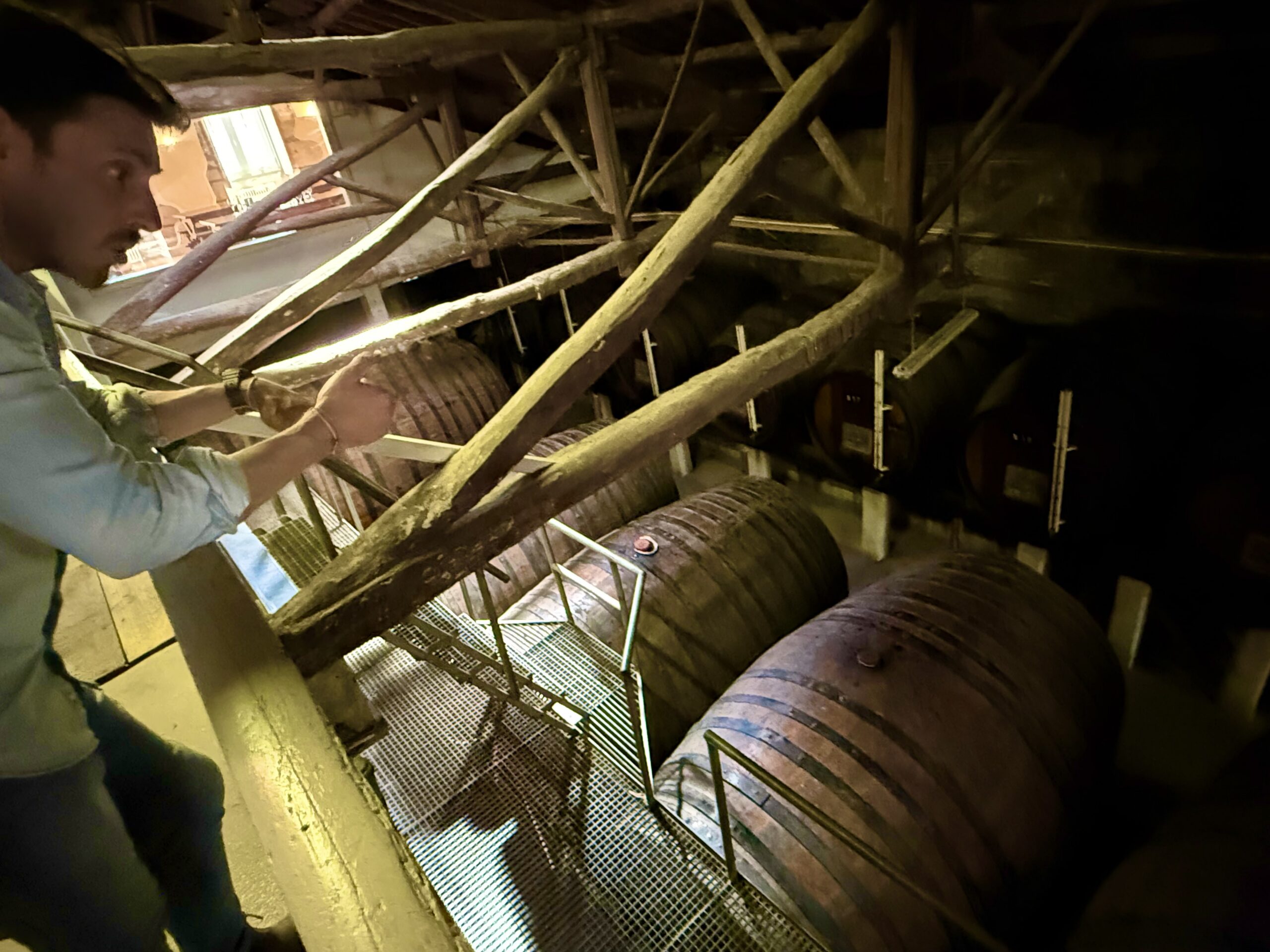
Emanuel Correia in the Quinta do Noval cellar.
Moving on to the crushing room, Emanuel explains that “Quinta do Noval continues to use traditional foot treading for Its wine production. The rationale is that human feet are more gentle, therefore the color and flavor from skins is released without cracking the bitter seeds. Another advantage is that the rhythmic marching acts as a natural ‘punch-down,’ keeping skins submerged to maximize color and for softer tannins.”
A highlight, of course, is viewing the massive cellars. Unlike most port producers who age and store their wines down river in Vila Nova de Gaia, Quinta do Noval maintains their cellars on site, where 640 to 2,500-liter oak and chestnut casks mature the wines.
Michel’s Tasting Notes 🍷
2023 Cedro do Noval – The wine exhibits a powerful minerality and offers crisp, citrusy notes. Made from a combo of Viosinho, Gouveio and Rabigoto grapes, the wine is partially fermented in French oak.
2023 Noval Reserva – Made from a blend of Viosinho and Gouveio, this wine is fuller, fruitier and shows more balance and freshness. Given 94-pts by Suckling
2022 Quinto da Noval Touriga Nacional – One of the most acclaimed varietals in the Douro. An intense wine with huge aromas of dark fruit and quite a few spicy notes: black pepper, cumin and thyme. This is a serious wine with a very long exquisite finish — oozing vanilla and licorice.
2022 Nacional Reserva — Even deeper than the previous 2022. Rich in alcohol (14%) this is dark chocolate and cherries, with very fine tannins. A wine to hold for sure, but likely to give much pleasure when ready. It is produced from Nacional, Francesa and field-blending grapes
2016 Noval Port – Aged in barrel for 18-months, with cassis, violet and blackberries. More than its pleasant concentration, I appreciate its stylish elegance.
20 year old Noval Tawny – A completely different animal! This amber colored port shows dried fruit, walnuts, almonds and figs with overtones of caramel. Made from a mix of Nacional, Francesa, Tinta Roriz, Cao and Sausao grapes.
Port Terminology: Twenty-Year Old Tawnies are made from older ports that average 20-years of age; it is not a single vintage. A Colheita, on the other hand, is a single-vintage Tawny, aged at a minimum of 7 years before bottling
Quinta do Noval is part of AXA Millésimes, whose portfolio includes renowned estates such as Château Suduiraut, Château Pichon Baron, Château Pibran in Bordeaux, as well as Domaine de l’Arlot in Burgundy and Disznókö in Hungary, Outpost and Platt Vineyards in Napa. Quite an Empire!
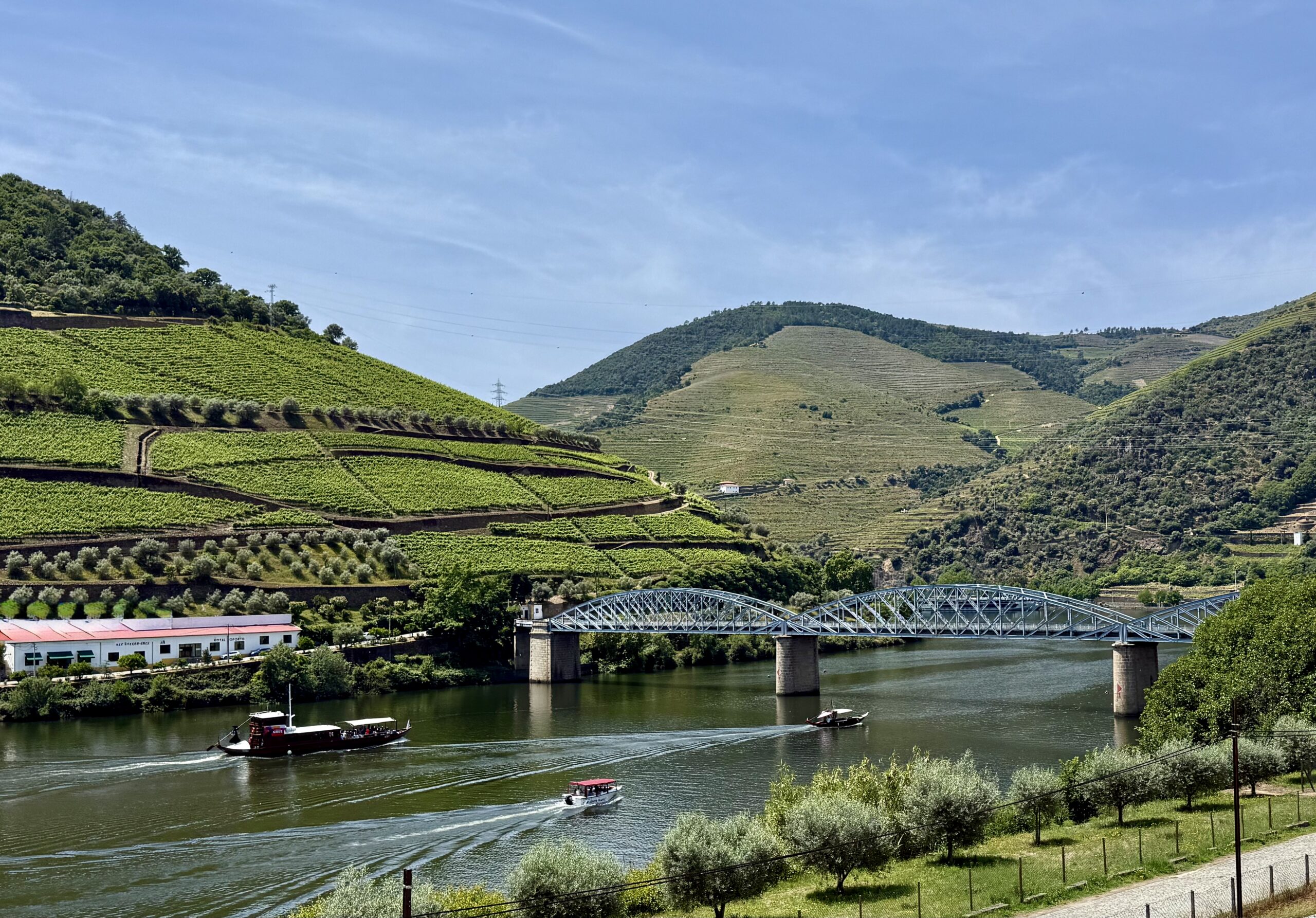
Quinta do Bomfim sits on the banks of the Douro River, where views include the Ponte do Pinhão – another bridge constructed by Gustave Eiffel.

Tasting at Quinto do Bomfin featuring vintage ports and 30-year old Tawnies.
Quinta do Bomfim
Our next tasting, at Quinto do Bomfim, is just a block from our hotel, right on the Douro River. The Symington Family who own four of the leading port houses: Graham’s, Dow’s, Warre’s, and Cockburn’s also own Quinta do Bomfim as well as another 25 quintas.
The vineyards here are around 100-years old and the winery itself dates back to 1896 — almost youthful relative to other Douro Valley estates. Interestingly, Quinta do Bomfim is as modern and high tech as Quinta do Noval is traditional. The winery uses a pendulum-swing destemmer to select berries which are then crushed in vats using automated paddles and plungers to immerse and extract the grapes. The thought process here is that machines are more uniform and consistent than human crushers.
Aging is also on premise, similar to Quinta do Noval. The property produces Dow’s Classic Vintage Port and Dow’s Quinta do Bomfim Single Quinta Vintage Port.
Michel’s Tasting Notes 🍷
Altano Branco – Pleasant, zesty and citrusy, the vines for this wine come from a higher altitude with low temps, giving crisp acidity to the Malvasia Fina, Vioshino and Rabigato. I’d qualify this one as a perfect apéritif.
Pequeno Dilema – More serious wine in this blend of Vioshino, Arinto, Codega do Larinho, Rabigato and Alvarinho. The wine undergoes ten months of barrique aging and spends time on lees as well. The end result is aromas of quince, white flowers and pear. Very pleasant.
Quinta do Ataide, Vinha do Arco – Made from 100% Touriga Nacional grapes, organically grown with an average age of 45 years. The wine has excellent concentration, structure and elegance.
Quinta do Vesuvio – Elegance personified! A blend of primarily Touriga Nacional and Franca, this sensational wine sees a minimum of 15 months in French oak and delivers a complex mouthful with rich dark fruit. Aromatics are beautiful and Vesuvio seems like it would have huge aging potential. Vineyards are in the Douro Superior, 20 miles from Spain on beds of schist. Production there started in 1823.
Dows LBV (Late Bottled Vintage) – The wine comes from a single vintage, is aged in wood for 4-6 years, then bottled. It is filtered so no reason to decant. Made from the same grapes and same plot as the Dow’s 2011 which won Wine Spectator “Wine of the Year” in 2014!
Dow Vintage 1994 – A masterpiece! Focused, pure, loaded with black currants, licorice and Dow’s signature black pepper tannins. Thirty minutes after the initial tasting, the wine’s freshness is still evident! (Marla’s favorite)
Dows Tawny 30-years – The long aging this wine goes through adds layers of complexity. Rich, silky, not too sweet, the wine unloads aromas of quince, pears and citrus. A treat very reminiscent of some of the finest older Yquems. (My favorite. I can’t resist the Tawnies!)
RESTAURANT BOMFIM 1896
We cap off our day with dinner at the Quinta do Noval restaurant, Bomfim 1896. Michelin-starred Chef Pedro Lemos oversees the menu, inspired by traditional Douro fare — many dishes are prepared over a wood fire to reflect the stoves typical in Douro kitchens. The restaurant name is inspired by the founding date of Dow’s Port and the wine list, of course, features numerous Symington Family wines.

Restaurant Bomfin 1896, featuring numerous Symington Family wines.

Michelin-starred Chef Pedro Lemos oversees restaurant Bomfin 1896, a homage to Dow’s Port. Photo courtesy of Pedro Lemos.
CRUISING THE DOURO
On our last evening in Pinhão, we cruise down the Douro River at sunset, courtesy of Ferrão Boats — the perfect finale. Our hosts, Captain Marco and First Mate Mateo provide a grand evening. Both grew up on the Douro and know the region intimately. Mateo, the wine expert, also owns a vineyard and shares an insightful tasting along the way.
Floating into the twilight, we reminisce about the past days, grateful to have discovered this extraordinary country, its ancient history, exquisite wines and most especially, our new Portuguese friends who made it all an unforgettable experience.