

Portland: The Maine Event
Text & photos by Marla Norman
Driving from Boston into Maine, we stop, open all the car windows and inhale the scent of dense pine forests and salty coastal waters — exhilarating and soothing all in the same breath. Pastures filled with wildflowers and trim cottages make for picture-perfect landscapes, the same scenery that inspired artists Winslow Homer, Andrew Wyeth and H. W. Longfellow.
Michel and I are feeling pretty creative and poetic ourselves. But mostly, as we approach Kennebunkport, we’re thinking about LOBSTER!!! Spotting the sign for Mabel’s Lobster Claw, we pull over immediately. One of the original Maine Lobster Shacks, Mabel’s has been serving seafood and freshly-baked pies since the 1950s. Inside, the bustling little cafe is homey and casual; old photographs line the walls.
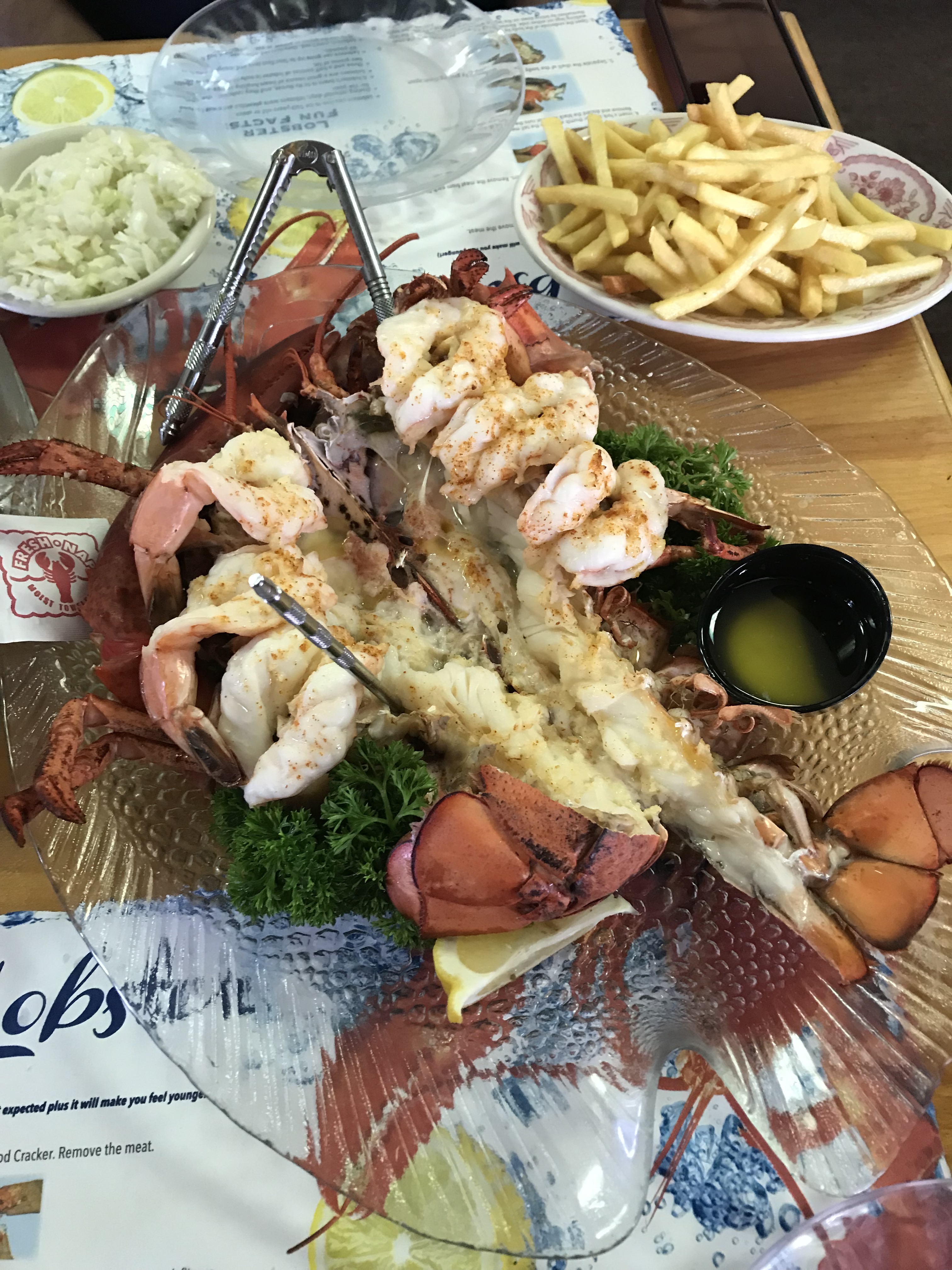
Mabel’s Special: Whole lobster with prawns, fries & coleslaw.
We order crab cakes, a whole lobster with prawns, fries, coleslaw — and dive in! The crab cakes are meaty and perfectly seasoned. The lobster is succulent and sweetly briny. My eyes are rolling back in my head. It’s impossible to imagine a better start to the trip.
Later, when our waitress asks if we’d like dessert, we hesitate for two seconds, (Ok! Maybe ½ of 1 second) then succumb to the pies, both Blueberry and Raspberry. After all, we’re on vacation….
FOREST CITY
Known as “The Forest City,” Portland lives up to it’s monicker. Enormous groves of trees surround the city and numerous parks dot the boulevards. The city itself is relatively small, with a population under 75,000. But as we drive in, traffic is heavy and throngs of visitors are lined up along the East End restaurants, shops and hotels. Tourism is big here and the region’s excellent seafood is a major part of the draw.
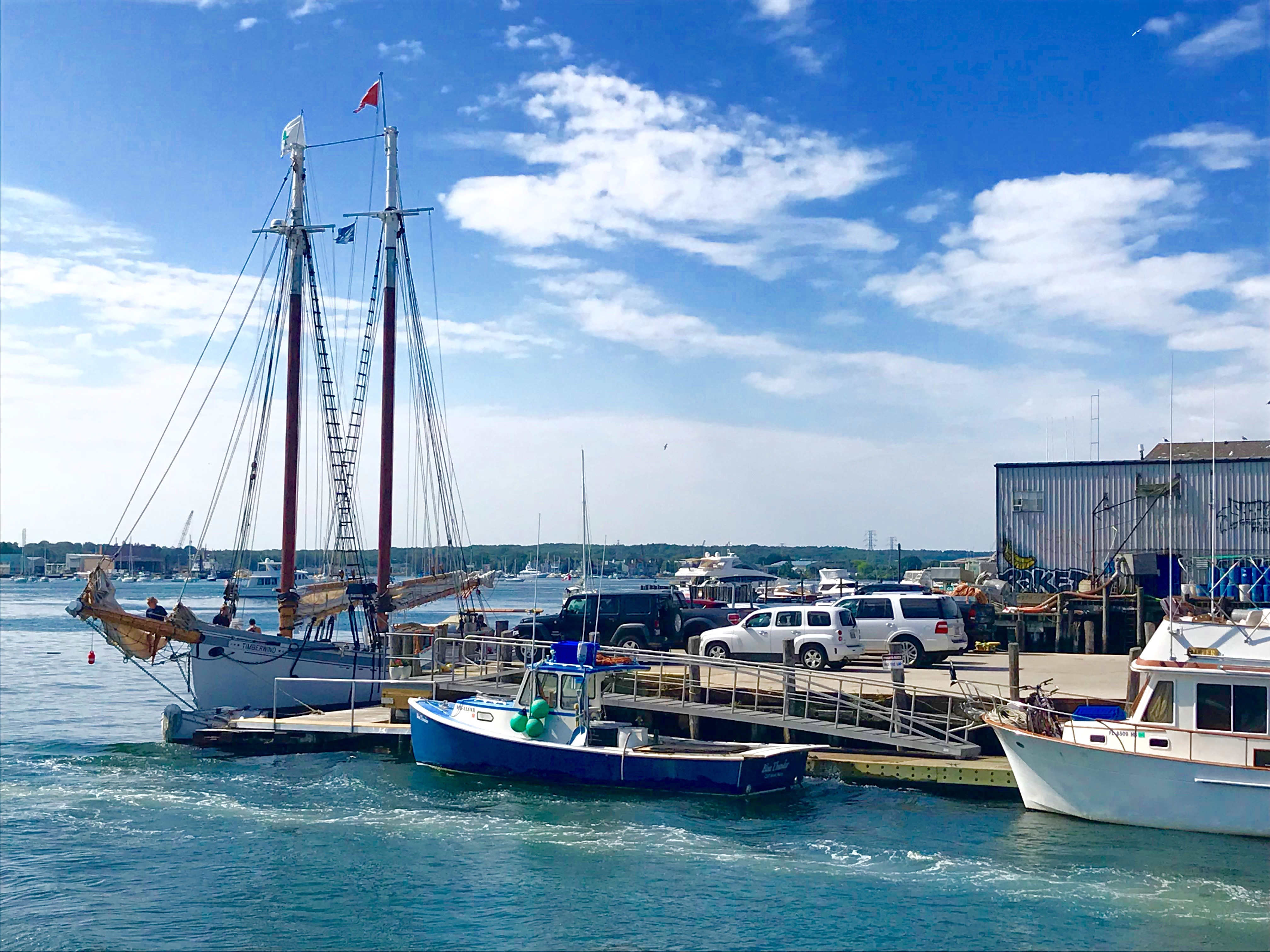
Ships, ferries and water taxis line up to transport tourists along the New England coast.
A STORIED PAST
Portland’s first permanent settlement began in 1632, when it was incorporated as part of the Massachusetts Bay Colony. Much of this original development was destroyed however, by the French and their Native American allies in 1676. Residents rebuilt and the town survived until 1775, when the British Navy burnt the city to the ground, a prelude to the eventual American Revolution.
Undaunted, these tough-minded New Englanders rebuilt once again. Today, the oldest surviving home in Portland dates back to 1785. The property originally belonged to General Peleg Wadsworth, a distinguished officer during the American Revolutionary War. Wadsworth was also a Congressman and close friend of George Washington. Now he’s primarily remembered as the grandfather of the poet Henry Wadsworth Longfellow.
General Wadsworth left his daughter Zilpah the family home. There, she and her husband, Stephen Longfellow, raised eight children, including their son Henry. The Longfellow House & Gardens is now a National Historic Landmark, open to the public. Many of the family’s original furnishings as well as Longfellow’s piano, writing desk and “gentleman’s traveling lap desk” are still on view.
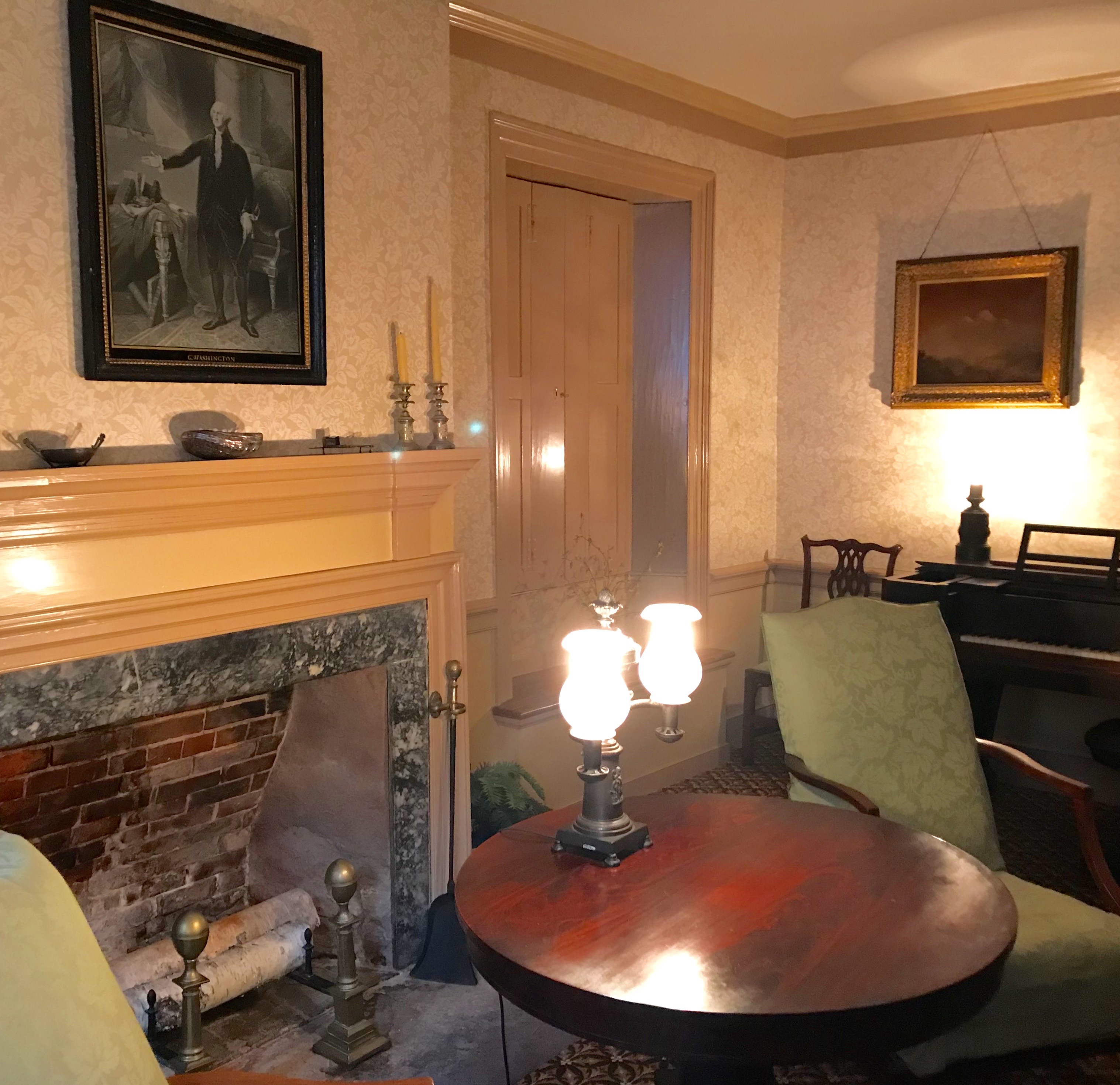
Living room of Wadsworth-Longfellow House, with portrait of George Washington and the great poet’s piano.
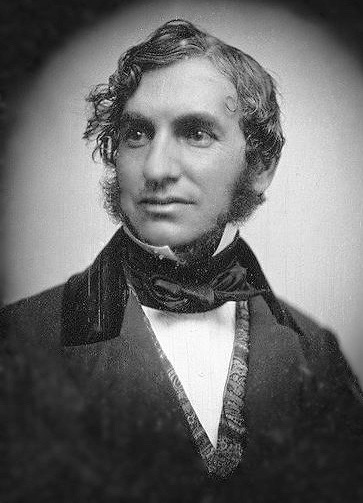
Henry Wadsworth Longfellow at age 43 in 1850. Photo courtesy of the Maine Historical Society.
It’s raining the day we visit. The dim light and flickering shadows make it easy to imagine the young writer, composing his famous verse by a fire…..
A hurry of hoofs in a village-street,
A shape in the moonlight, a bulk in the dark,
And beneath from the pebbles, in passing, a spark
Struck out by a steed that flies fearless and fleet:
That was all! And yet, through the gloom and the light,
The fate of a nation was riding that night;
And the spark struck out by that steed, in his flight,
Kindled the land into flame with its heat.
(Paul Revere’s Ride)
In 1836, Longfellow accepted a position at Harvard to teach modern languages and soon after began publishing his poetry, eventually becoming one of the most recognized writers of his day in both the US and Europe.
From the Longfellow House, we leave the 1700s and move into the 19th century — when vastly improved transportation made Portland a wealthy economic hub as well as a popular summer destination. Train lines, including the Grand Trunk Railroad, used Portland as a central station, while steamboats, operating along the Atlantic coast, utilized the city ports.
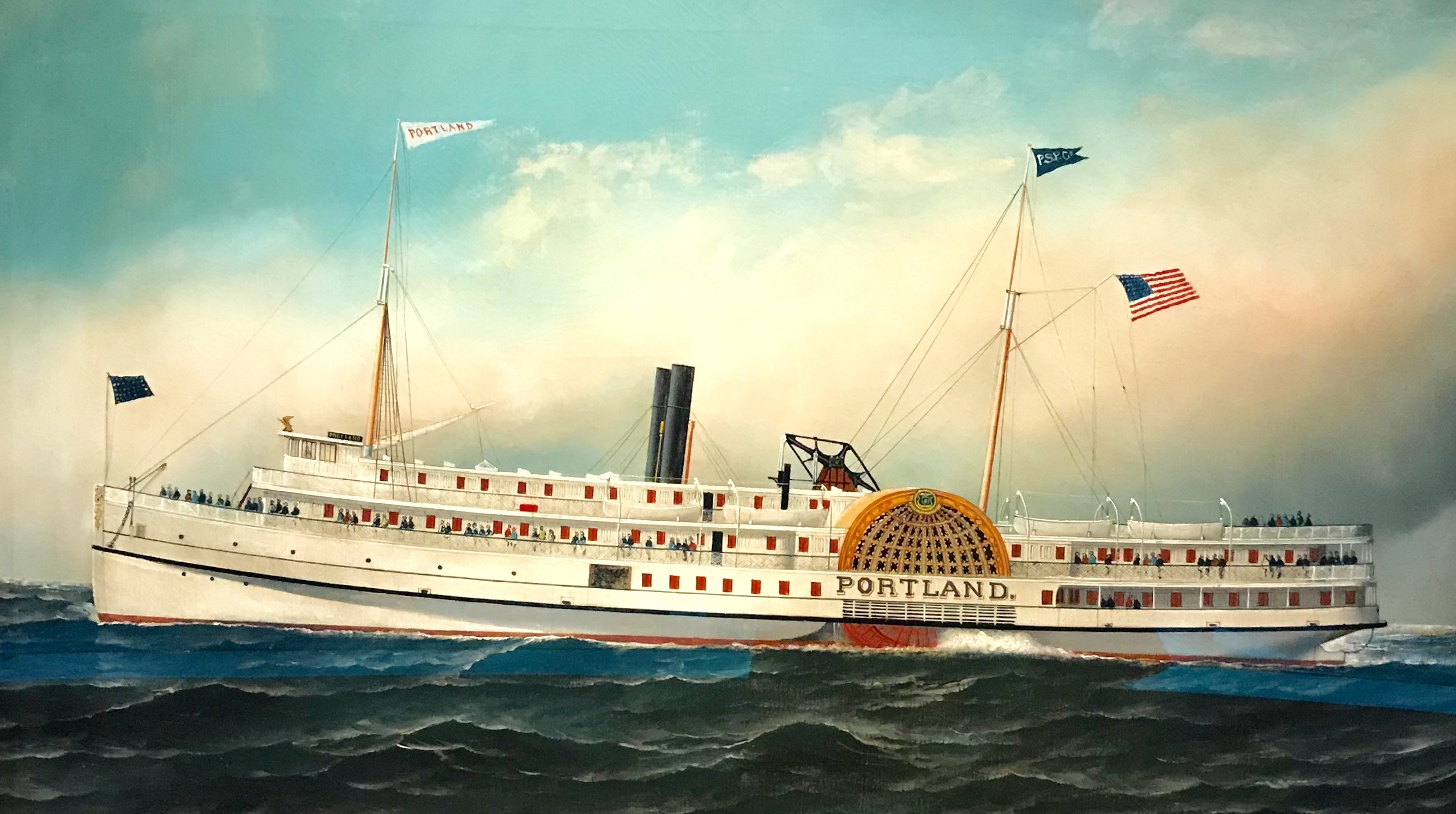
The Portland – This painting by Antonio Jacobsen depicts the largest, fastest and most luxurious steamboat of the day, built in Maine in 1889. Photo by Marla Norman taken at the Portland Museum of Art.
Successful entrepreneurs built second homes in Portland to take advantage of cooler seasonal temperatures. One of the most impressive of these summer homes is the Ruggles Morse Mansion or Victoria Mansion as it’s now known. Built between 1858 and 1860, this lavish home boasts ornate marble mantelpieces, a freestanding mahogany staircase and numerous stained glass windows, including a magnificent 6-foot by 25-foot stained-glass skylight. Many of the walls are covered in elaborate frescoes featuring trompe l’oeil. A Turkish smoking room is particularly jaw-dropping.
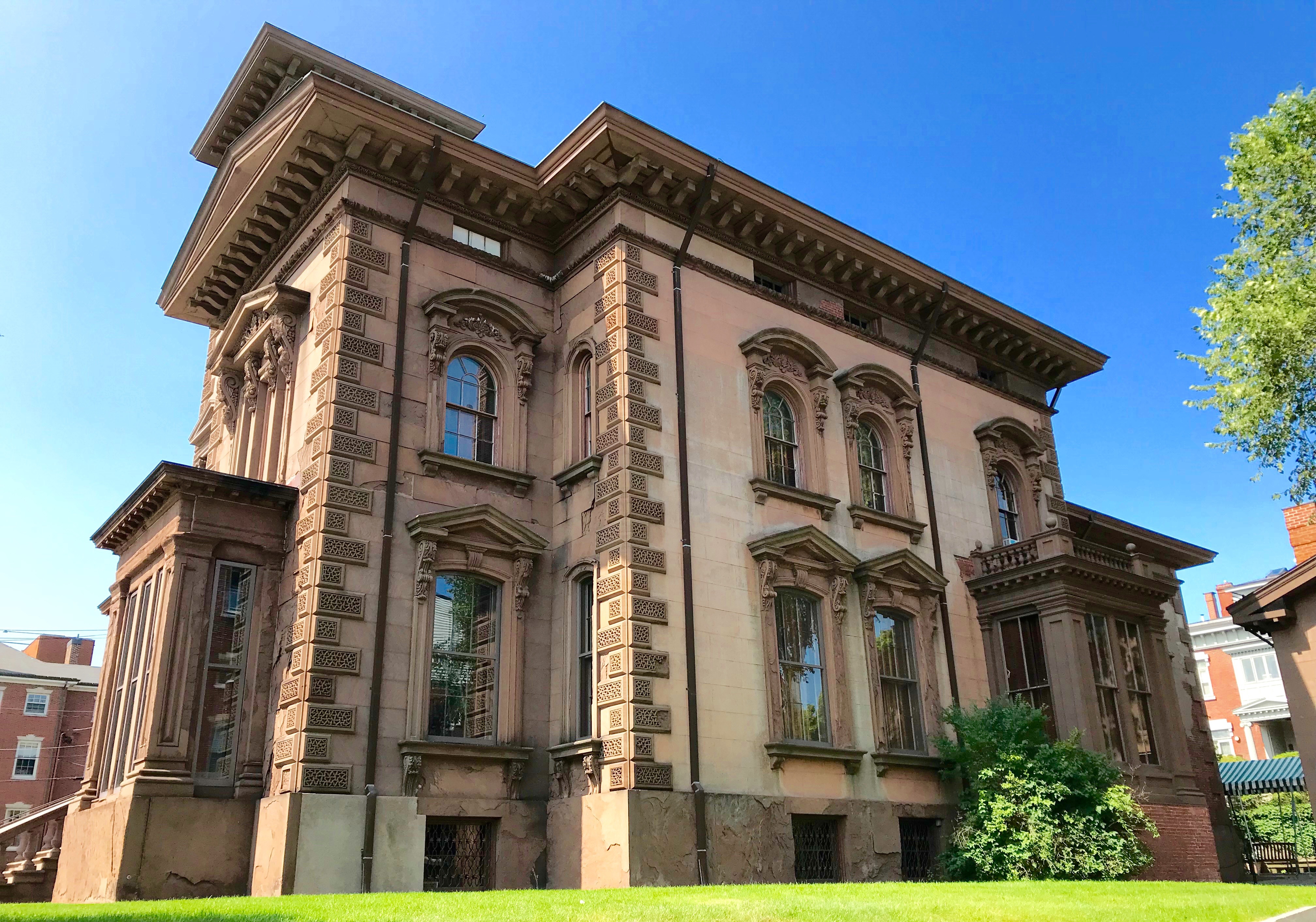
Victoria Mansion, built between 1858-1860 by hotel magnate, Ruggles Morse.
Both Morse and his wife Olive were from Maine originally, but moved to New Orleans where Morse managed luxury hotels. Their Portland home was designed by architect Henry Austin, a master of the Italianate style. Considered one of the most advanced structures of the day, the house had gas lights, hot and cold running water, flush toilets and central heat.
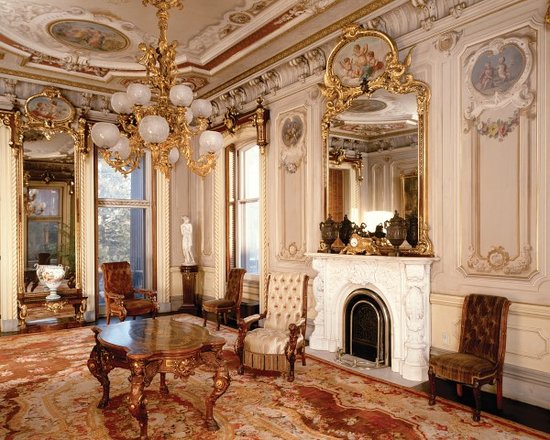
The formal parlor – Walls and ceilings were painted by Giuseppe Guidicini. Photos by J. David Bohl courtesy of the Victoria Mansion.
Incredibly, the house sat abandoned, with many of the furnishings left behind for over 11 years. In 1941, the property was saved from demolition and opened as a museum. Since 1970, the Morse house has been listed on the National Register of Historic Places.
After wandering the palatial rooms and exploring Portland’s past, we’re ready to rejoin the 21st century — and examine a few of the city’s culinary treasures.
BEST U.S. RESTAURANT CITY
Shortly after arriving, we learn that Bon Appétit magazine selected Portland as the Restaurant City of the Year. Eager to explore this topic, we begin our own research. The results are listed below:
CENTRAL PROVISIONS
414 Fore Street
A recent James Beard finalist for “Best New Restaurant in the Nation,” Central Provisions cooks up an impressive variety of small plates that changes (thoroughly) every day. The prices are also impressive at first glance, but don’t hyperventilate. Just order quickly and be amazed at the quality and ingenuity.
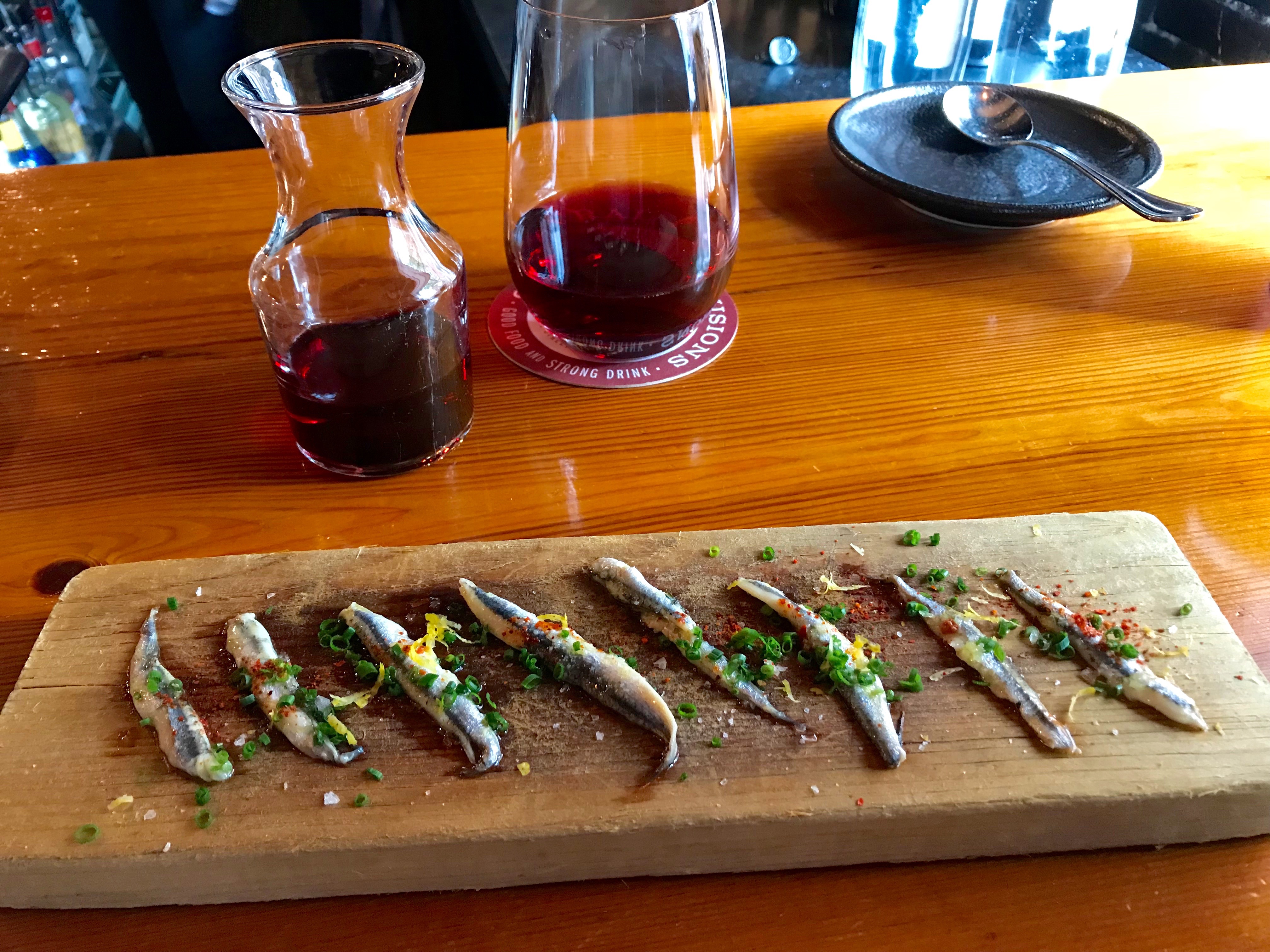
Boquerones at Central Provisions.
The menu offers a number of meat choices, but we stick with seafood and sample fresh Boquerones (tasty little sardines) and Lobster Fritters with lots of crunch and lobster. An Oyster Stew with corn, peppers & carrots in a thick, creamy broth was savory and luscious. Our favorite dish was the Bread & Butter. I know, sounds crazy! But the Central Provisions version includes whipped local butter with sabayon — so good, it alone could justify the rest of the menu.
EVENTIDE OYSTER CO.
86 Middle Street
Like so many of the East End restaurants, Eventide is jammed with diners. And the hostess, a bit overwhelmed, is a little brusque. But we find a place to stand and staff members quickly arrive to take our drink and appetizer orders. A brief wait later, we’re munching on Tuna Crudo, so fresh, it just pops and then melts in your mouth. House-made Potato Chips are nicely warm and slightly peppery.
Waiting is also made tolerable — actually downright pleasurable — with an Eventide specialty known as Walking Dead — rum, pineapple, orange and tiki seasoning. This concoction arrives in cute, innocent looking parrott mugs and goes down s0 smoothly, you have no idea how powerful they are. The fact that diners are only allowed two drinks should be a hint!
After we’re seated, we devour a remarkable selection of Maine Oysters: John’s River, Otter Cove & Browne Point. A plate of Caso Bay Mackerel is served with black trumpet mushrooms & beets. The Chowder of the Day also includes the exquisite and almost-never-seen black trumpets — we’re in heaven! On our way out, we even hug the hostess.
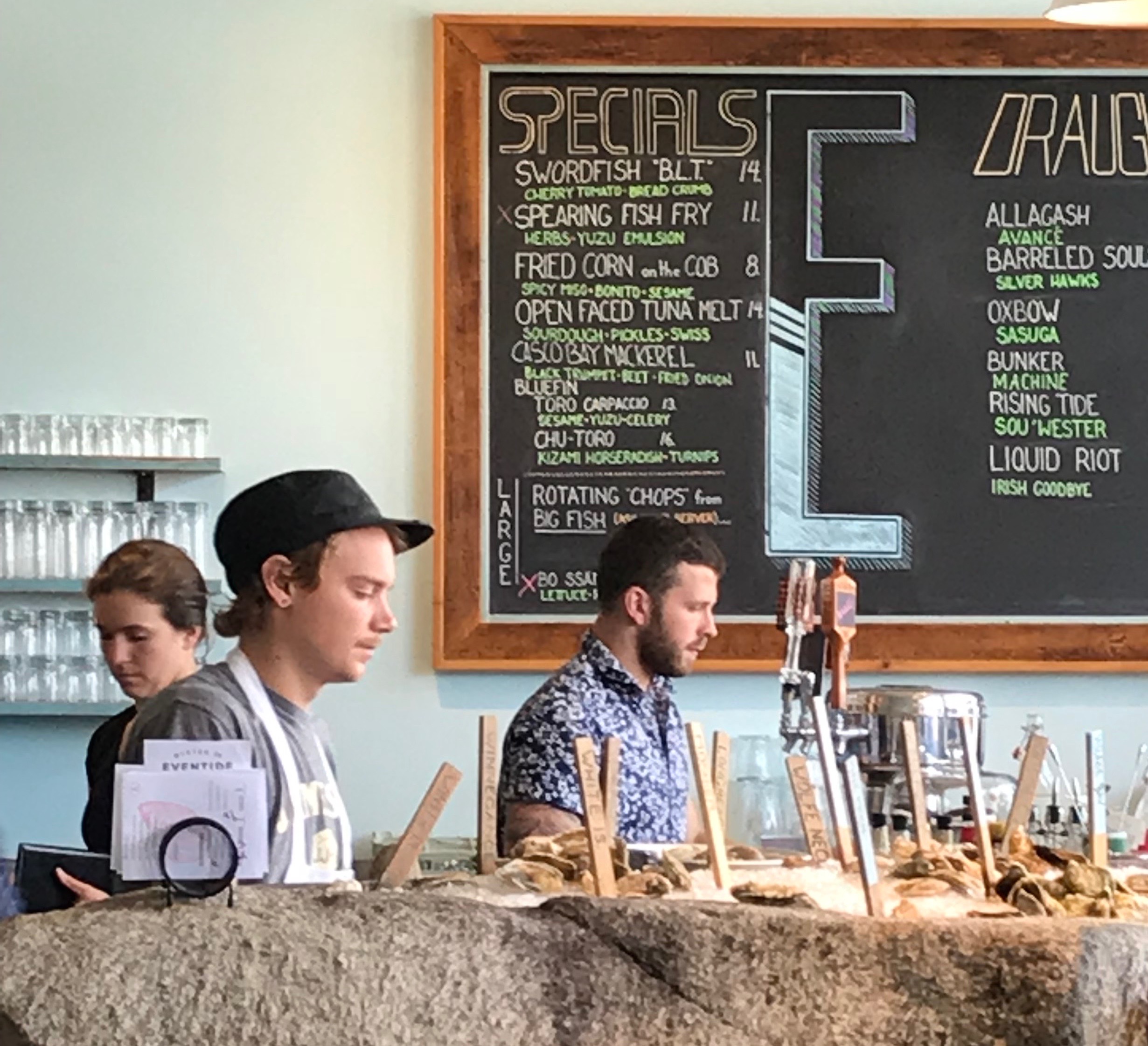
Remarkable selection of oysters at Eventide.
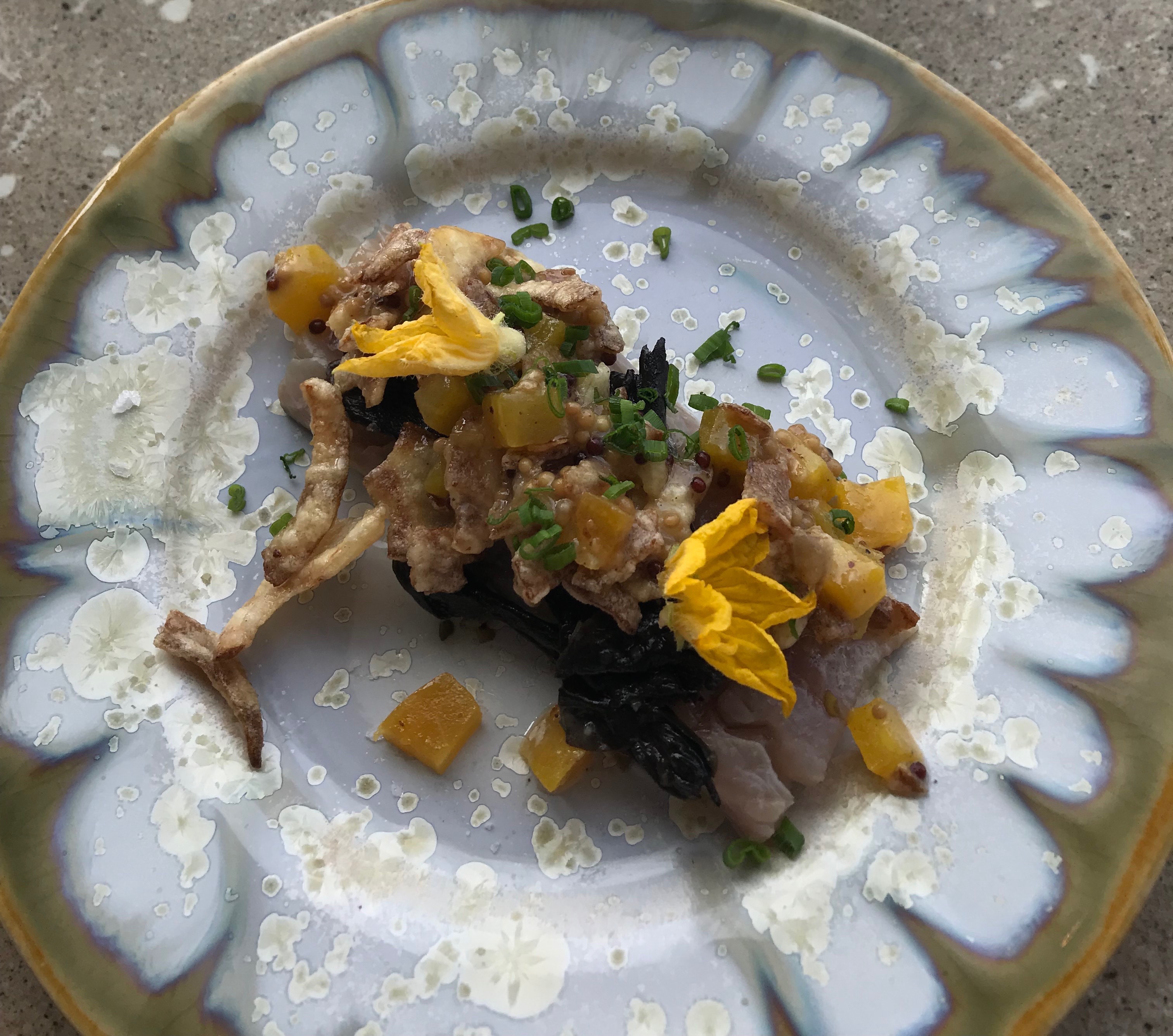
Plate of Caso Bay Mackerel, with black trumpet mushrooms.
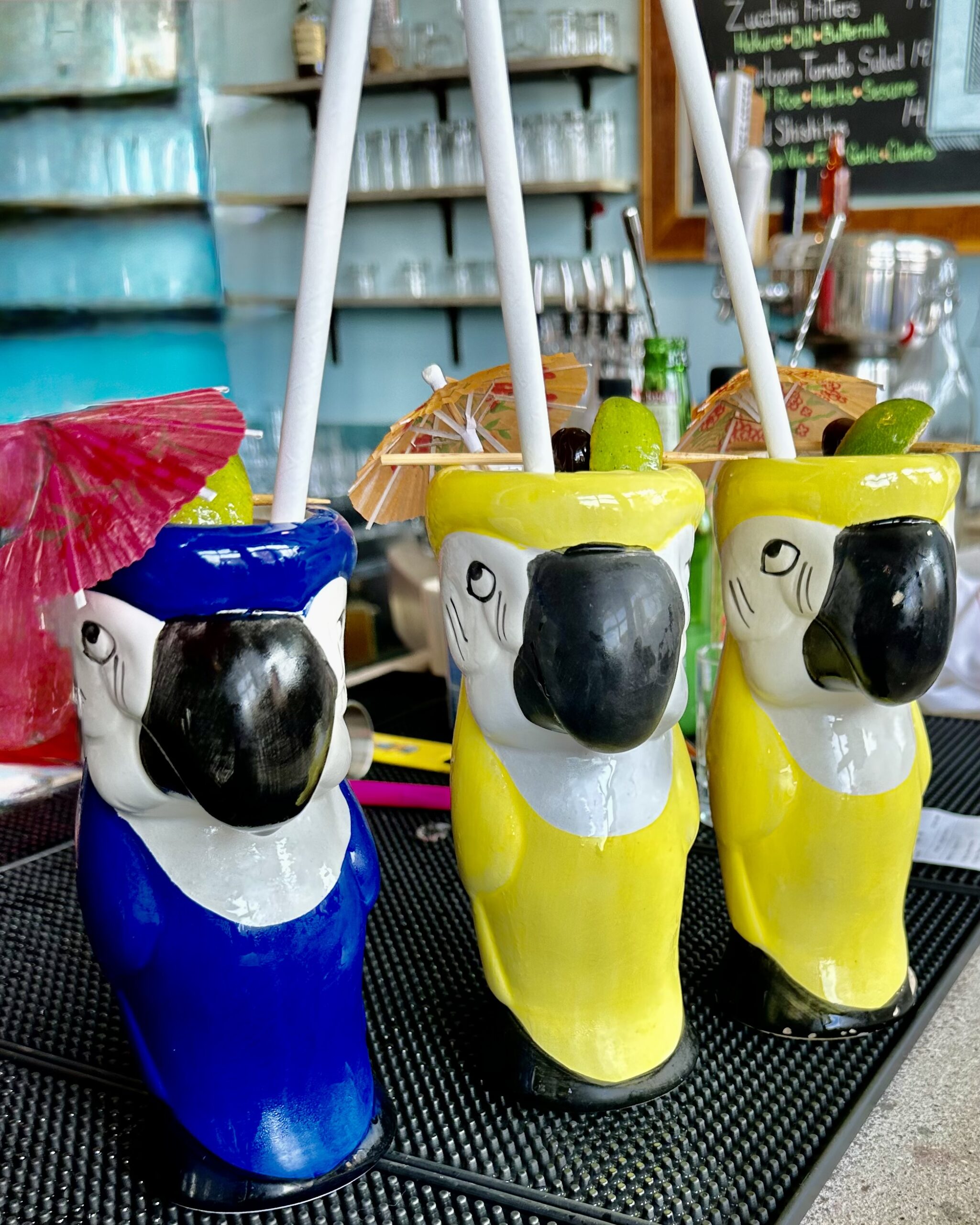
They look so innocent…they’re anything but. The “Walking Dead” parrots at Eventide
FORE STREET
288 Fore Street
Fore Street is the epitome of an excellent restaurant in a busy vacation city and and Fore Street (excuse the bad pun) is at the forefront of it all. Upon entering, we find a busy bar within a large, two-story dining room. There’s also an open kitchen with chefs working to prepare food — always fun to observe. The staff in general is polished and professional — our waitress tells us she’s been working at the place for over a decade… she knows the menu well and recommends that we order the last tomato puff. We take her advice and still dream of it!
In addition to the puff, we began with oysters — as we do with every meal in Portland. For a main course we choose diver scallops with a side of succotash. We also decide to go off seafood and try a pork loin — seeing the pork being roasted on the spit when we walked in made the decision easier. Served with a side of braised cabbage and sitting on its own juice, it was a delight.
The Fore Street wine list is not huge, but well organized. Since seafood is a priority at the restaurant, clean, crisp whites adorn the selection. Michel selects a Guy Amiot Aligoté and our waitress mentioned that it’s her favorite — and it was a perfect pairing.
NOTE: When dining at Fore Street, be sure to make a reservation a day or two in advance or you’ll be doomed to dine at either 5:30 pm or 9:45 pm. The price of fame!

At Fore Street – Ope ovens and chefs hard at work. Photo courtesy of Fore Street.

Hevenly! Tomato in Puff Pastry, severed with balsamic and when requested, a dollop of goat cheese.

Diver scallops with cherry tomatoes and a side of succotash.
SCALES
68 Commercial Street
Walking through the small, rustic entrance to Scales, we’re bowled over by the cool, sophisticated space on the other side of the door. And it’s an enormous space at that. Not only that, it’s packed to the rafters.
Fortunately, we’re able to grab seats at the bar, which stretches a long, long way down the side of the restaurant. Again, the extensive choice of oysters is too tempting to pass up. We watch enthralled as our order is shucked and placed on a bed of ice, right in front of us. Next up, Maine Clam Chowder, one of the best I’ve ever had in my life! Seared Tuna with toasted sesame aioli and pickled mustard seeds is sweet and spicy in perfect proportions. Baked Haddock with morel mushrooms, fingerling potatoes, leeks and fumet cream left us speechless.
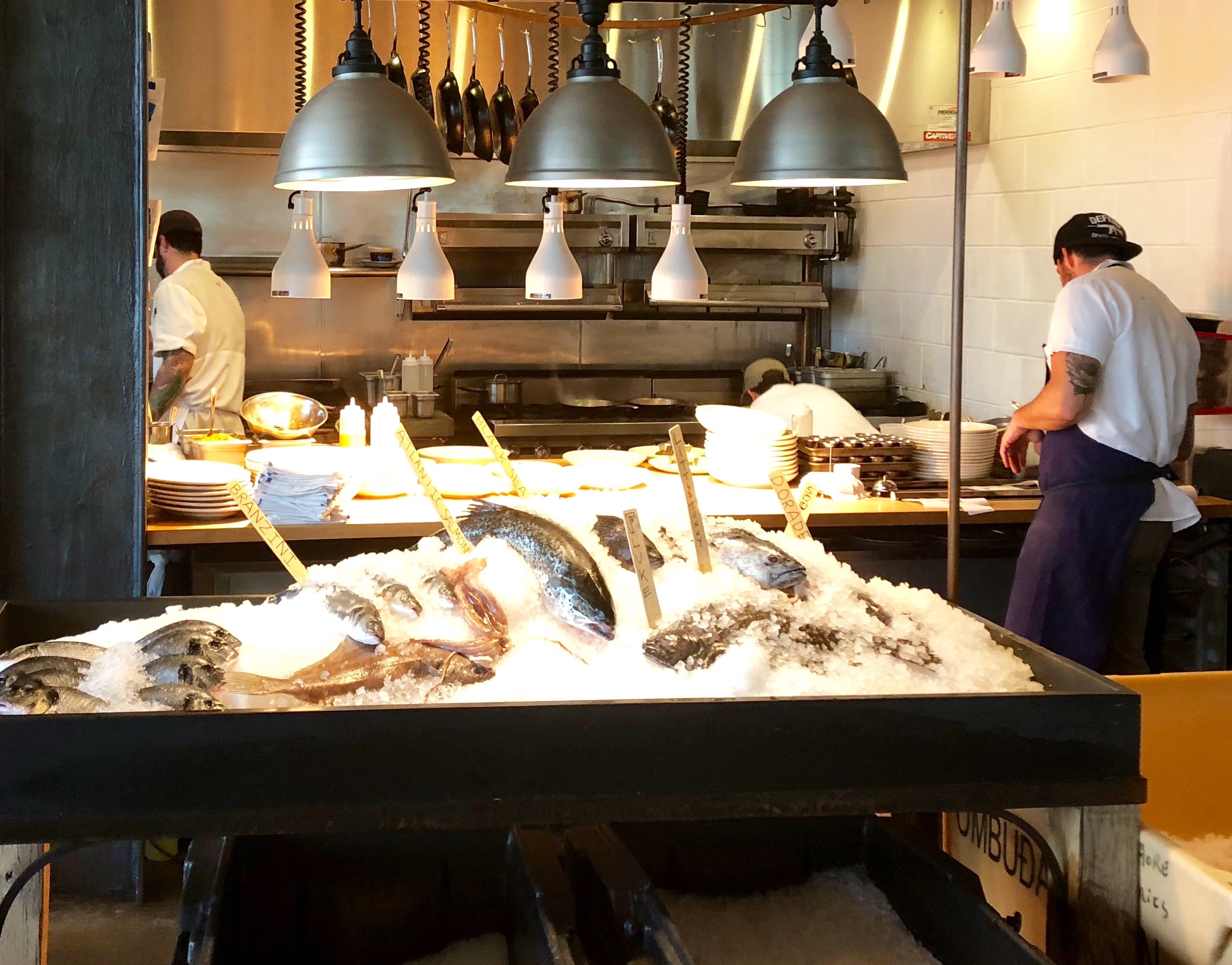
Doesn’t get any fresher. Iced-down fish at Scales.
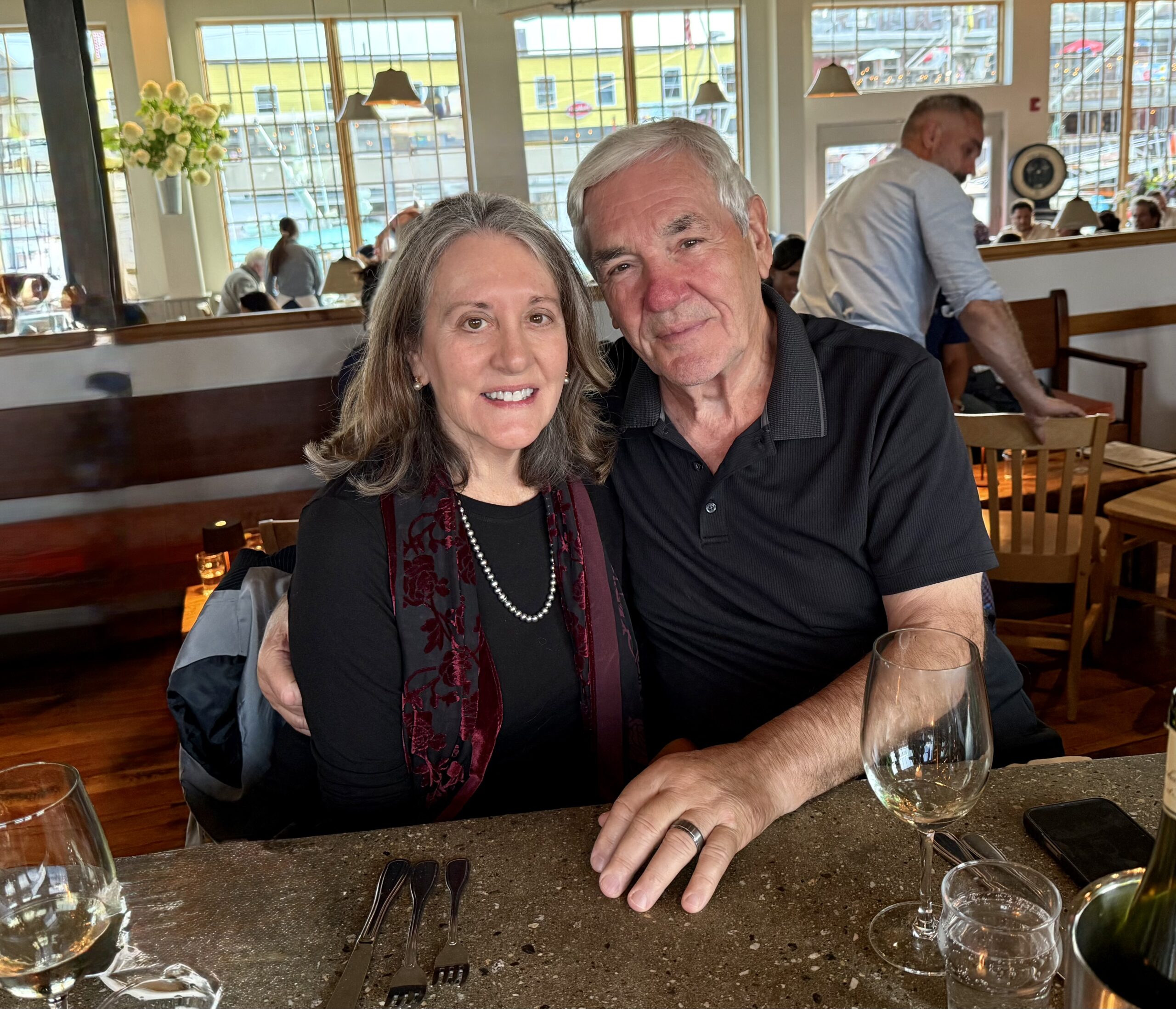
At Scales, the best seat is at the bar to watch watch the oysters and seafood being prepared.
HOMER’S VISION
To visit Portland without paying homage to the region’s distinguished artists is unthinkable. The Portland Museum of Art is Maine’s largest public art institution. Renowned arthictevct I.M. Pei was one of the designers. The collection includes notable works by many European masters, from Monet, Matisse and Renoir to Picasso. But, of course, the star here is Winslow Homer, who made Maine his home for a number of years. On rotation at the museum are 16 of his paintings, including his masterpiece Weatherbeaten, and more than 400 of his illustrations. The museum also manages Homer’s former studio in nearby Prouts Neck.
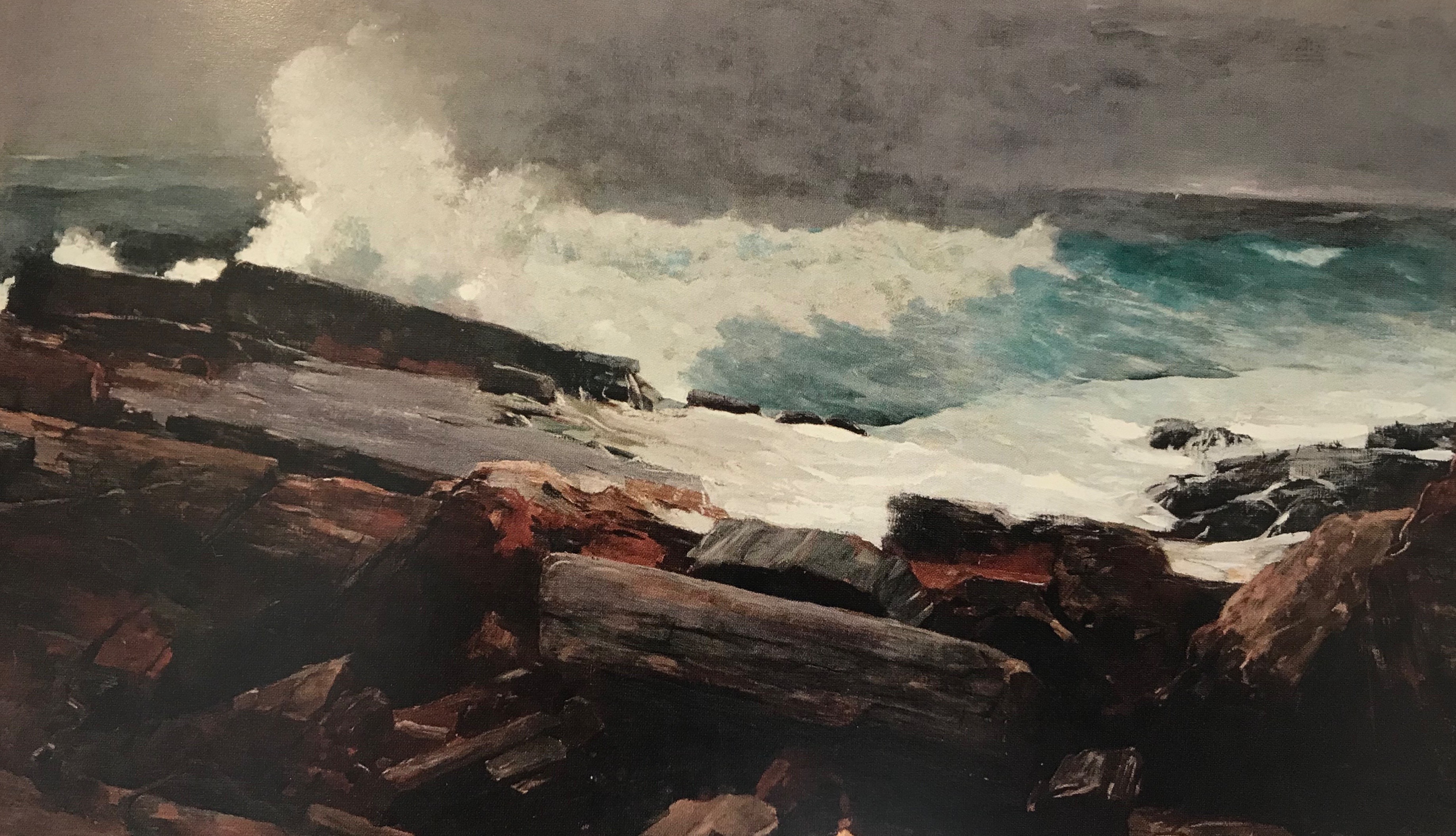
Weatherbeaten by Winslow Homer. Photos by Marla Norman.
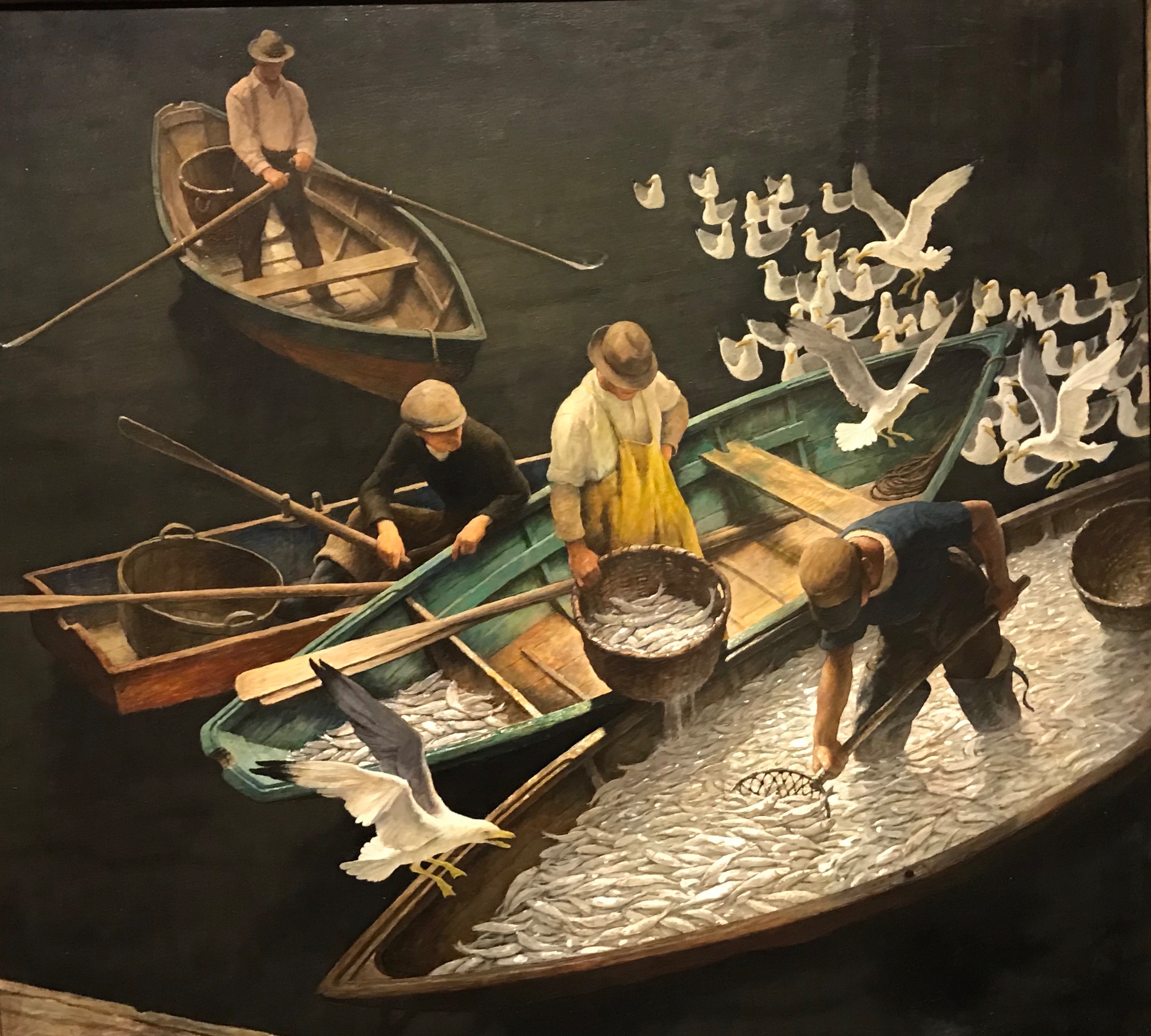
Dark Harbor Fishermen by N.C. Wyeth.
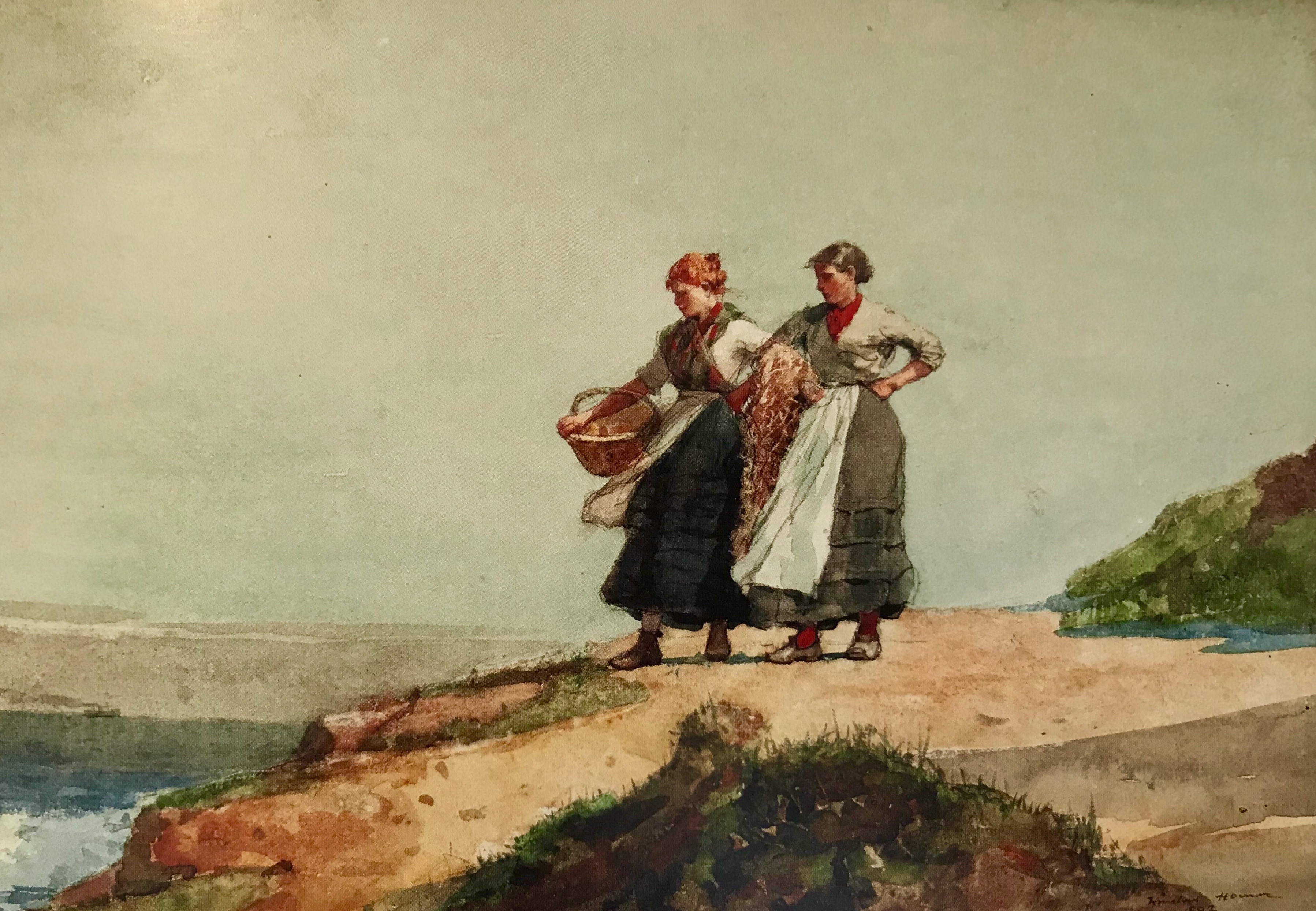
Looking out to Sea, Cullercoats by Winslow Homer.
Regarded as one of the greatest American artists of the 19th century, Homer was largely self-taught and began his career as a commercial illustrator. Originally born in Boston, Homer’s fascination with the rugged New England coast inspired much of his best work.
Works by other iconic New England artists are here as well: Andrew Wyeth, Edward Hopper and Marsden Hartley. Seeing the famous landscapes juxtaposed to the spectacular New England scenery we’ve been admiring since we arrived in Portland is thrilling. We leave the museum with our senses sharpened and new appreciation for the region.
CAPE ELIZABETH
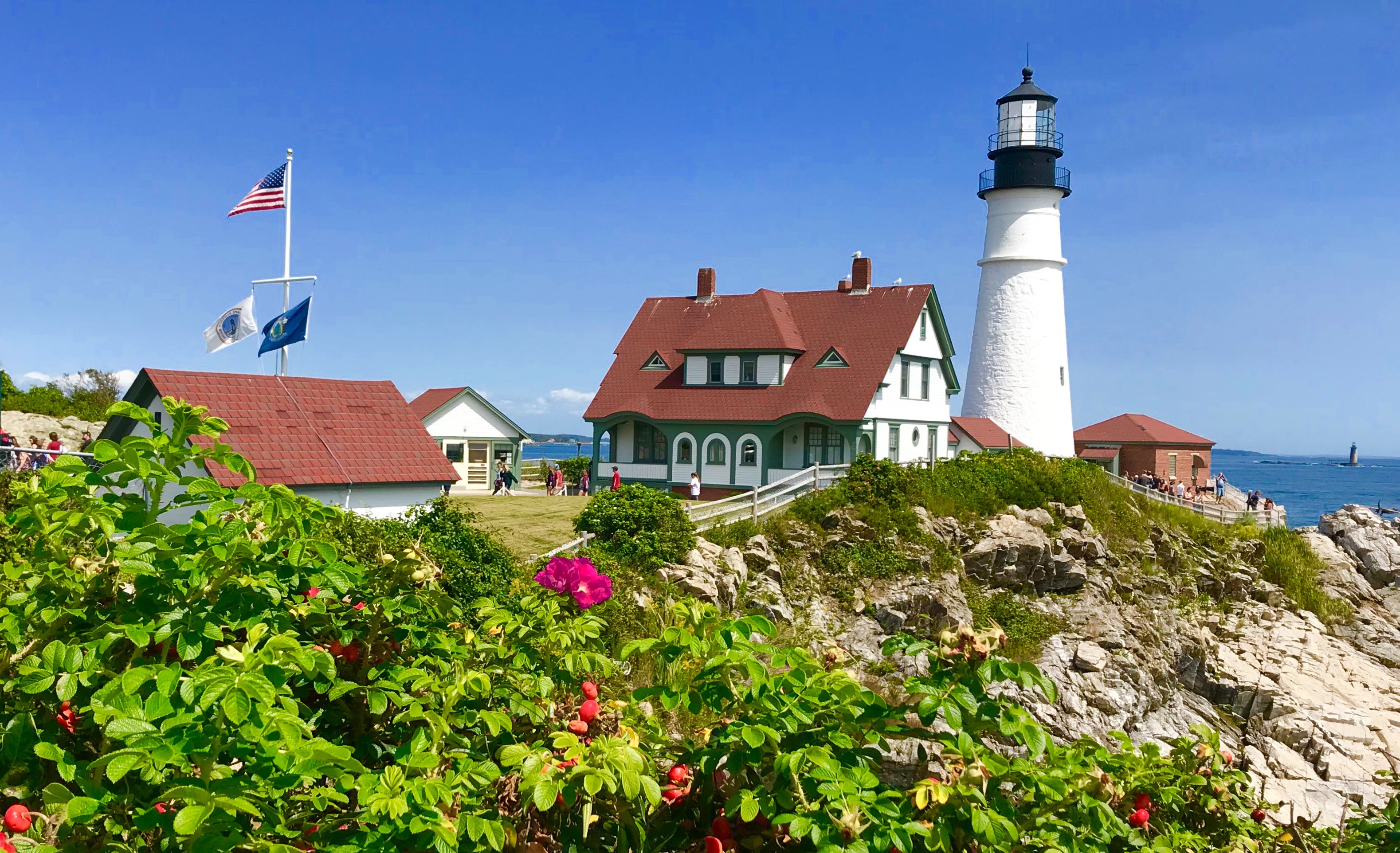
Undoubtedly, the most recognizable image in Portland is the Portland Head Light on Cape Elizabeth. The beloved lighthouse has been the subject of any number of great paintings and is undoubtedly photographed thousands of times on a weekly basis. As you can see, we also found the cape irresistible.
The Portland Head Light sits at the entrance of the primary channel into Portland Harbor. The oldest lighthouse in Maine, the structure was completed in 1791, originally commissioned by none other than George Washington himself. Now, of course, the light house is automated; its aerobeacon is visible some 28 miles out. The Keeper’s House is a museum housing memorabilia and a room-by-room chronology of local history.
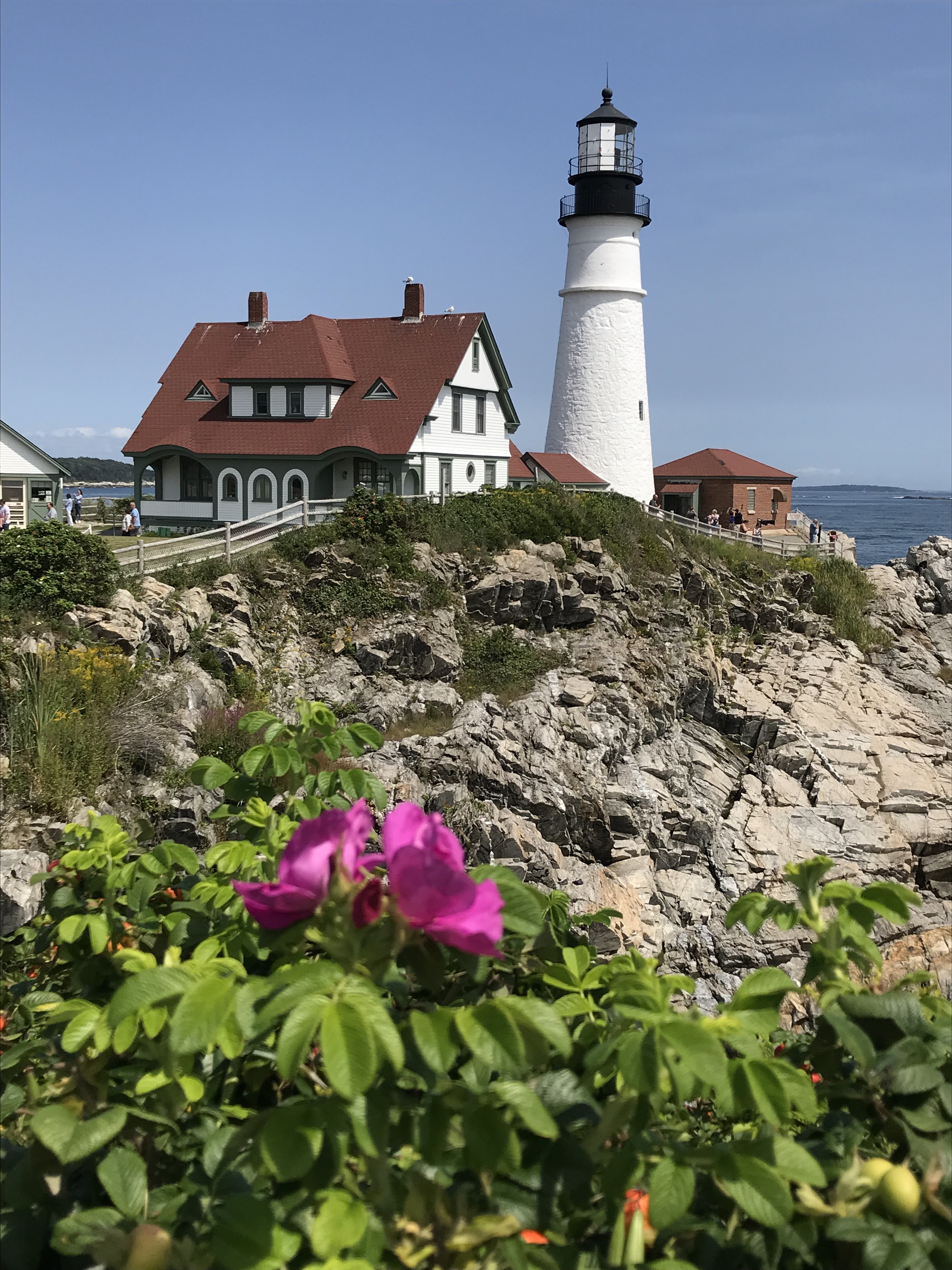
Portland’s most iconic image – the Head Light on Cape Elizabeth.
Cape Elizabeth includes three coastal parks: Fort Williams Park, Two Lights State Park and Crescent Beach State Park. Another 560 acres is under a land trust and also open to the public. Needless to say the scenery is magnificent. As we stroll along the coastal paths, the murmur of the surf, tangy breezes and sapphire-colored water leave us breathless. We click away with our iPhones to try to capture the visual beauty of the place and hope we can remember the sounds, feel and tastes.
Away from the coast, picnickers are comfortably ensconced on grassy beds. Food trucks selling lobster and crab sandwiches are parked in shady knolls, with long lines of hungry fans waiting patiently to order. The scent of fried fish and buttery lobster is overpowering.
Without saying a word, Michel and I both dash for the closest line. After all, this vacation isn’t over just yet………


