

Nosing around Wine & Aromas
Text by Marla Norman & Michel Thibault
Photos by Marla Norman
In Wine 101 classes we learn to swirl and smell before drinking. Why exactly this ritual can be so pleasurable is maybe less clear…..
Of our five basic senses — sight, hearing, smell, taste and touch — the sense of smell is the one that most baffles neuroscientists and psychologists. What we do know is that no other sense is more closely linked to memory, particularly on a subconscious level, than the ability to smell.
Whether we realize it or not, we’re capable of distinguishing literally thousands of unique odors — an ability crucial to survival throughout human evolution. Smoke and rotten food are a few quick examples. Interestingly, kissing is thought to have originally developed from sniffing! (Fifthsense.org.uk)
Childhood memories linked to scent remain with us throughout our entire lives. And these associations constantly influence our choices. Researchers call these learned behaviors the “Proustian Memory Effect” — in reference to Marcel Proust who, in his book Remembrance of Things Past, vividly described how the aroma of a Madeleine pastry evoked scenes from his youth. (Given the French prowess with perfumes and fragrances, perhaps it’s only fair that this corollary is named after one of the country’s greatest writers.)
The fact that smell is so closely linked to specific experiences explains why a fragrance you find irresistible is one someone else despises. “In a recent study undertaken by the U.S. military to create a “stink bomb,” it was impossible to find an odor (including U.S. army issue latrine scent) that was unanimously considered unpleasant across various ethnic groups. So it isn’t just neutral or moderate odors that vary by culture, what we think stinks does too.” (Scientific American)
But back to wine……. Since the human tongue is limited to just five essential tastes: sour, bitter, salty, sweet and savory, much of what you experience in a glass of wine is through your nose — an almost endless array of fruity, earthy, leathery, floral, herbal, mineral, and woodsy flavors.
Wine aromas are categorized as primary, secondary and tertiary. As you drink a glass, swirl, place your nose in the glass and inhale — again harking back to Wine 101. You’re likely to smell fruit first or possibly flowers. Continue swirling and inhale as you drink. Complex and aged wines evolve quickly as they oxygenize. Experiencing the evolving scents and aromas are all part of the intrinsic joy in wine.
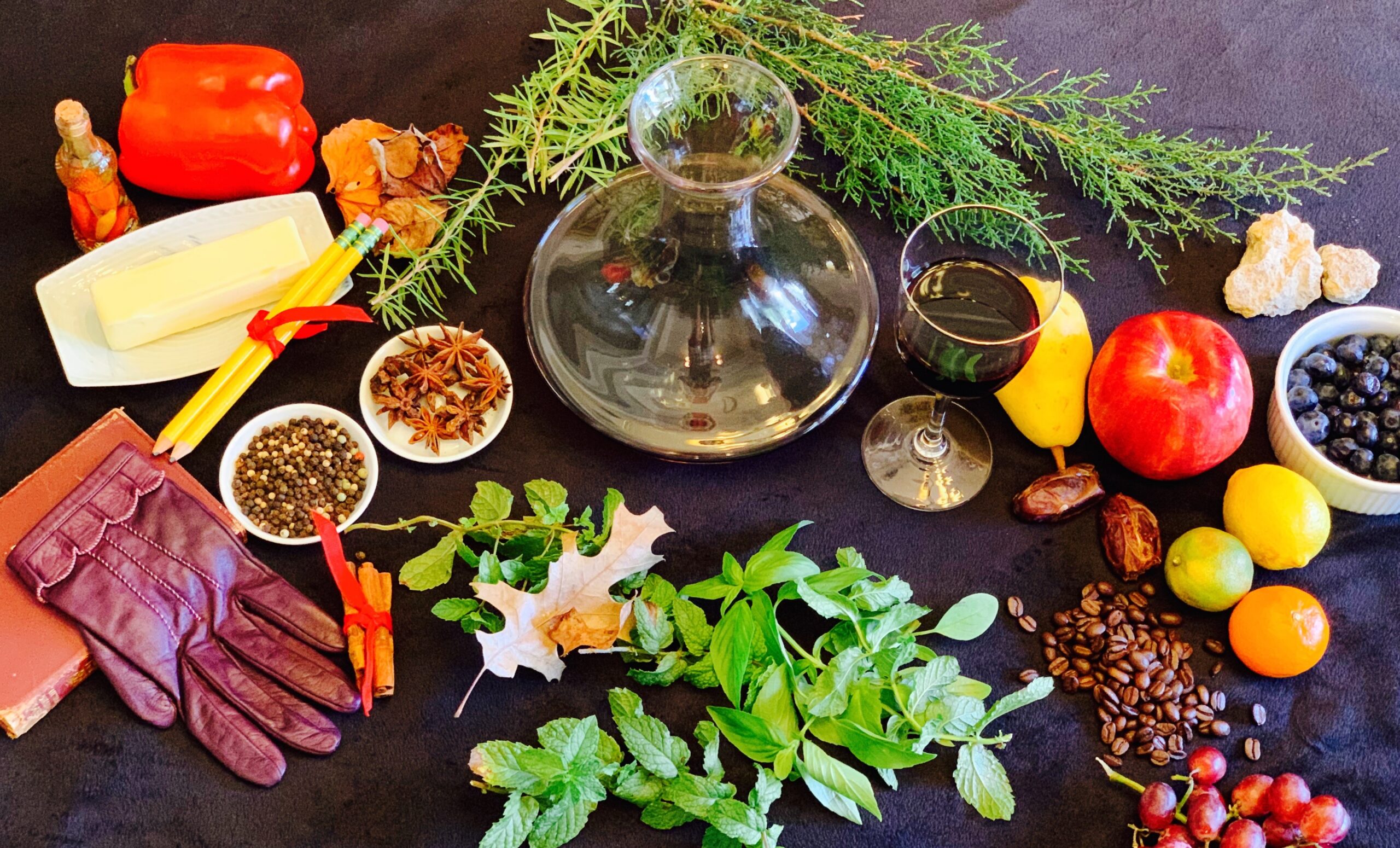
Literally hundreds of unique scents have been catalogued to describe wine.
Primary Aromas: Smells derived from the fruit itself. Fruity and/or floral. Expect violets, rose, chamomile, green apple, citrus, black and red berries.
Secondary Aromas: After fermentation, wines take on additional scents. Here also, the winemaker’s choice in barreling will have a subtle or noticeable influence. Look for nutty, buttery, vanilla, cedar and other wood-like aromas.
Tertiary Aromas: As a wine ages, oxidative traits are displayed in scents known as tertiary aromas often described as damp earth, wet forest, mushrooms or vegetal-like components.
Bouquet: Is the term used to refer to the buttery scents in wine which result after a malolactic (secondary fermentation). In contrast, wine fermented and aged in stainless steel tanks will continue to exhibit fruit and primary wine aromas.
Sommeliers work diligently to develop their sense of smell, spending hours sniffing out fruits, vegetables, etc. to train and enhance their olfactory capacity.
At Bordeaux’s Cité du Vin – a museum dedicated to every aspect of winemaking – one of the most popular exhibits is the “Buffet of Scents” – where visitors can experience everything from tropical aromas, to old leather and pencil shavings. A great way to sharpen up the senses before tasting the regional Grands Vins.
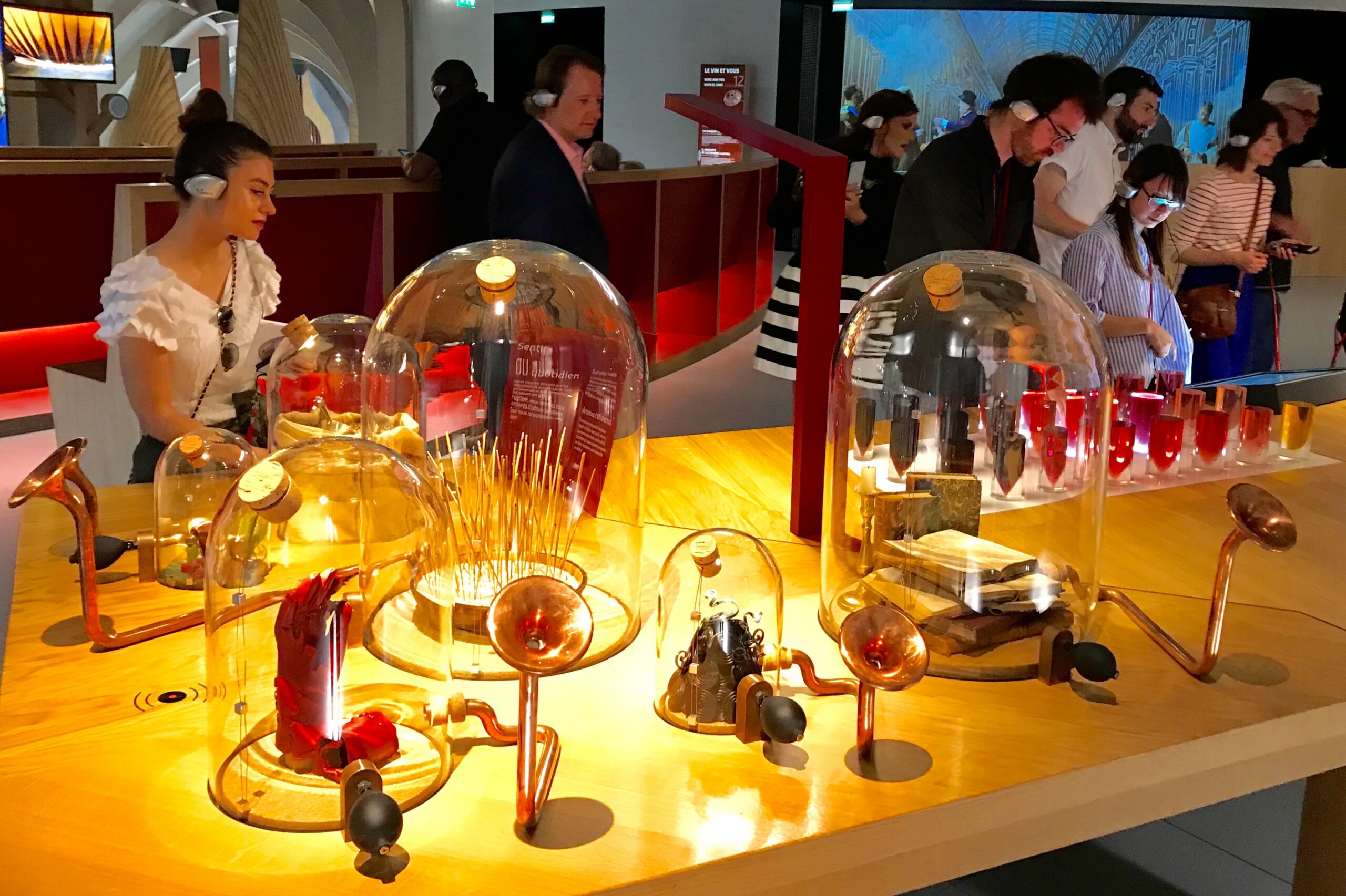
At Bordeaux’s spectacular wine museum, La Cité du Vin visitors experience the “Buffet of Scents.”
Literally hundreds of unique scents have been catalogued to describe wine. Let’s take a look at what the professionals say about the wine they’re drinking — the folks trained to sniff out a thousand and one different aromas. Often helpful, manytimes poetic and literary…then there are the critiques that have you scratching your head or running to the nearest fruit stand or pharmacy.
Legendary wine critic Robert Parker once described a 2015 Araujo Eisele Cabernet (He rated 100-points) as having a spicy nose ” with forward notes of cinnamon, vanilla, blonde tobacco, and cumin. With a swirl, highly expressive lily and rose aromas immediately lift from the glass, followed by a dark bouquet of black currant and boysenberry.”
“A super precise and chalky bouquet of oyster shells and iodine intertwined with fine red berry and rose petal notes” was Parker’s write-up for the 2007 Gosset Celebris Extra Brut Rosé Champagne
Antonio Galloni enthusiastically awarded the 2016 Vine Hill Ranch Oakville 100-points, writing: “The rush of black cherry, plum, menthol, licorice, sage, dark spice and earthy notes build as this statuesque Cabernet Sauvignon shows off its magnificent pedigree.”
Jeb Dunnuck gave a 100-point rating to the 2016 Château Montrose, citing aromas of “creme de cassis, graphite, damp earth, lead pencil shavings, and burning embers.”
Neal Martin awarded the 2016 Cos d’Estournel 100-points because of its “very intense but broody bouquet with fathomless deep black fruit tinged with blueberry and violet. The aromas almost seem to envelop the senses.”
“Rose petals, sandalwood and currants with some plums and fruit tea” were James Suckling’s notes describing the 100-point 2015 La Mission Haut-Brion. And he compares the aromas of a 2012 Dal Forno Romano Amarone Della Valpolicella to “a decadent nose of treacle tart, chocolate, tar, tons of black fruit such as blackberries and mulberries and even ash and licorice.”
Treacle Tart, by the way, is an English dessert made with a sugary syrup, known as Treacle and lemon. You might also wonder about the appeal of “tar” in wine? But however imaginative professional descriptions can be, they clearly help stimulate our wine awareness and quite often entertain!
All to say: “Here’s to making more scents out of wine! (You knew we’d throw in a bad pun somewhere.)


