Summer’s Second Act in Montréal
by Marla Norman & Michel Thibault
Photos, unless otherwise noted, by Marla Norman
If you live in Texas, you pray for the end of summer. Labor Day weekend is for celebrating temperatures beginning to dip below 100 degrees. Of course, our Canadian neighbors have a completely different perspective.
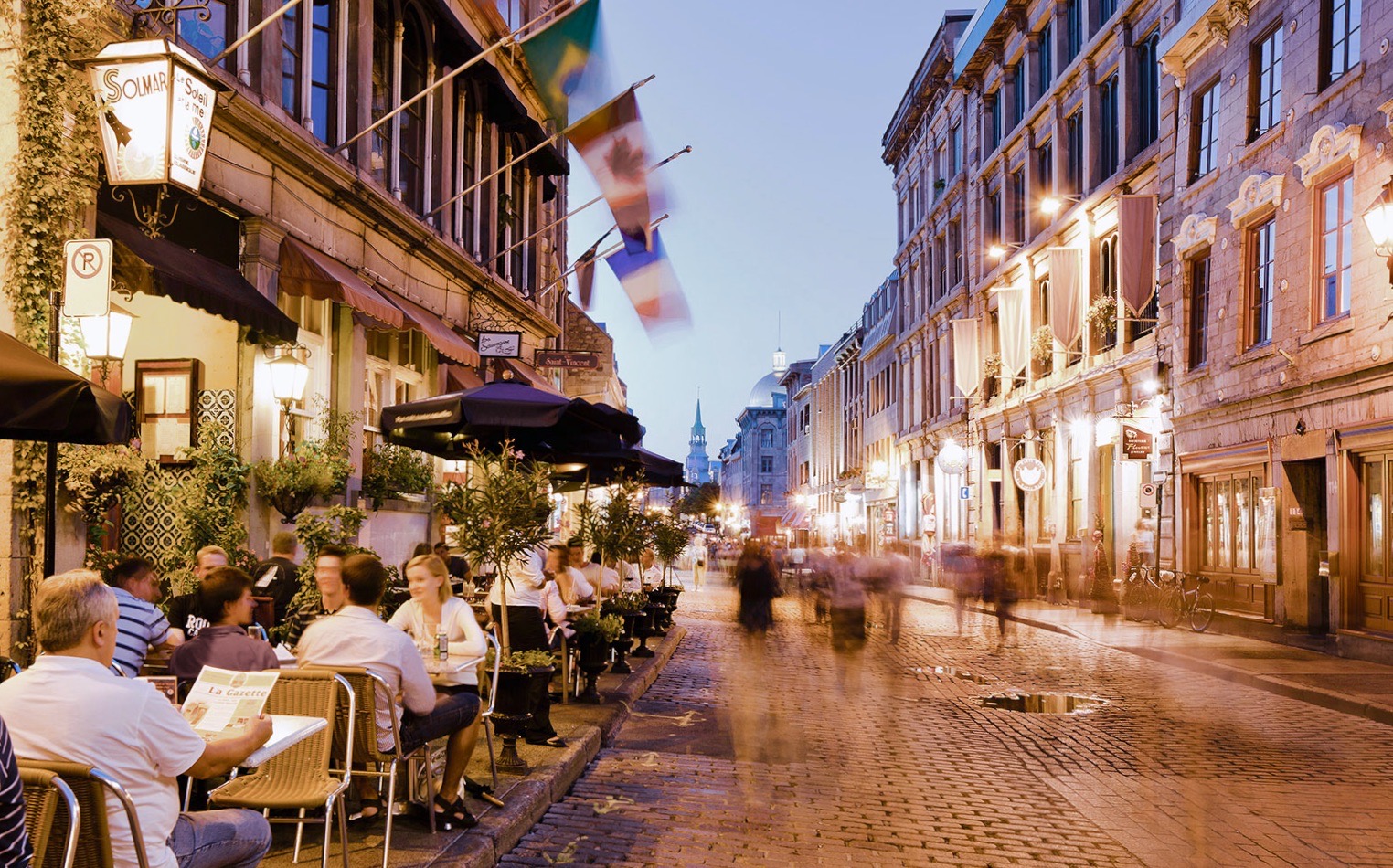
In Montréal, September is a time to savor the last warm days and to celebrate before winter’s chill. The entire city feels like one giant block party. Local residents take to the streets. Musicians play on every corner. Restaurant terraces are packed with diners from dusk to dawn.
For the Québécois, the clock is ticking. By the first of October, temperatures begin to drop and, by law, all restaurants must shut down outdoor dining. The first snows arrive in early November. So, Summer is squeezed and stretched for as long as possible.
When Michel and I arrive in Montréal on Labor Day weekend, the temperatures are in the mid-70s — pure bliss after the scorching Texas heat we’ve been enduring. (Note: Canadians also celebrate Labor Day on the first Monday in September.) The ambrosial temperatures aren’t lost on our Canadian friends either. In fact, it’s difficult to get through all the revelers. As we head for Vieux-Montréal, we get a little lost and end up in China Town. There, young people are out in droves — most with a strolling beverage.
Rerouting, we finally arrive at the Place d’Armes, home to the Basilique Notre Dame. The cathedral’s 228-foot towers are easy to spot, even for disoriented tourists. Inside, the immense ceiling with thousands (no exaggeration!) of 24-karat gold stars are jaw-dropping. Exquisite stained-glass windows, imported from Limoges, France, are equally breathtaking.
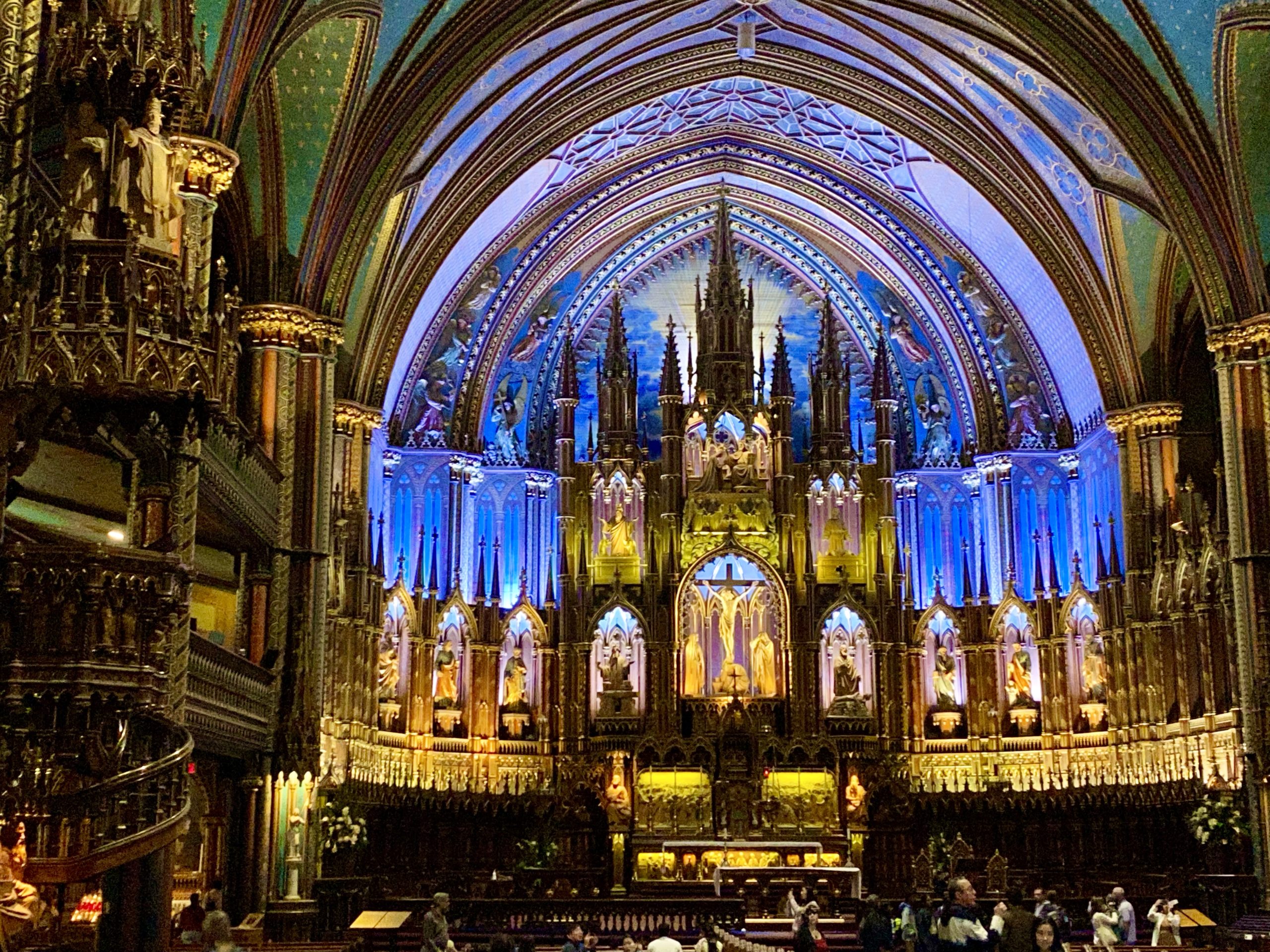
At the Basilique Notre Dame, stained-glass windows, imported from Limoges, France illuminate the altar.
The pulpit is another work of art, with an intricately carved staircase and figures of Ezekiel and Jeremiah at the base. Exiting, we view the colossal 7,000-pipe Casavant organ. And, in a perfectly timed moment, the 12-ton brass bell — largest in North America — marks the hour. It’s profound, monumental and absolutely deafening!
A few blocks past the cathedral, we find a seat at Modavie. After a satisfying dinner of Gougères, Mussels & Fries and Truffle Tagliatelle, we’re ready to call it a night. It was a long day of travel for us, but the streets seem even busier than when we arrived. In Montréal this lovely Summer-ish evening is still quite young.
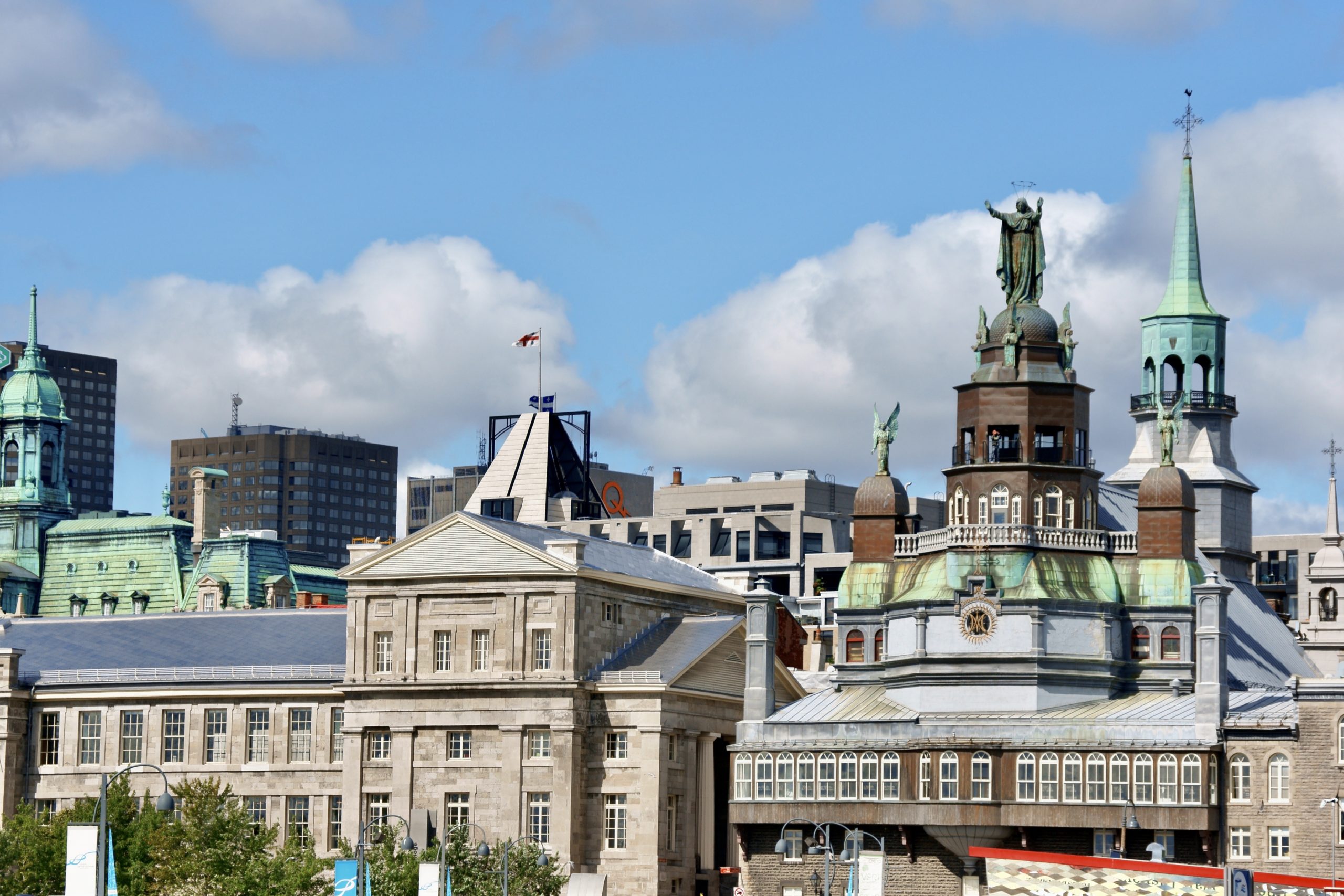
In Vieux-Montréal, Notre Dame de Bonsecours Chapel on the right and the Town Hall on the left.
LA VILLE VERTE
Our first stop the following morning is Boulangerie Ange (Angel Bakery) An easy walk from our hotel, we’re tempted by a vast array of French pastries — from Croissant to Pain aux Raisins, Chausson aux Pommes, fruit tarts and many, many more heavenly delights. Even the coffee is divine.
After the indulgent breakfast, we stroll the wide boulevards. Most impressive are the high-rises, which dot the sky, and endless rows of cranes hovering next to them. And yet, somehow, in spite of the seemingly endless new construction, Montréal still feels very approachable and livable. Streets are immaculate. Parks are tucked in-between buildings or in large tracts all over the city.
Especially appealing are huge planters filled with flower arrangements. These too are located throughout the city. Gardeners zoom in via small trucks and unload long hoses to water and tend to the plants. Then, in October, as the city begins its winter hibernation, the planters — and there are hundreds — are loaded up and taken to greenhouses.
Each year the city spends millions of dollars on landscaping. It’s an astonishing operation, particularly considering the fact that the plants can only be on display for a maximum of four months — another manifestation of Montréal’s Summer infatuation.
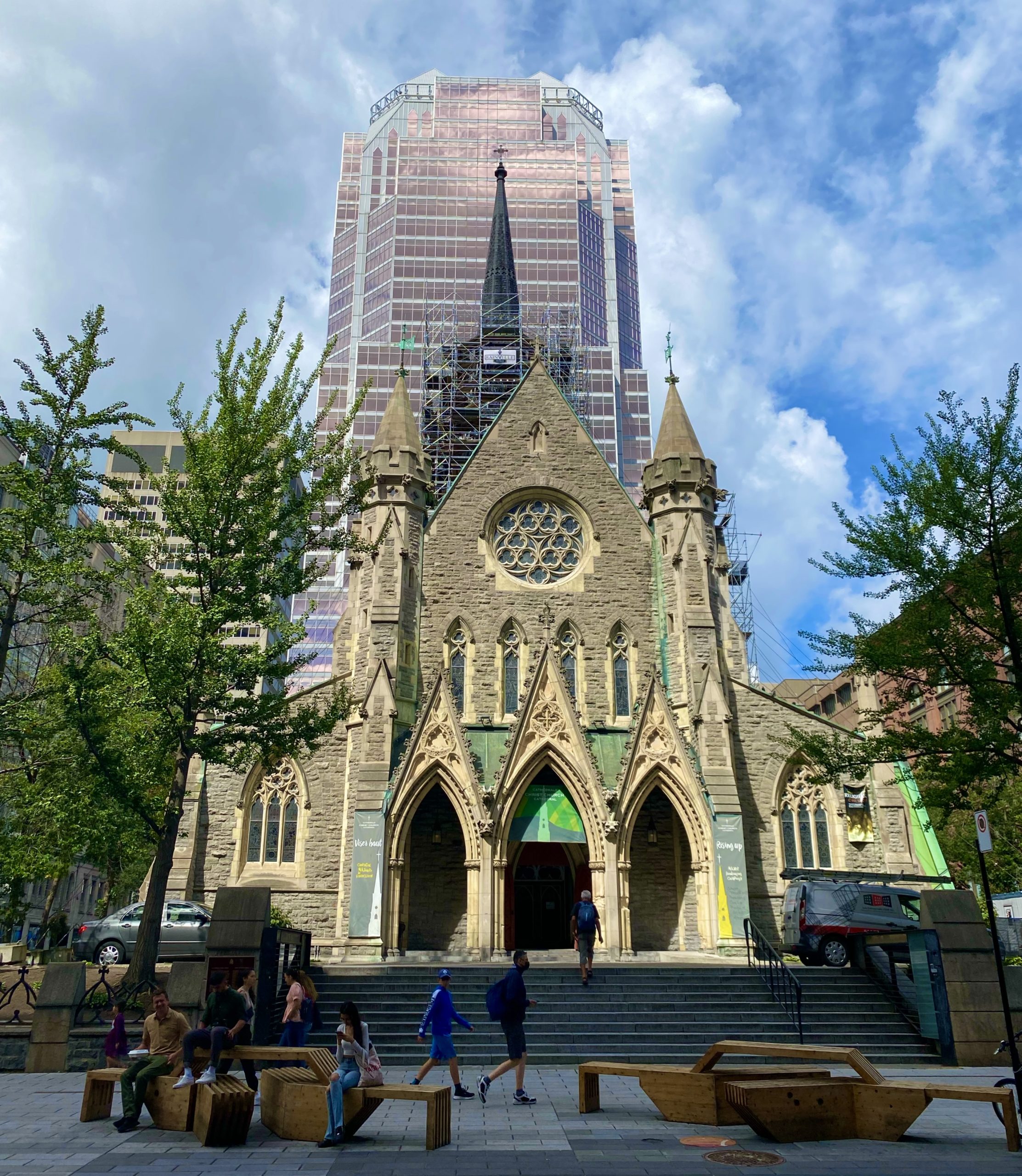
Recently constructed skyscrappers tower over 100-year old Sainte-Catherine Church. Photo by Marla Norman.
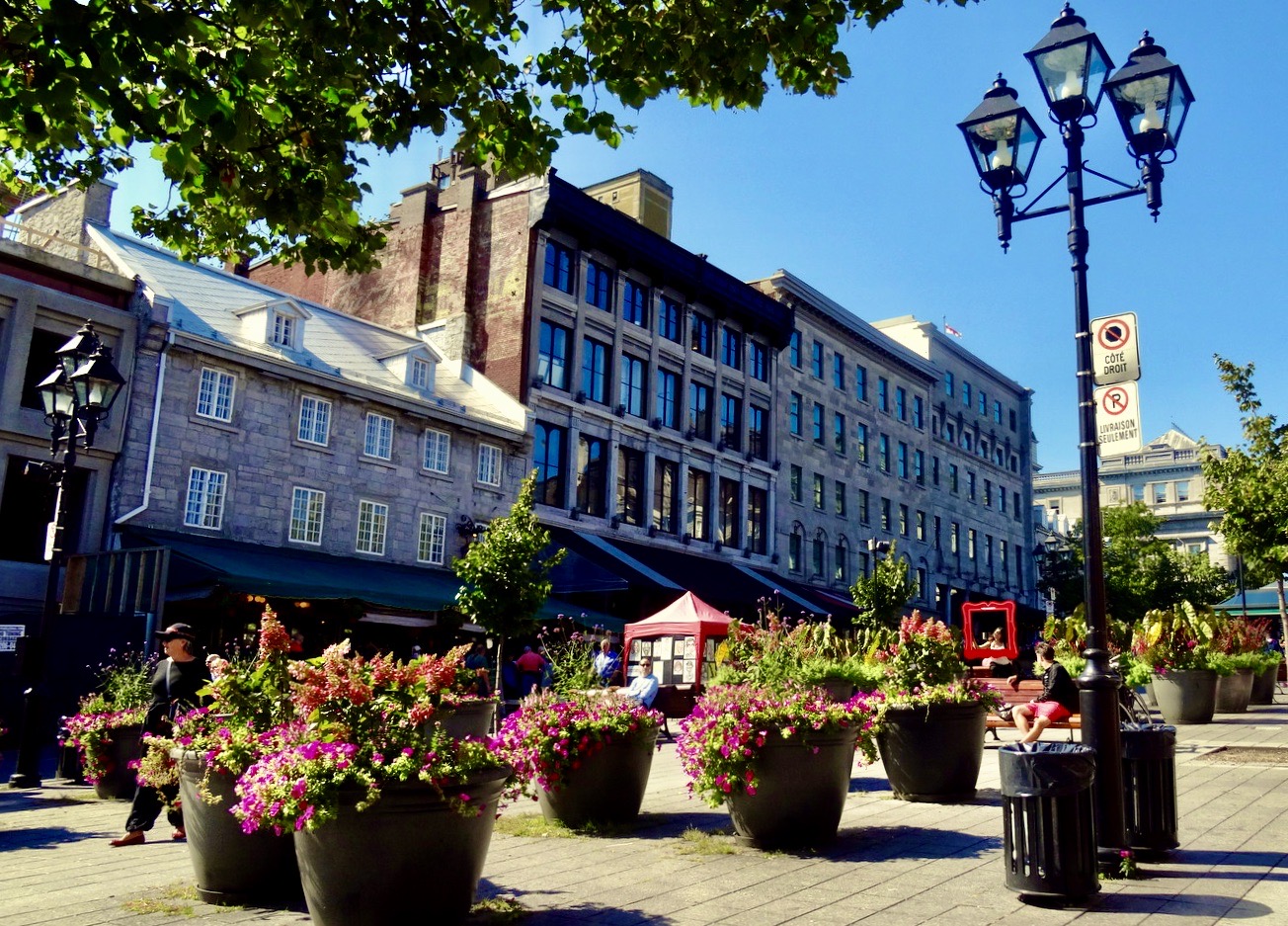
Place Jacques Cartier filled with blooming flowers and greenery…at least until October, when the pots are whisked away to winter over in greenhouses.
FAST BACKWARD
When French settlers from the Loire Valley first arrived in what is now Montréal, they named their new settlement Ville Marie (City of Mary) for the Virgin Mary. Later, the name was changed to Montréal (Mount Royal).
To learn more about the city’s history, we take a fast elevator ride back to Montréal’s 17th century at the Musée d’Archéologie et d’Histoire Pointe-à-Callière. Upon landing, we find ourselves in an active archaeological dig set up within the earliest foundations of the city. To wander among the remnants of stores, homes, old streets, etc. is a bit eerie, but an undeniably privileged view of Montréal some 500 years ago.
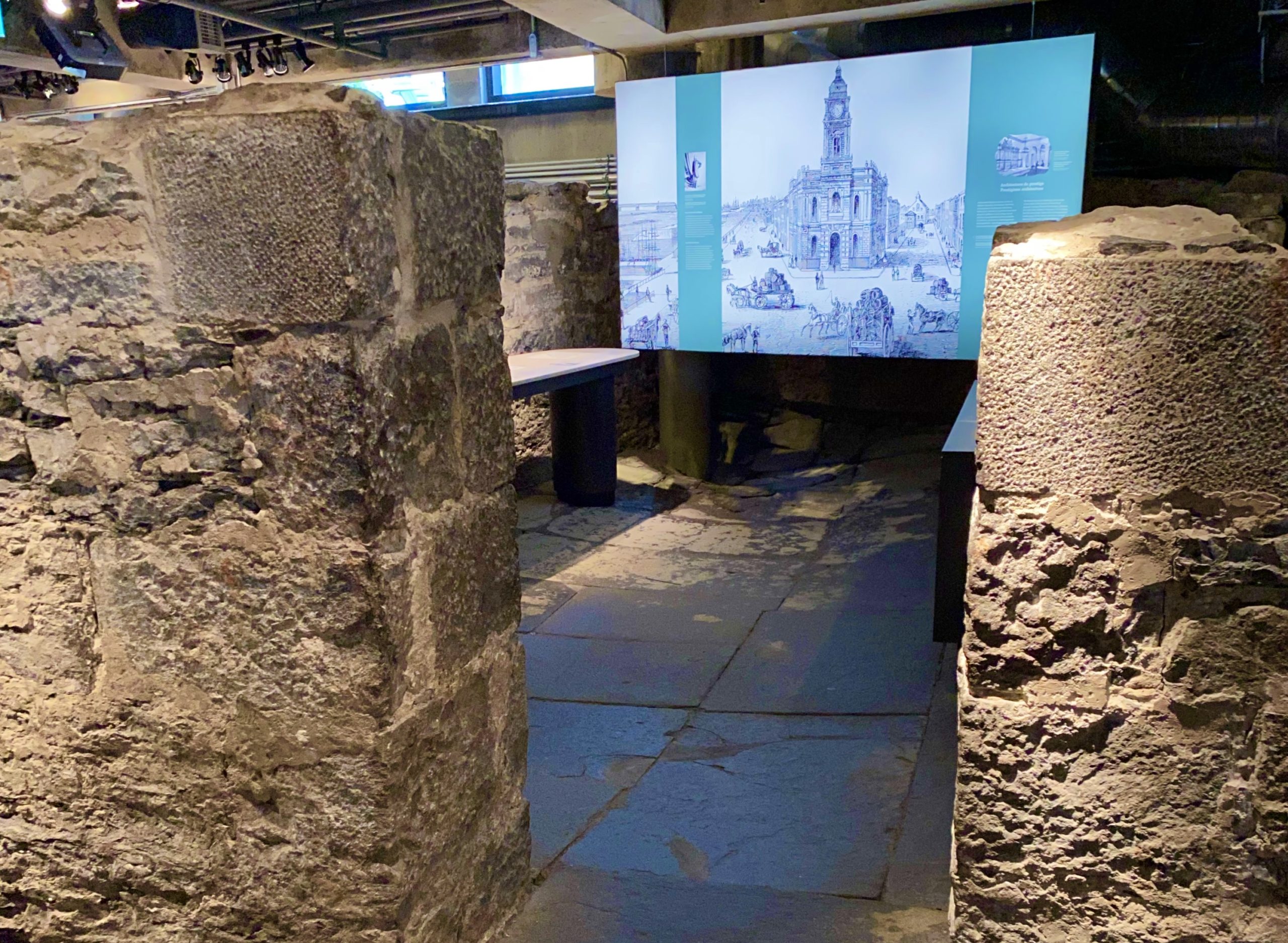
Archaeological dig of Montréal’s early foundations at Musée Pointe-à-Callière.
The museum also offers a superb cinematic experience of Montréal’s complete history — from 4,000 years ago, when the first descendants of the Iroquois occupied the island of Montréal until the French settlement, later British conquest in 1760, up through modern times.
We break for lunch at Marché Atwater. Situated in Montréal’s Southwest borough, close to the Lachine Canal, Atwater Market takes its name from the avenue bordering it. The market has been in operation since 1933, and its Art Deco-style architecture makes it among the most beautiful buildings in the city. Open year-round, Atwater Market is celebrated for its many butcher shops, cheesemongers, produce stands and food trucks.
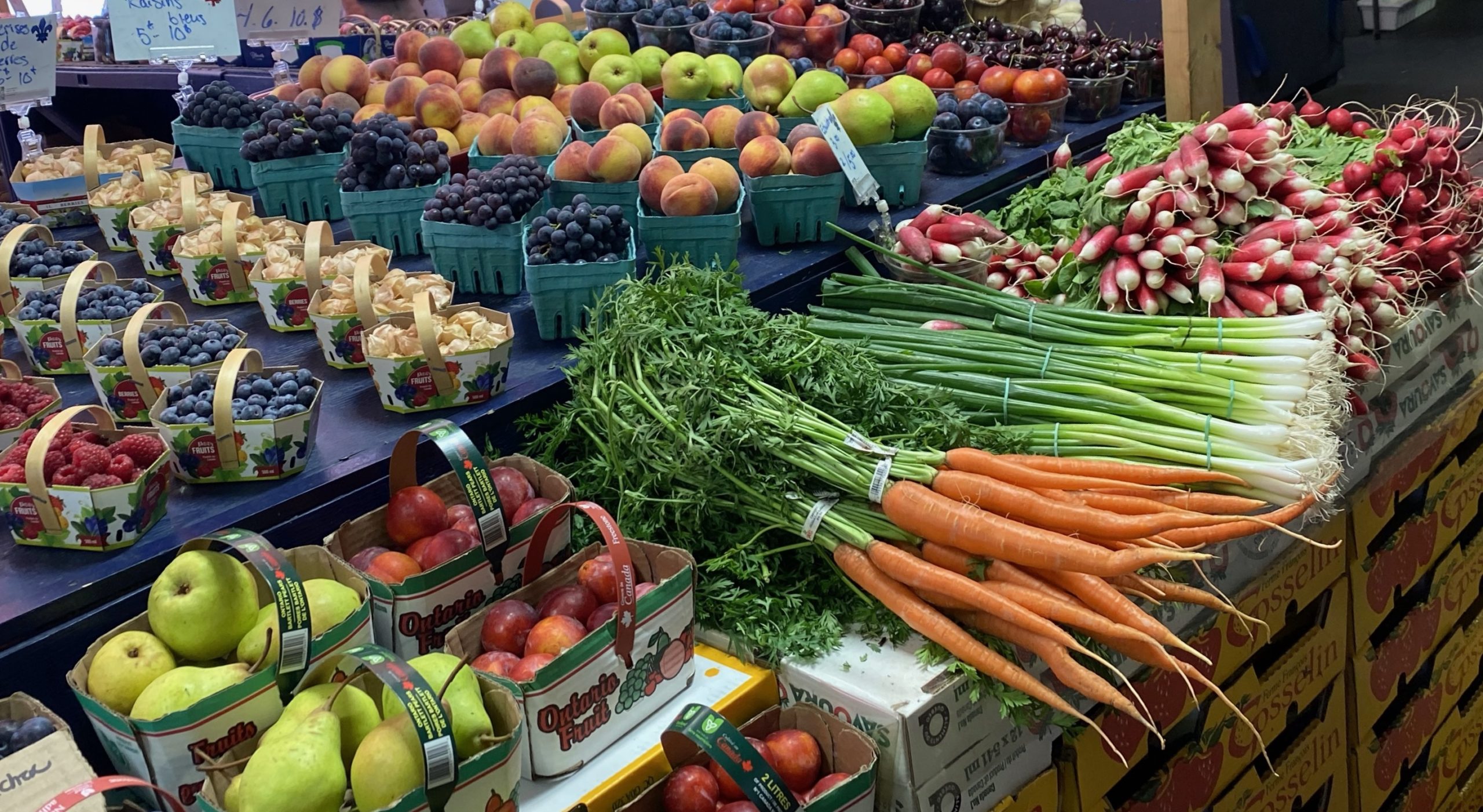
Luscious produce stands at Marché Atwater.
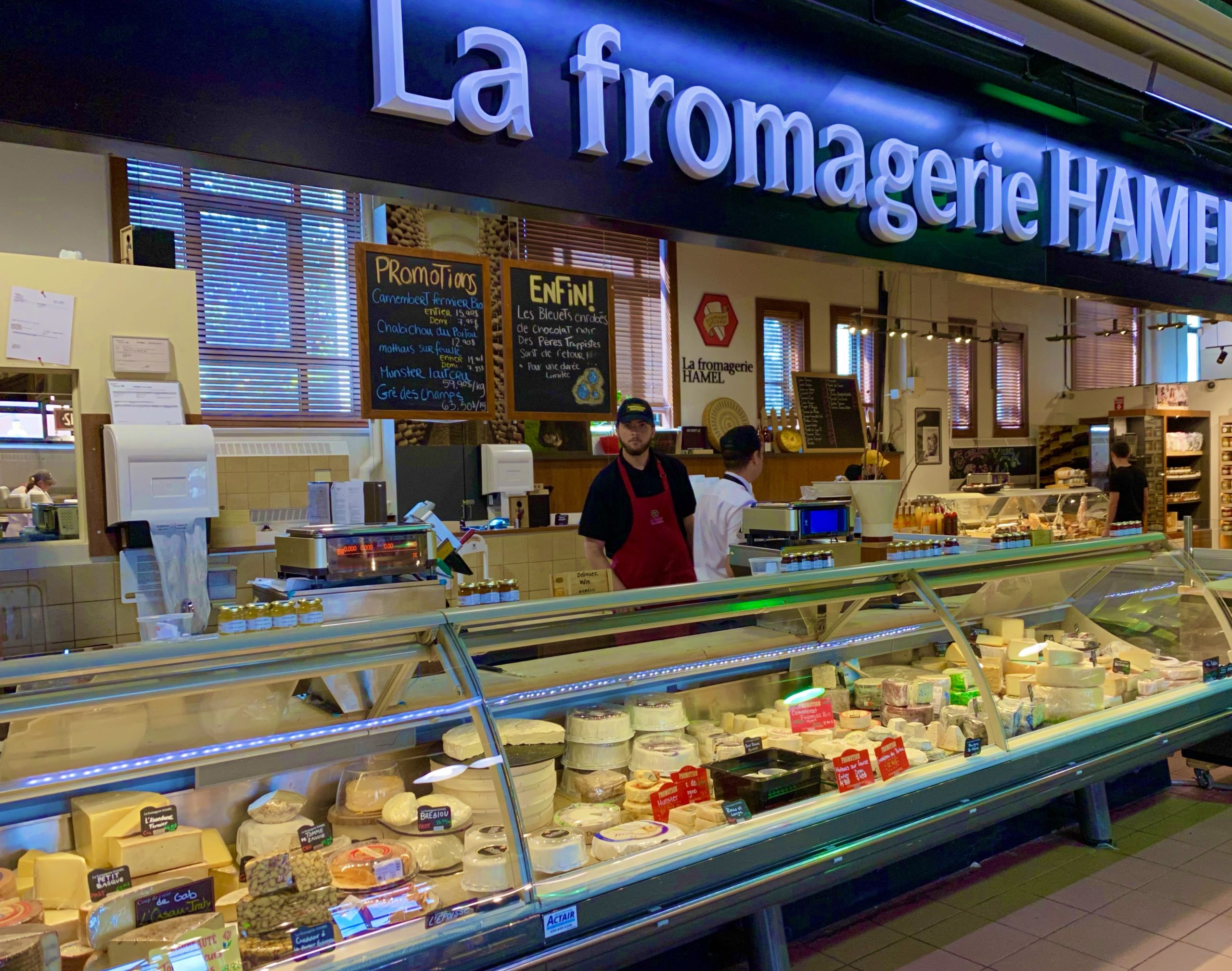
Impressive cheese displays at Marché Atwater include regional Québécois and imported French selections.
We head straight for the cheese. Glass displays offer an endless number of temptations. Michel, the consummate amateur de fromage, quickly selects Chèvre, Époisses de Bourgogne and Chaource. After purchasing a fresh baguette from one of the boulangeries, we move on to one of the many enticing boucheries for slices of roasted chicken and pork. The Grand Finale: fresh strawberries, peaches and pears from the fruit vendors — un pique-nique parfait!
FRANKLIN’S MISSION TO MONTRÉAL
Day 3, we visit Musée du Château Ramezay, built by Montréal’s 11th governor, Claude de Ramezay. The pretty château looks as if it were plucked from a Normandy village. Now a UNESCO-listed historical property, the museum displays collections of colonial life, documents from the era, clothing and portraits.
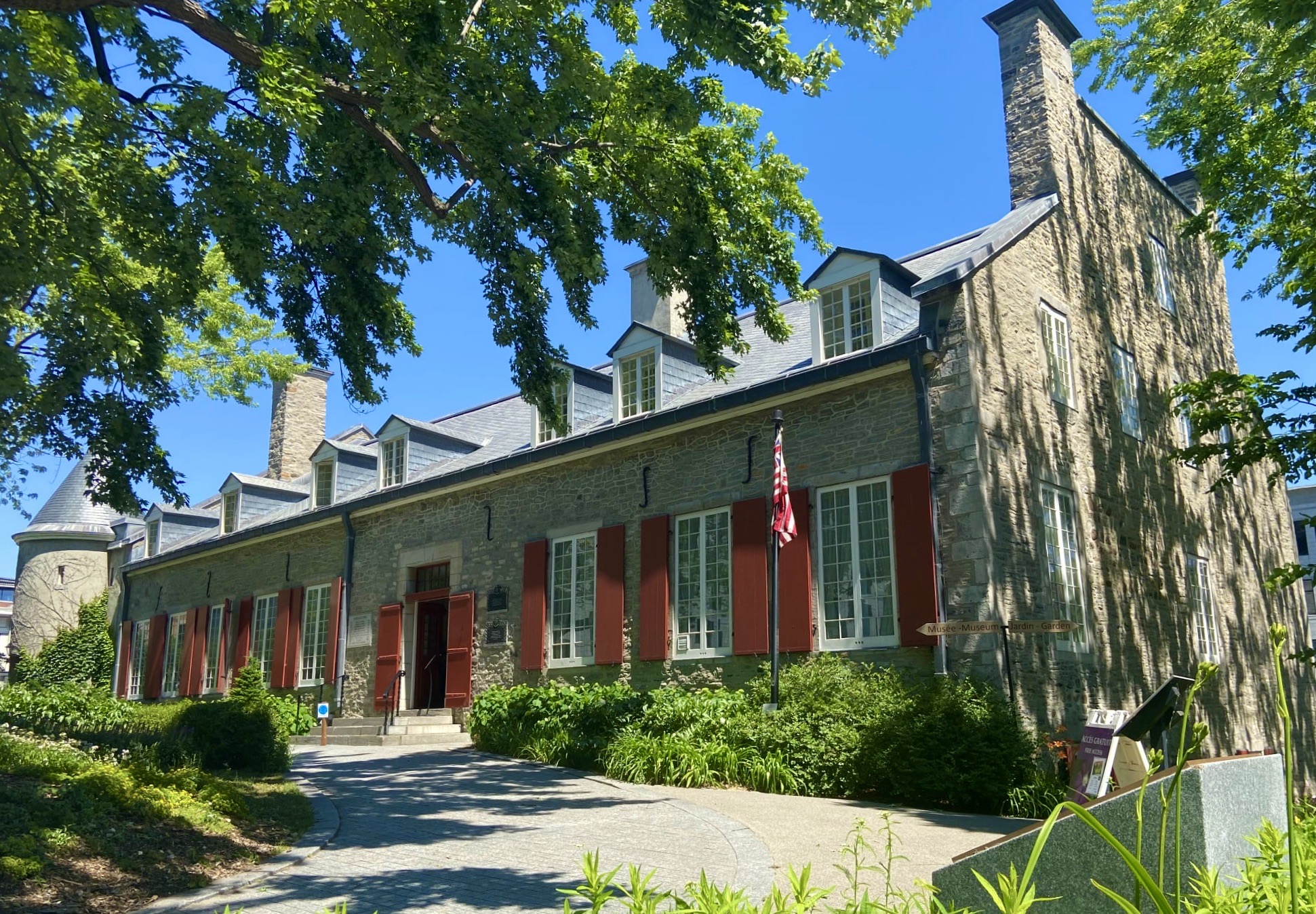
Musée du Château Ramezay features exhibits and artifacts from Montréal’s Colonial past. Photo courtesy of Château Ramezay
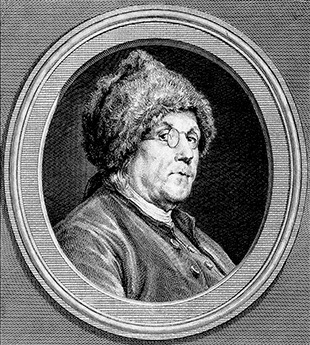
Benjamin Franklin wearing the fur hat gifted him during his stay in Montréal. Engraving by Augustin de Saint-Aubin.
Particularly interesting, from an American perspective, is an exhibit featuring Benjamin Franklin, who visited Montréal during the winter of 1776, and stayed at Château Ramezay. Franklin was sent to Canada with the hope of persuading the Canadians to join the 13 colonies to fight the British. The aging statesman, who was 70 at the time, feared he might not survive the harsh conditions, writing: “I have undertaken a Fatigue that at my Time of Life may prove too much for me, so I sit down to write to a few Friends by way of Farewell.”
After arriving in Montréal, Franklin quickly realized that the recently negotiated Quebec Act, which guaranteed French Canadians religious and legal customs, had preempted any resistance against British rule. Moreover, the impoverished Continental Army was even less appealing.
On the positive side, Franklin was gifted a Marten fur hat during his visit, that coincidently helped to make him a standout during his next diplomatic mission. In Paris, his new cap was an instant sensation. Women even began to imitate the fur hat with oversized wigs in a style called “coiffure a la Franklin.” And ultimately, Franklin confirmed French military support, which proved invaluable in winning the American war against the British.
MICHEL ON MONTRÉAL RESTAURANTS
After visiting Château Ramezay, we break for lunch at Monarque. Stylish and chic, the main dining room features an illuminated bar with over 400 wine selections. We take a seat and are instantly distracted by the elegantly-clad locals, who flock to Monarque for business rendezvous. Once we tear ourselves away from crowd-watching, we’re further impressed with the menu, featuring Canadian cuisine, from oysters to Prince Edward Island Côte de Boeuf. Cheese plates also offer unique local products as well.
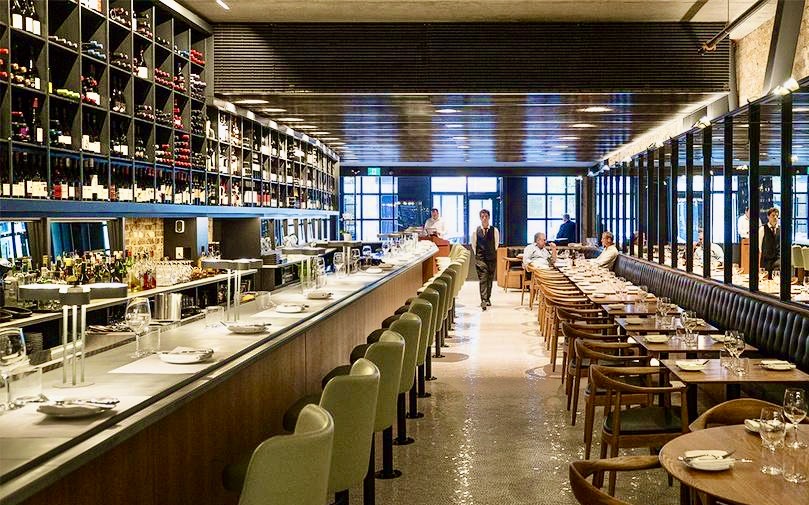
Ultra chic Monarque restaurant offers over 400 wine selections and regional cuisine. Photo courtesy of Monarque.
We’re staying at the Ritz-Carlton, Montréal, so of course we book at the hotel restaurant, Maison Boulud. Daniel Boulud is one of the most heralded French chefs and his modern take on French classic dishes has made many fans including us.
Maison Boulud offers four different seating areas: a plush bar, a formal dining room, a veranda with lots of windows and finally, an exterior garden for pretty days enjoyment. We select the veranda as the evening temperatures are a bit cool. A friendly waiter, who is also a certified sommelier (at his age, we were barely finishing high school 😩) suggests some fun wines. Great start except ….for the loudmouth man in the pink jacket two tables down, a guy who thought the entire dining room should be aware of his every thought.
On to the Menu: Of course, we start with the oysters served with mignonette and cocktail sauces. They are small size, but delicious. AND the cocktail sauce is unreal! I could have made it my meal, it was so thick and rich. Meanwhile, Marla takes a bite of my entrée — risotto topped with lobster mushrooms and black truffles — and steals my plate!! The truffles are flavorful, but light and the entire dish is ethereal. I try to grab back a small portion to my side of the table. Marla had ordered the halibut which is served with spring onions and smoked eel on a barigoule sauce made of olive oil, artichokes, white wine, fennel and garlic. A Provençal dish with energy which is well suited for our Meo-Camuzet Bourgogne Rouge. The wine is a little earthy at first but gains texture and grip with a few minutes of decanting.
We end the meal with three Canadian cheeses: Sauvagine Triple Cream, Niagara Gold, Cendrillon, all representing different textures and flavors. With that cheese selection, we opt for a 20 year old tawny port — an excellent combination. In the end, if it hadn’t been for our super loud neighbor, it would have been a perfect experience. I can’t blame the restaurant as every customer counts these days, but what has happened to self restraint?
Without a doubt, our favorite spot in Montréal is Bar George in Le Mount Stephen Hotel — we visit two nights in a row! This place is the epitome of a cool big city lounge. From the outside, the hotel looks majestic. Built in the late 1800s, the building was once the home of Lord George Mount Stephen, the first President of Canadian Pacific Railway and, in his day, one of the most powerful men in Canada. Now classified as a historical monument, the building construction is as much about grace and beauty as practicality.
On our first visit, the exterior courtyard is packed, but fortunately the indoor bar is available. And what a stunning experience it is! Imagine a plush room with stained glass windows and gorgeously lacquered wood ceiling and walls — a treatment reminiscent of the woodwork of the Art Nouveau masters of the early 1900s. Food, drinks and service are also stellar. The staff, led by a master bartender, works seamlessly. It’s a always a pleasure to see bartenders concoct cool libations, spend a full minute shaking the drink to make sure all ingredients are nicely blended, and then BOOM, your drink appears, beautifully decorated and very tasty.
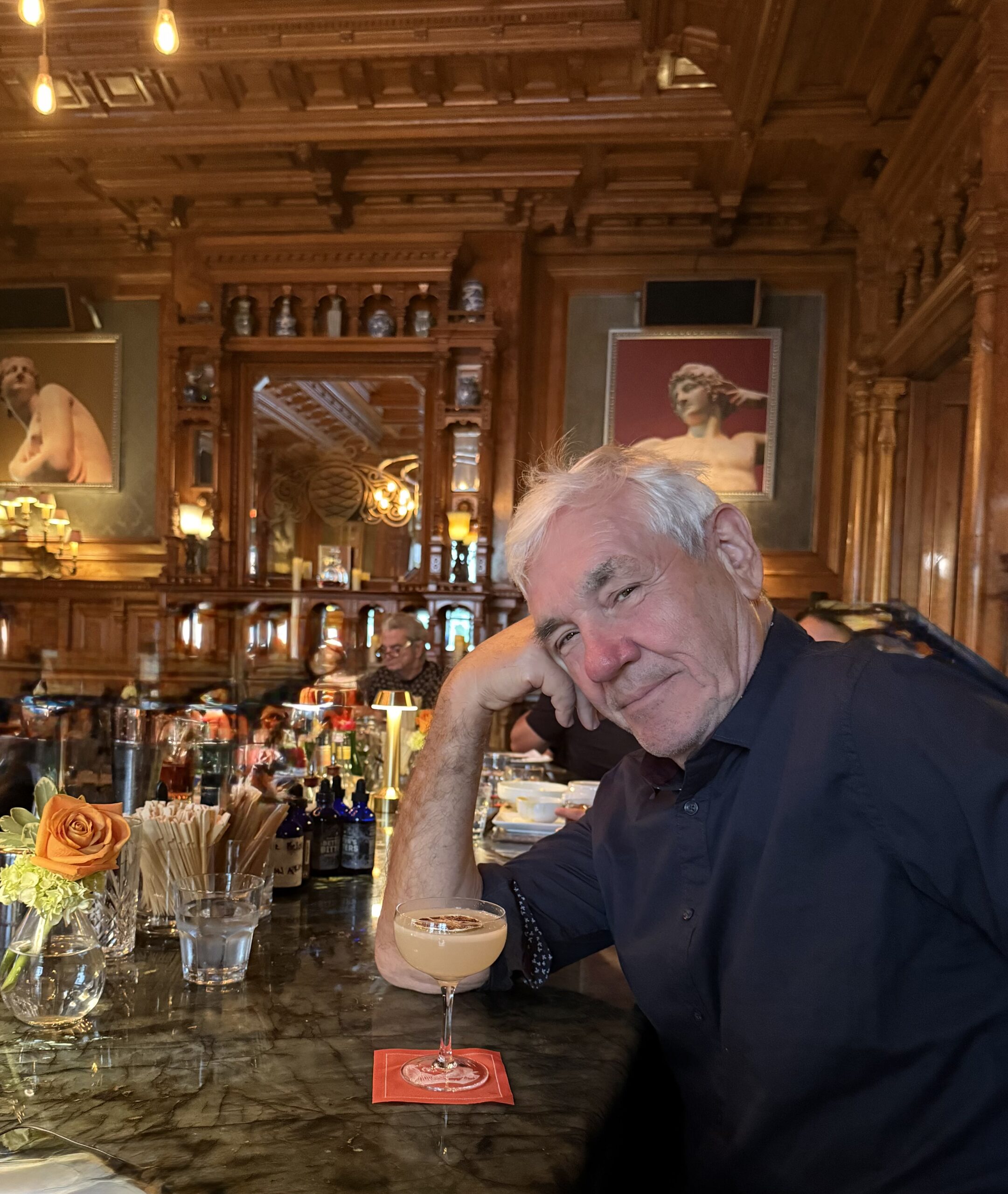
BEFORE: Michel with “Crimson Smoke” consisting of Del Maguey Puebla mezcal, Campari, lime, grapefruit.

AFTER….
The food matchs this overall quality. Offerings range from light apps and snacks to full-size entrées: the Bar George Pâté with frisée is delicious; Devils on Horseback consists of bacon, almond, prunes and whipped liver parfait — sounds weird but is exceptional. For dinner on the second night, we opt for the Rigatoni with roasted peppers, burrata, Parmigiana and mascarpone along the Chicken Roulade, which includes a truffle potato cake and oyster mushrooms. Ouch on our waistline but what the heck…we’re doing a lot of walking on this trip.
Another place we spot during our wanders around Montréal is Le Pois Penché (The Leaning Pea). The overall look is that of a busy brasserie. A highlight there is a wonderful 2022 Domaine des Perdrix Vosne-Romanée, which while quite young, featured very soft tannins and refined aromas. For food, we love an Artic Char that is served whole and expertly deboned tableside — a perfect match for our Burgundy.
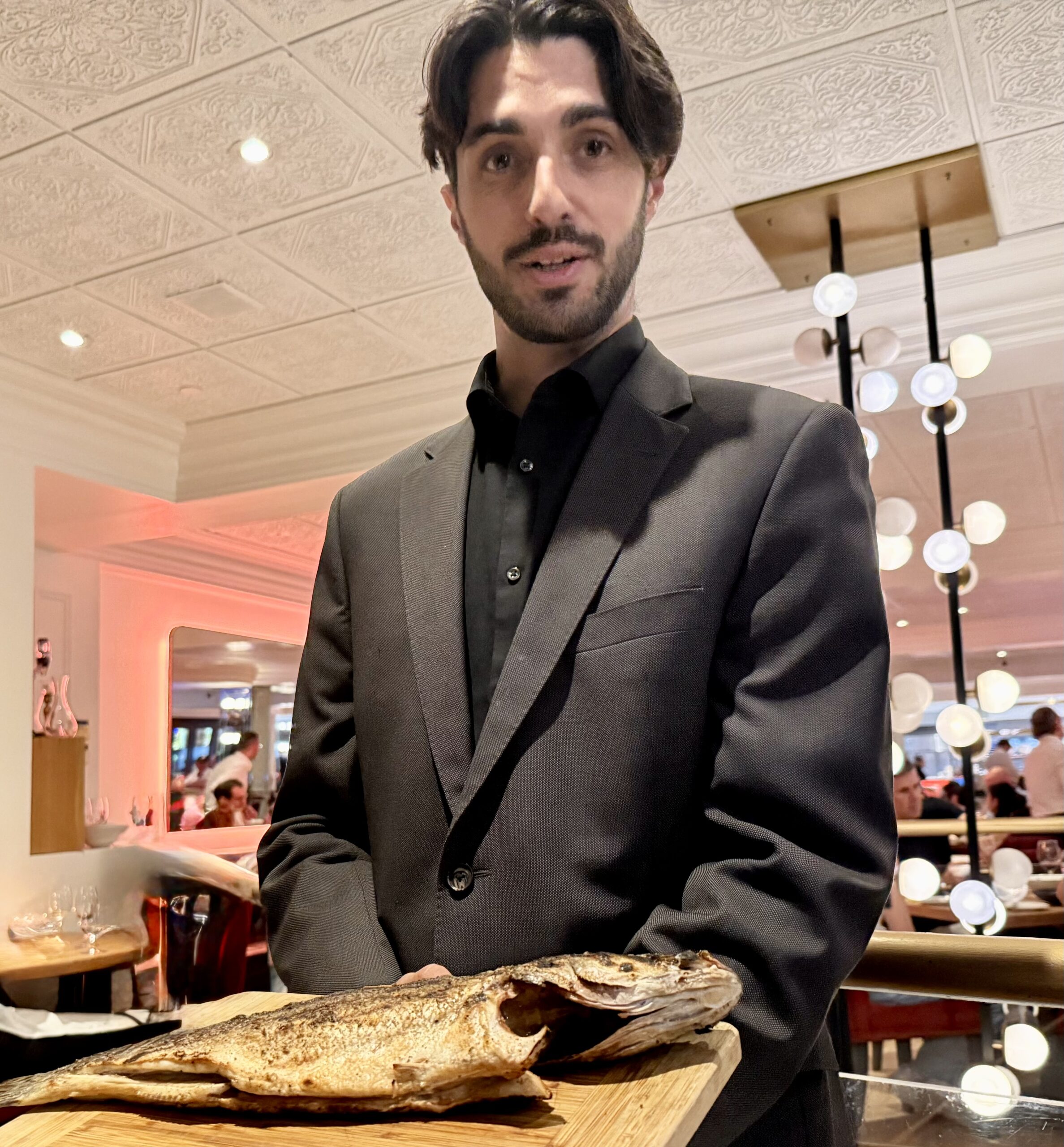
Expertly prepared and deboned fish at Le Pois Penché.
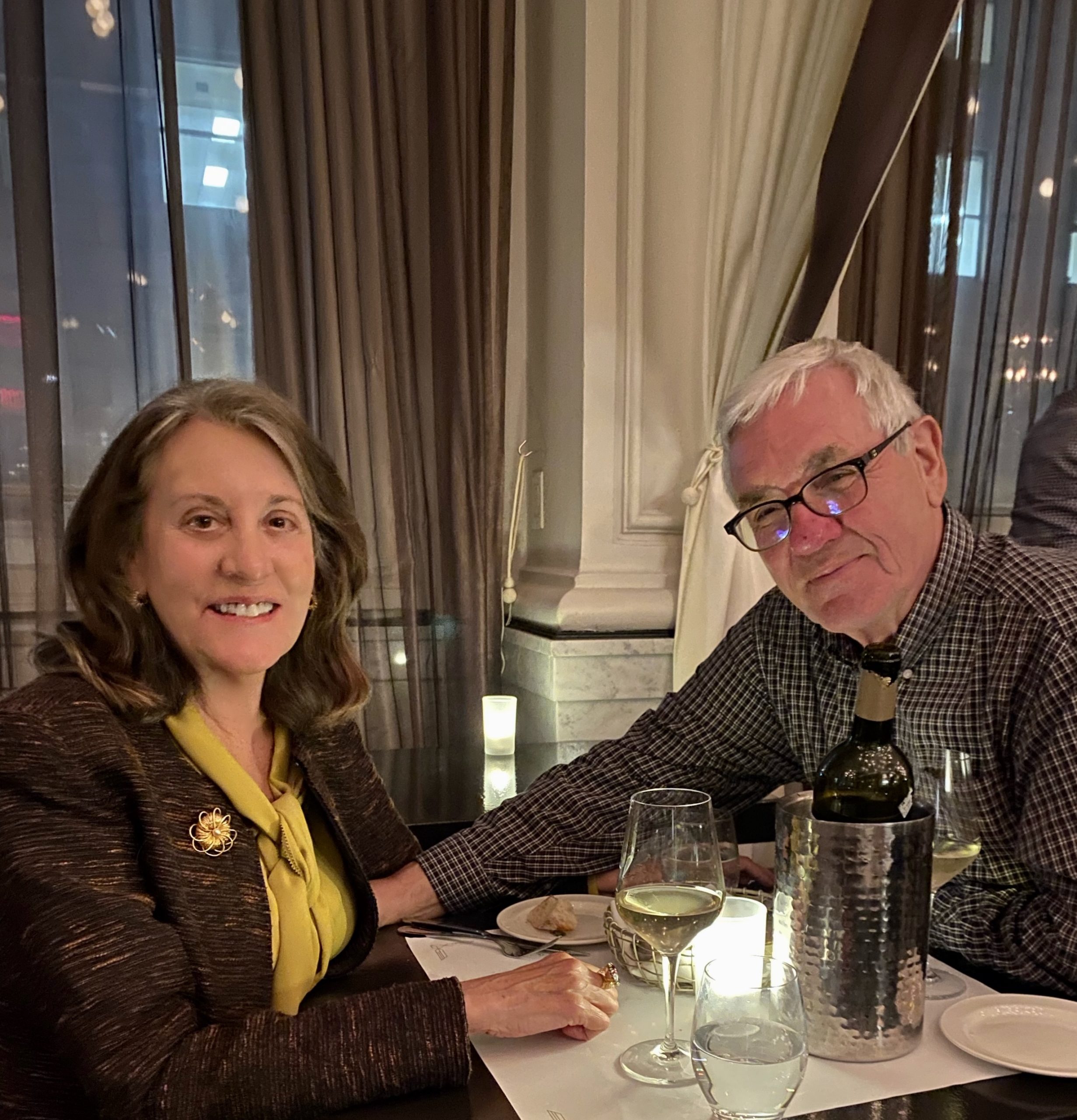
Marla & Michel – at Brasserie 701, Vieux-Montréal.
We experience more elegant dining another evening at Brasserie 701 located in the Hotel Place d’Armes. The neoclassical decor is set off by dozens of chandeliers and unique light fixtures. It’s our last night, so we go all out, with fresh oysters, escargots, house made raviolis, duck confit and lobster risotto.
To cap off the evening, we share a bottle of Champagne at Maison Saint-Paul. Numerous cocktails and glasses of wine are available, but Maison Saint-Paul is known for its impressive Champagne collection AND sabering. We decide to make use of the house swords and “break open a bottle” ourselves. Later, as we sit and sip, the bar fills rapidly with bubbly customers. The manager tells us the corks continue popping until at 3:00 a.m. nightly.
Outside, the streets are again buzzing with activity. The evening temperatures are sublime. And as the partying continues to build we can almost sense the urgency…Summer’s final act is approaching!
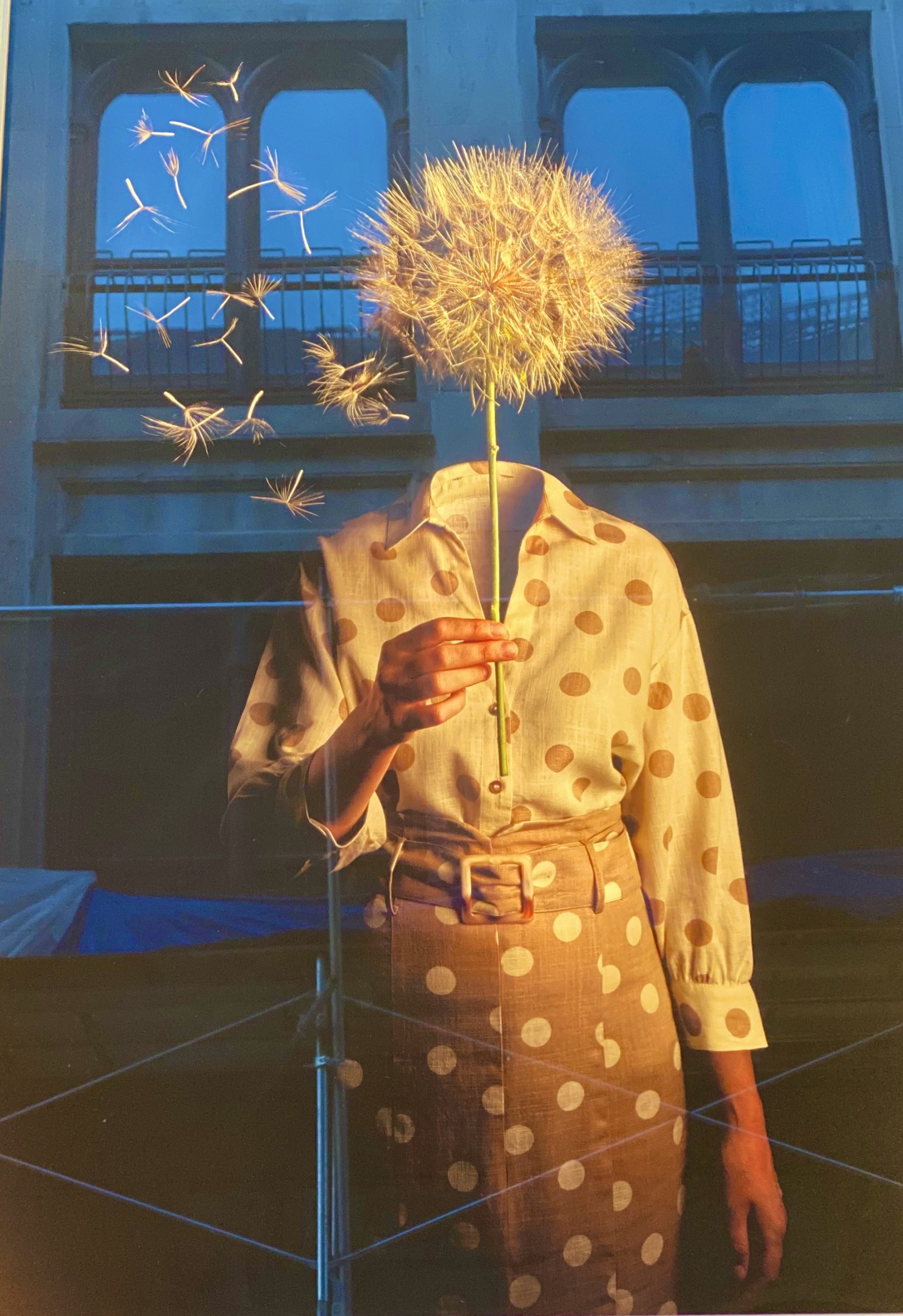
Wishing Summer would never end….photograph displayed at Galerie LeRoyer, Vieux-Montréal.